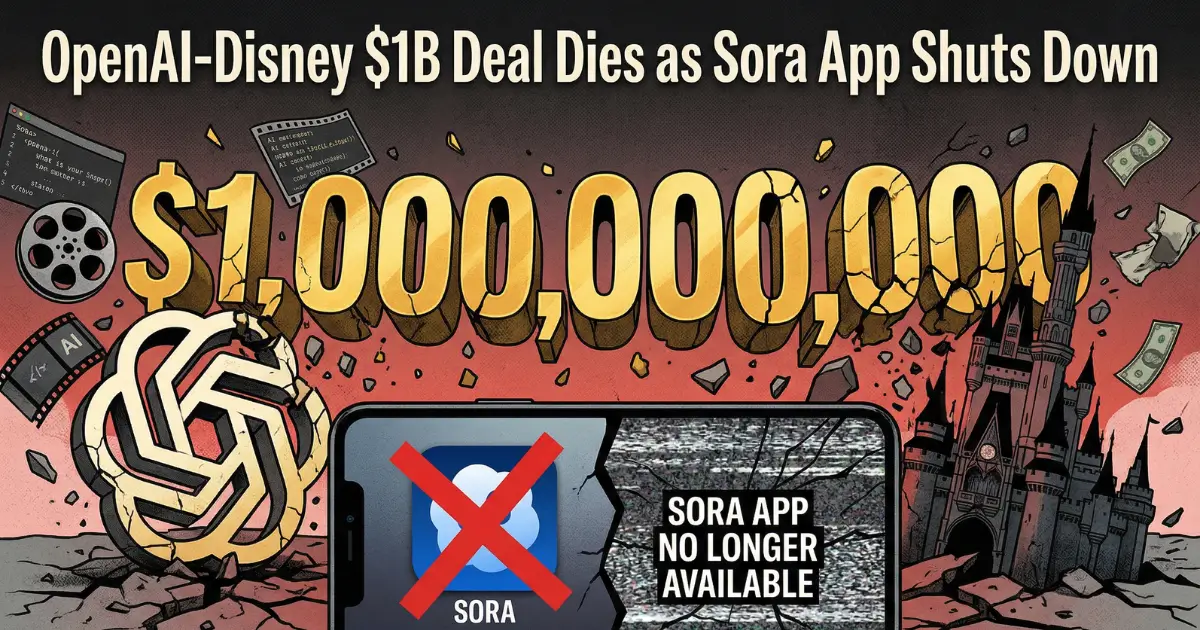
What was supposed to be a landmark alliance between Hollywood and Silicon Valley has come crashing down in spectacular fashion. Disney and OpenAI's billion-dollar collaboration, once predicted to remake Hollywood, quietly flamed out this week, its death marked by a single post on social media.
OpenAI announced on March 24 that it would discontinue Sora, its generative AI video creation app launched last year, without providing a clear reason for the decision. The shutdown immediately unraveled the blockbuster deal the two companies had signed just months earlier.
A Deal That Never Got Off the Ground
Under the agreement signed in December 2025, Disney had pledged to invest $1 billion in OpenAI and license more than 200 of its iconic characters from Disney, Marvel, Pixar, and Star Wars for use in Sora-generated videos. The vision was ambitious: fans would be able to create short AI-generated clips featuring beloved characters, while Disney would integrate OpenAI's technology across its streaming and employee operations.
But despite the fanfare, it appears no actual money ever changed hands, as the deal was never finalized. With Sora now shutting down, the entire arrangement has been abandoned.
Sources told Reuters that Disney was completely blindsided by the news, with one insider calling it a "big rug-pull." Disney, for its part, responded diplomatically, stating that it respected OpenAI's decision to shift its priorities and would continue exploring AI opportunities elsewhere.
Why OpenAI Pulled the Plug
The reasons behind Sora's sudden death come down to cold, hard economics. An OpenAI spokesperson told CNN the company needed to make trade-offs with products that carried high compute costs. AI video generation is extraordinarily resource-intensive, consuming massive amounts of processing power for every clip produced.
With OpenAI already burning through billions annually and facing projected losses that could exceed $14 billion in 2026 alone, consumer-facing tools like Sora simply did not make financial sense — especially with a potential IPO on the horizon.
According to reports, OpenAI is now prioritizing capital efficiency, chip resources, and enterprise products over experimental consumer bets as it prepares for a possible public offering later this year. The company is redirecting its talent toward robotics simulation, advanced coding assistants, and enterprise AI infrastructure — areas with more predictable, high-margin revenue.
Sora's Troubled History
Sora's brief existence was marked by controversy from the start. When the second version of Sora launched in September 2025, it generated stunningly realistic videos but immediately raised alarms in Hollywood over its opt-out model, which required IP owners to proactively flag their copyrighted works for exclusion.
In November 2025, Japanese anti-piracy group CODA, whose members include Studio Ghibli, formally demanded OpenAI stop using their content to train the model. The platform also became flooded with what critics called "AI slop," alongside more disturbing content.
User interest faded quickly too. According to market intelligence firm Appfigures, Sora's US App Store downloads dropped 32% month-on-month in December 2025 and fell another 45% in January 2026.
What It Means for Hollywood and the AI Industry
The collapse of the Disney deal was deeply symbolic — it had been Disney's way of saying that if tech giants were going to train AI on its intellectual property, the company might as well profit from it and help shape the rules. That experiment is now over before it truly began.
The sudden collapse starkly exposes Hollywood's vulnerability to the unpredictable decisions of big tech companies. Studios that were watching the Disney-OpenAI partnership as a potential template for future AI licensing agreements are now back to square one.
The question of Disney's own AI future is further complicated by a leadership transition, as new CEO Josh D'Amaro has replaced Bob Iger, whose final major tech initiative now lies in ruins. How the new leadership approaches AI partnerships remains to be seen.
Meanwhile, OpenAI also quietly announced it was pulling back from Instant Checkout, an in-chat e-commerce feature that allowed ChatGPT users to purchase products without leaving the app — suggesting the cost-cutting extends well beyond Sora.
For OpenAI, the message is clear: the road to an IPO requires painful choices. For Hollywood, the lesson is equally stark — in the world of AI, billion-dollar deals can evaporate overnight.