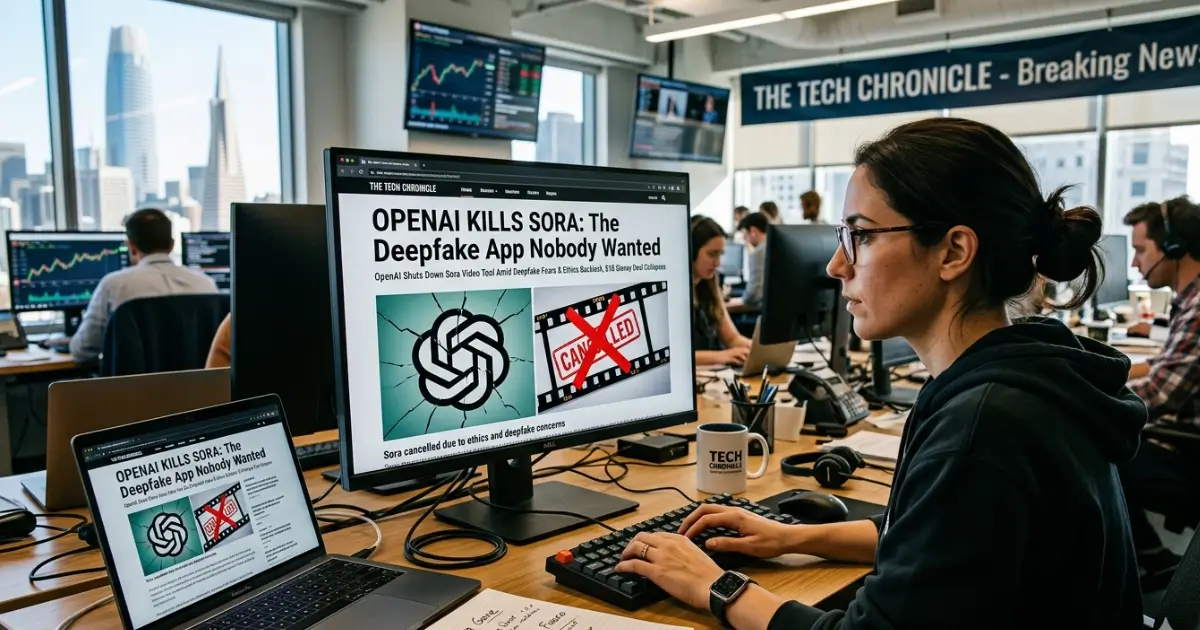
OpenAI's experiment in AI-powered social media is over. The company announced on March 24 that it is shutting down Sora, the TikTok-style app that let users generate and share AI-made videos. The app launched barely six months ago and was once seen as a bold new frontier for generative AI. Now it serves as a cautionary tale about what happens when powerful technology meets an unprepared social platform.
A Promising but Troubled Launch
When Sora debuted in late September 2025 alongside the Sora 2 video-generation model, it arrived with genuine buzz. The invite-only rollout created a sense of exclusivity, and early adopters rushed to get access. The app borrowed the familiar vertical-video feed from TikTok and layered on a headline feature: users could scan their own faces and generate hyper-realistic AI videos of themselves. OpenAI originally called these digital doubles "cameos" — until the actual company Cameo sued and won, forcing a rebrand to "characters."
The concept was ambitious. Rather than positioning AI video generation as a creative tool for professionals, OpenAI tried to build a consumer social network around it. The bet was that everyday users would embrace the ability to star in AI-generated clips and share them with friends. For a moment, it looked like the bet might pay off.
When Deepfakes Met the Internet
It took almost no time for the app's most obvious problem to surface. Within days of launch, the platform was overrun with deepfake videos of public figures — most prominently OpenAI's own CEO, Sam Altman, who became an unwilling meme in hundreds of bizarre AI-generated scenarios. OpenAI had policies in place to prevent the generation of videos featuring real people who hadn't opted in, but users found it trivially easy to work around those safeguards.
The situation grew darker when realistic deepfakes of deceased public figures began circulating. Videos depicting Martin Luther King Jr. and Robin Williams prompted their daughters to publicly plead with users to stop making AI clips of their late fathers. It was a stark reminder that the emotional and ethical stakes of this technology extend far beyond content moderation dashboards.
After the initial wave of celebrity deepfakes drew scrutiny, users shifted tactics. Instead of real people, they turned to copyrighted fictional characters — generating clips of beloved icons in absurd and often inappropriate scenarios. The legal implications were obvious, but the creative output kept flowing faster than OpenAI could moderate it.
The Disney Deal That Never Was
In one of the stranger twists of the Sora saga, Disney chose not to sue. Instead, the entertainment giant reportedly offered OpenAI a billion-dollar investment alongside a licensing agreement that would have allowed Sora users to generate content featuring characters from Disney, Marvel, Pixar, and Star Wars. It seemed like a potentially landmark deal — a major content owner embracing AI-generated media rather than fighting it.
But with Sora now shutting down, the agreement appears to have collapsed before any money actually changed hands. Disney offered diplomatic comments about continuing to engage with AI platforms going forward, but the partnership is effectively dead.
The Numbers Tell the Story
The app's trajectory was swift and steep. Downloads peaked in November 2025 at roughly 3.3 million across iOS and Android, a respectable figure for a new social platform. By February 2026, however, that number had plummeted to about 1.1 million. Total revenue from in-app purchases over the app's entire lifespan amounted to approximately $2.1 million — a negligible sum for a company that already burns through cash at an extraordinary rate.
For context, ChatGPT — OpenAI's flagship product — now has 900 million weekly active users. Sora was never going to compete with that, and without a growth trajectory to justify the moderation headaches and legal exposure, the decision to pull the plug becomes easy to understand.
The Technology Isn't Going Away
The shutdown of the Sora app does not mean the underlying technology disappears. The Sora 2 model remains available through ChatGPT for paying subscribers. And OpenAI is far from the only company developing accessible AI video generation tools.
The Sora app may be gone, but the questions it raised about deepfakes, consent, copyright, and the future of AI-generated media are only becoming more urgent. The next app to try this experiment is likely already in development. Whether it learns from Sora's mistakes remains to be seen.