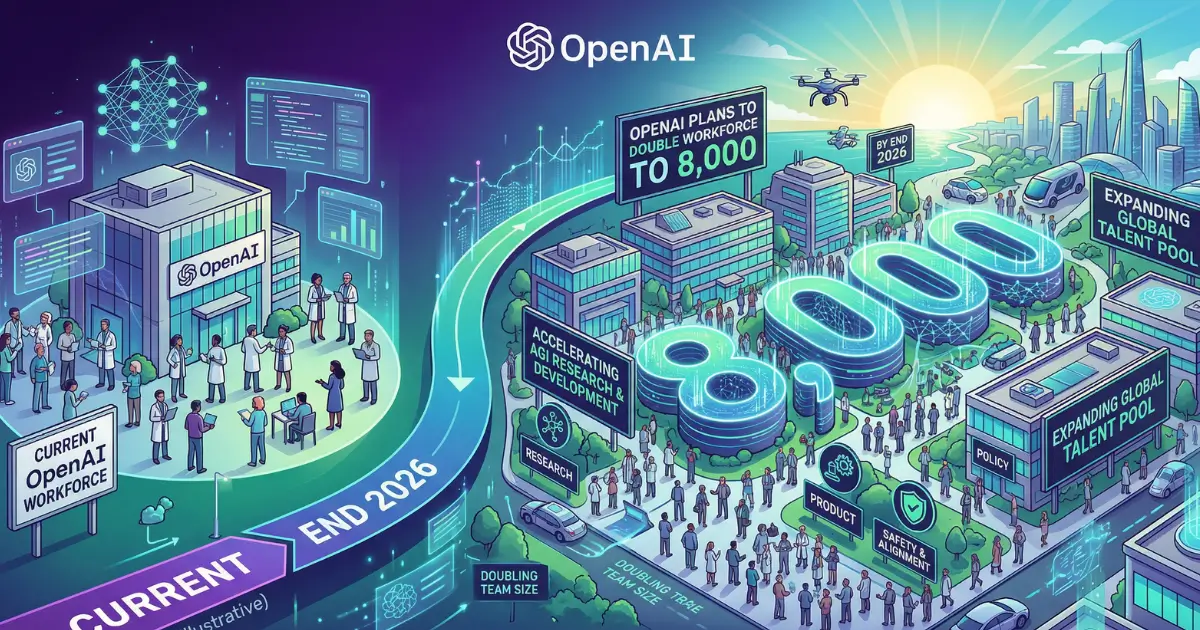
OpenAI is gearing up for its most ambitious expansion yet. According to a report by the Financial Times, the company plans to nearly double its workforce to approximately 8,000 employees by the end of 2026, up from roughly 4,500 today. The hiring push is aimed squarely at closing the competitive gap with rivals most notably Anthropic as the race to dominate the artificial intelligence industry enters its most critical phase.
A Strategic Doubling
The scale of the expansion is significant. Adding more than 3,500 employees in a single year would represent one of the largest talent buildouts in the AI sector's history. The new hires will be concentrated in product development, engineering, research, and sales the four pillars that OpenAI's leadership believes are essential to maintaining and extending its market position. A notable portion of the recruitment will focus on roles described as technical ambassadorship, a function designed to help enterprise clients understand and deploy OpenAI's AI tools more effectively within their own workflows. This signals a clear shift in strategy: winning the AI race is no longer just about building better models. It is about ensuring that businesses can actually use them.
The Anthropic Factor
The Financial Times report explicitly names Anthropic as the rival OpenAI is most eager to catch. While OpenAI remains the consumer-facing leader ChatGPT boasts hundreds of millions of monthly active users Anthropic's Claude models have been gaining serious traction among developers and enterprise customers, particularly in coding, reasoning, and safety-sensitive applications. Anthropic's lean but highly focused team has punched above its weight, earning a reputation for technical excellence that has forced OpenAI to respond. The hiring surge is a direct acknowledgement that talent and execution, not just model size, will determine who leads the next generation of AI.
Code Red Still Echoing
The expansion follows a turbulent period inside OpenAI. In late 2025, CEO Sam Altman reportedly issued an internal directive described as a code red, pausing non-core projects and redirecting engineering teams to accelerate development. The move was triggered in part by rapid advances from Google's Gemini models and the growing perception that Anthropic was outpacing OpenAI on product quality in key areas. The code red restructuring laid the groundwork for the hiring push now underway, clearing organisational clutter and refocusing the company on the areas where it needs to grow fastest.
From Lean Lab to Full-Scale Operation
For much of its existence, OpenAI operated as a relatively small research lab, relying heavily on its partnership with Microsoft for distribution, sales support, and cloud infrastructure. That model worked well during the early ChatGPT era, when demand for the technology outpaced the need for hands-on enterprise support. But as the market matures and competitors offer increasingly comparable models, customers are demanding more than access to a powerful API. They want integration support, customisation, security assurances, and dedicated account management all of which require people. The hiring push reflects OpenAI's recognition that it can no longer outsource those functions and remain competitive.
The Talent War Intensifies
Recruiting nearly 3,500 people in a single year will not be easy, particularly in a market where top AI researchers and engineers are among the most sought-after professionals on the planet. OpenAI, Google DeepMind, Anthropic, and Meta are all competing for the same limited pool of talent, often offering compensation packages that exceed one million dollars annually for senior roles. OpenAI's advantage lies in its brand recognition, its massive user base, and the sheer scale of its compute resources. But Anthropic and Google can offer their own compelling pitches safety-first culture and virtually unlimited infrastructure, respectively. The next twelve months will be as much a war for people as a war for technology.
What It Means for the Industry
OpenAI's hiring plans underscore a fundamental truth about the current state of the AI industry: the technology alone is no longer enough. Building frontier models is table stakes. The companies that will define the next era of AI are those that can hire, deploy, and support at scale turning raw capability into products that businesses and consumers actually rely on every day. By doubling its workforce, OpenAI is betting that execution and reach will matter more than any single research breakthrough. Whether that bet pays off will depend on how effectively it can absorb thousands of new employees without losing the speed and focus that got it here.