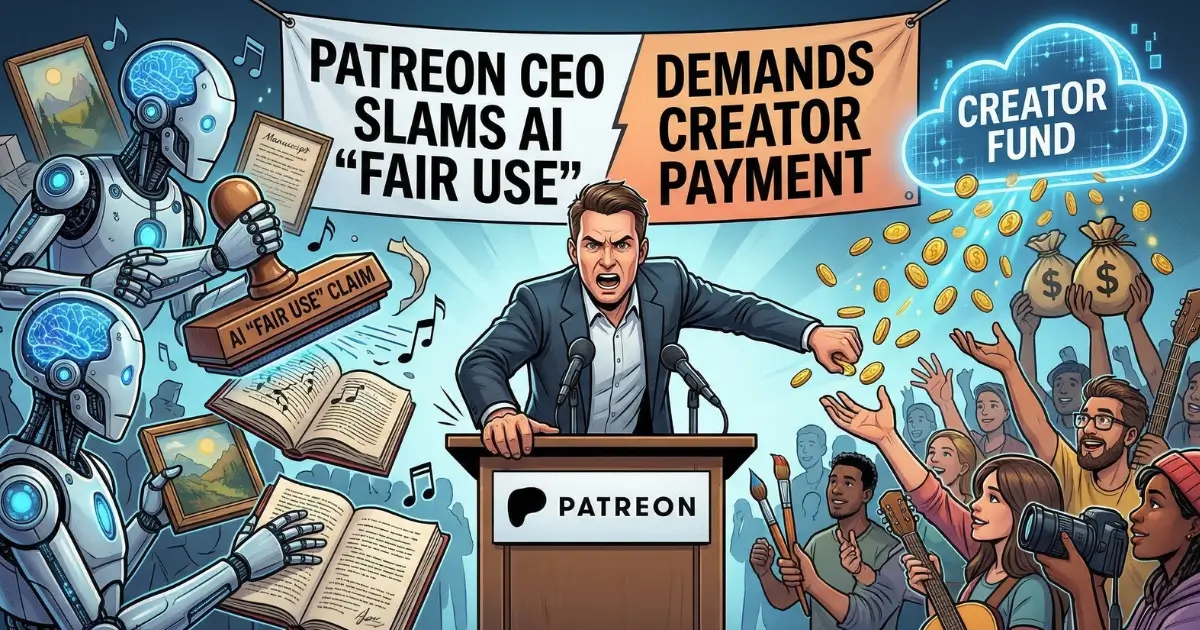
Patreon CEO Jack Conte made it clear at the SXSW conference in Austin this week that he is not opposed to artificial intelligence. But the founder of one of the internet's largest creator platforms drew a firm line: AI companies should not be able to train their models on creators' work without paying them, and their reliance on the "fair use" defense is, in his words, bogus.
A Pattern of Disruption
Conte framed the rise of AI as the latest chapter in a long cycle of disruption that creators have endured throughout the internet age. He drew parallels to the shift from purchasing music on iTunes to streaming, and to the pivot toward short-form vertical video driven by TikTok. Each wave broke existing models that creative professionals had painstakingly built, yet creators adapted and ultimately survived. Conte expressed confidence that the same resilience will carry them through the AI era, emphasizing that change does not have to mean the end for artists.
The speech carried a deeply personal undertone. Conte originally launched Patreon to solve a problem he had experienced firsthand as a working musician — getting audiences to directly pay creators for their art. That same principle now drives his stance on AI: the people who produce the creative material fueling these powerful models deserve a seat at the table.
The Fair Use Double Standard
The sharpest moment of the talk came when Conte challenged the legal foundation that AI companies use to justify scraping creative content without permission. He argued that the fair use claim collapses under scrutiny because these same companies are simultaneously signing multimillion-dollar licensing agreements with major rights holders and publishers such as Disney, Condé Nast, Vox, and Warner Music.
His reasoning was straightforward: if using creators' work as training data were truly legal under fair use, there would be no need to pay anyone at all. The fact that large corporations receive compensation while millions of independent illustrators, musicians, and writers receive nothing exposes a glaring inconsistency. Those individual creators' work has been consumed by AI models that have generated hundreds of billions of dollars in value for the companies behind them, yet the creators themselves see none of it.
Not Anti-Tech, But Pro-Fairness
Conte was careful to clarify that his critique is not rooted in opposition to technology or progress. He acknowledged the inevitability of change and even expressed excitement about navigating the challenges ahead. His argument is not that AI is harmful but rather that it is becoming good enough — and consequential enough — that society needs to plan for how it compensates the artists whose work powers it.
He stressed that societies which value and incentivize creativity benefit everyone, not just the artists themselves. When planning for the future of AI, he argued, the conversation must include provisions for the creative community rather than treating their contributions as free raw material.
Reading Between the Lines
It is not difficult to see a business motivation behind Conte's advocacy. Patreon hosts a community of hundreds of thousands of creators, and securing AI training compensation for that community would directly strengthen the platform's value proposition. If licensing deals become standard practice between AI companies and creator platforms, Patreon would be well positioned to broker those arrangements at scale.
Still, the underlying argument resonates beyond Patreon's commercial interests. The debate over whether AI training constitutes fair use remains unresolved in courts, and Conte's public challenge adds momentum to a growing chorus of voices demanding clearer rules.
A Hopeful Closing
Conte ended his talk on an optimistic note, expressing his belief that humans will continue to create and appreciate the work of other humans for a long time, regardless of how advanced AI becomes. He drew a distinction between what large language models do — predicting and reproducing patterns from existing content — and what great artists do: standing on the shoulders of giants and pushing culture forward into uncharted territory.
For now, the battle over fair use and creator compensation is far from settled. But with voices like Conte's growing louder, AI companies may soon find it harder to train on creative work without writing a check.