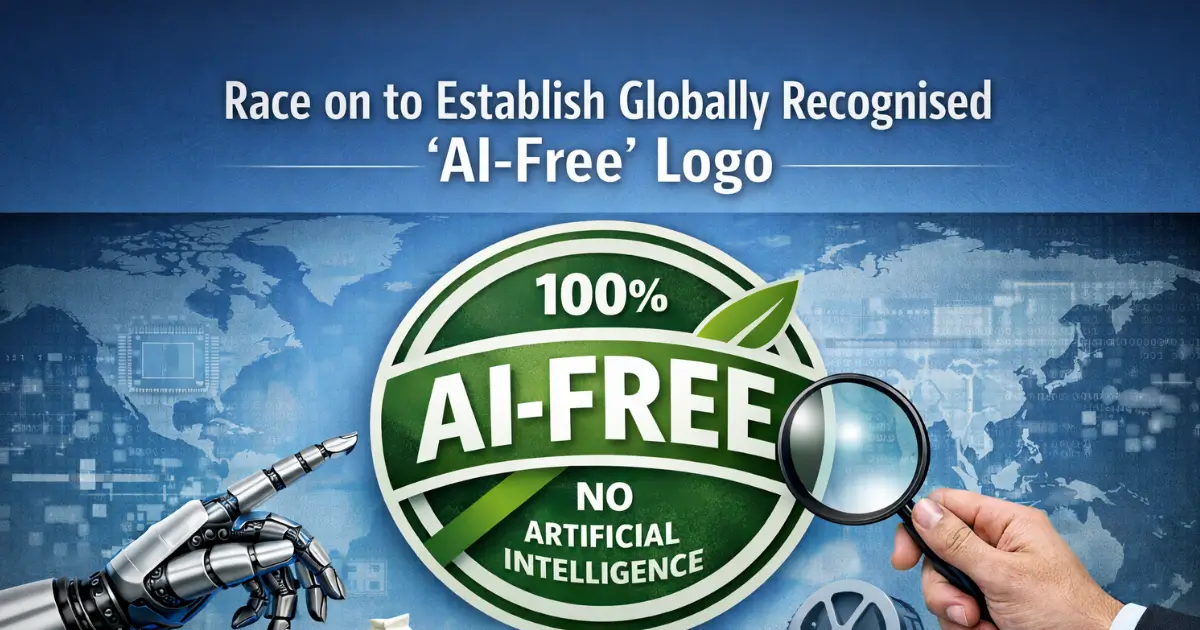
A growing global movement is pushing to create a universally recognised “AI-free” label, designed to show that a product or piece of content was created entirely by humans rather than artificial intelligence. The initiative reflects rising concerns about the rapid expansion of AI technologies and their potential impact on jobs, creativity, and authenticity.
Organisations, artists, and technology groups are now competing to establish a standard logo that could identify human-made work in areas such as books, films, marketing materials, and digital content.
Push for a Global Standard
Several groups around the world are working to design labels that certify content as free from artificial intelligence involvement. Some of the proposed labels include phrases such as “AI-free,” “No AI,” “Human-made,” and “Proudly Human.”
Supporters say the goal is to create a mark similar to widely recognised certifications like the Fairtrade logo, which helps consumers quickly identify ethically produced goods. A clear and trusted label could allow audiences to distinguish between content created by humans and that generated using AI systems.
However, the growing number of competing initiatives may also create confusion if a single global standard is not agreed upon.
Concerns Driving the Movement
The push for an AI-free certification comes amid rising anxiety about how artificial intelligence is transforming industries. Creative professionals—including writers, designers, and filmmakers—have expressed concerns that AI-generated content could replace human work or flood the market with automated material.
For some artists and creators, an AI-free label would help highlight the value of human creativity and craftsmanship. They argue that consumers should have the ability to choose whether they want to engage with human-made or AI-generated content.
Others believe such labels could also promote transparency, especially as AI tools become more capable of producing realistic images, videos, and written text.
Challenges in Defining “AI-Free”
Despite growing interest in the concept, defining what qualifies as “AI-free” is not straightforward. Many modern tools incorporate some form of artificial intelligence, from editing software to automated recommendation systems.
Experts say that determining whether a product is completely free from AI involvement could be complicated. For example, a book written by a human author might still involve AI-assisted editing tools or digital production systems.
Because of these complexities, industry groups are debating how strict the criteria should be for labeling a product or service as AI-free.
Competing Initiatives Emerging
According to reports, at least eight separate initiatives are currently working on different versions of AI-free certification systems.
Each group is proposing its own design, guidelines, and verification process. Some initiatives are focused on creative industries such as publishing and filmmaking, while others aim to certify products and services more broadly.
The challenge now is whether these initiatives can collaborate and agree on a single system that consumers worldwide would recognise and trust.
Industry Divided on the Idea
While many creators support the concept, not everyone in the technology sector agrees with the need for AI-free labeling.
Some technology experts argue that artificial intelligence has become deeply integrated into modern production processes and that drawing a clear boundary between AI-assisted and human-created work may be unrealistic.
Others say the focus should instead be on transparency—clearly disclosing when AI tools are used—rather than promoting labels that reject the technology entirely.
Growing Demand for Transparency
Despite the debate, demand for greater transparency around AI use continues to grow. Governments, regulators, and industry groups are increasingly exploring ways to identify AI-generated content, particularly as generative AI systems become more powerful.
In areas such as journalism, education, and entertainment, the ability to verify whether content was produced by a human or an algorithm is becoming an important issue.
Supporters of the AI-free label believe it could play a role in building trust with audiences who value authenticity and human creativity.
The Future of AI Certification
The race to create a globally recognised AI-free logo highlights the broader tension between technological innovation and concerns about its impact on society.
If a single standard eventually emerges, it could become a powerful tool for creators who want to emphasise human-made work. At the same time, the initiative raises larger questions about how society should balance the benefits of artificial intelligence with the preservation of human skills and creative expression.
For now, the effort to establish an AI-free certification remains a work in progress. But as artificial intelligence continues to reshape industries, the demand for clear labeling and transparency is likely to grow.