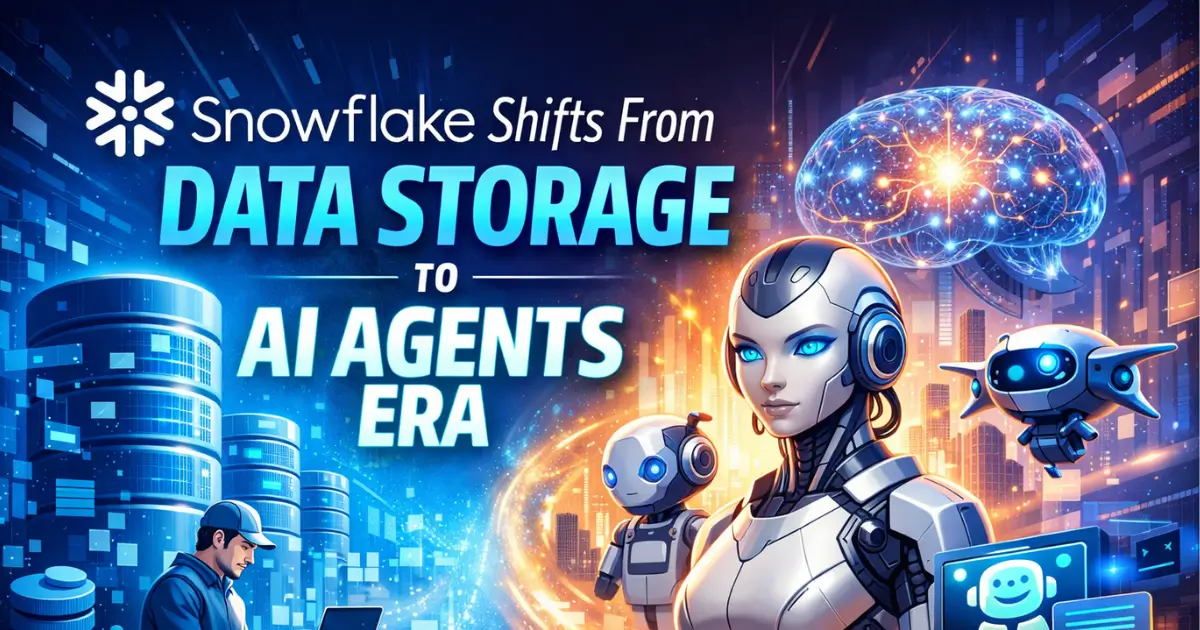
Snowflake is making its biggest strategic bet yet: transforming from a company that stores enterprise data into one that ships AI agents capable of acting on it. CEO Sridhar Ramaswamy laid out this vision in a new interview on TechCrunch's Equity podcast, where he declared the chatbot era is ending and the agentic era is beginning.
The message is clear Snowflake no longer wants to be the place where data sits. It wants to be the platform where data gets things done.
From Data Warehouse to AI Action Platform
When most people think of Snowflake, they think of cloud data warehousing storing, querying, and analysing massive datasets. That was the company's bread and butter since its founding in 2012, and it powered the largest software IPO in history back in 2020.
But under Ramaswamy, who took over as CEO in early 2024 after the retirement of Frank Slootman, the company has been steadily pivoting. Snowflake now describes itself as the "AI Data Cloud company" and has been shipping AI features at an aggressive pace throughout 2025 and into 2026.
The centrepiece of this transformation is Project SnowWork, an autonomous AI platform announced in March 2026. SnowWork lets business users describe what they need in plin language a board-ready forecast deck, a churn risk analysis, a supply chain report and the system autonomously plans the steps, pulls from governed data, runs the analysis, and delivers a finished output.
It is not a chatbot answering questions. It is an agent completing work.
What "Shipping With Your Data" Means in Practice
Ramaswamy's phrase "shipping with your data" captures the core idea behind Snowflake's pivot. Instead of enterprises storing data in Snowflake and then using separate tools to act on it, Snowflake wants the action to happen inside its own platform.
Project SnowWork achieves this by deploying AI agents that operate directly on top of a company's governed data. These agents understand the organisation's metrics, business definitions, and security policies. They can execute multi-step workflows querying databases, generating insights, building presentations, and recommending next steps all within a single conversational interaction.
The platform includes pre-built profiles for common business roles in finance, sales, marketing, and operations. Each profile understands the workflows, terminology, and KPIs relevant to that function. For example, a sales operations team can automate recurring reporting across multiple data sources and produce presentation-ready outputs in minutes rather than the days it previously took.
Crucially, all of this runs within Snowflake's existing security framework role-based access controls, data masking policies, and audit logging apply to everything the AI agents do.
Big Internal Changes to Support the AI Push
Snowflake is not just adding AI features on top of its existing platform it is restructuring internally to support this shift. The company acquired TensorStax in early 2026 to accelerate its agentic AI capabilities for data engineering. It also launched Cortex Code, an AI coding agent designed to automate development tasks within the Snowflake environment.
Ramaswamy has brought what the company describes as a "startup mindset" to its operations, focusing on building with urgency. The company disclosed that 9,100 accounts were using its AI products as of the end of February 2026, providing a baseline for measuring how quickly adoption grows from here.
The company has also partnered with OpenAI to deepen its enterprise AI capabilities a deal that TechCrunch previously reported signals where the broader enterprise AI race is heading.
A Crowded Race for the Agentic Enterprise
Snowflake is not the only company chasing the agentic AI opportunity. Microsoft, Salesforce, ServiceNow, and Nvidia have all introduced agent-based platforms aimed at connecting enterprise data directly to workflows. The competitive pressure is real and intensifying.
However, Snowflake has a distinct advantage: it already sits on top of the governed data that these AI agents need to function. Clean, trusted, policy-compliant data is the fuel that makes autonomous agents reliable rather than reckless. If enterprises are going to trust AI to take actions not just suggest them that trust has to be grounded in a verified data foundation.
Industry analysts have pointed out that the real bottleneck for enterprise AI adoption is not the quality of AI models but the readiness of the data behind them. Snowflake's pitch is that it has already solved the data governance problem, and now it is building the execution layer on top.
What This Signals About Where AI Is Headed
Ramaswamy's core argument is that the industry is moving past the era of conversational AI and into an era where AI systems complete actual work. The implication for enterprises is significant: the companies that can connect intelligence to execution securely and at scale will define the next phase of enterprise software.
For Snowflake, this means the data warehouse is no longer the product. It is the foundation. And the real product is what AI agents can build on top of it.