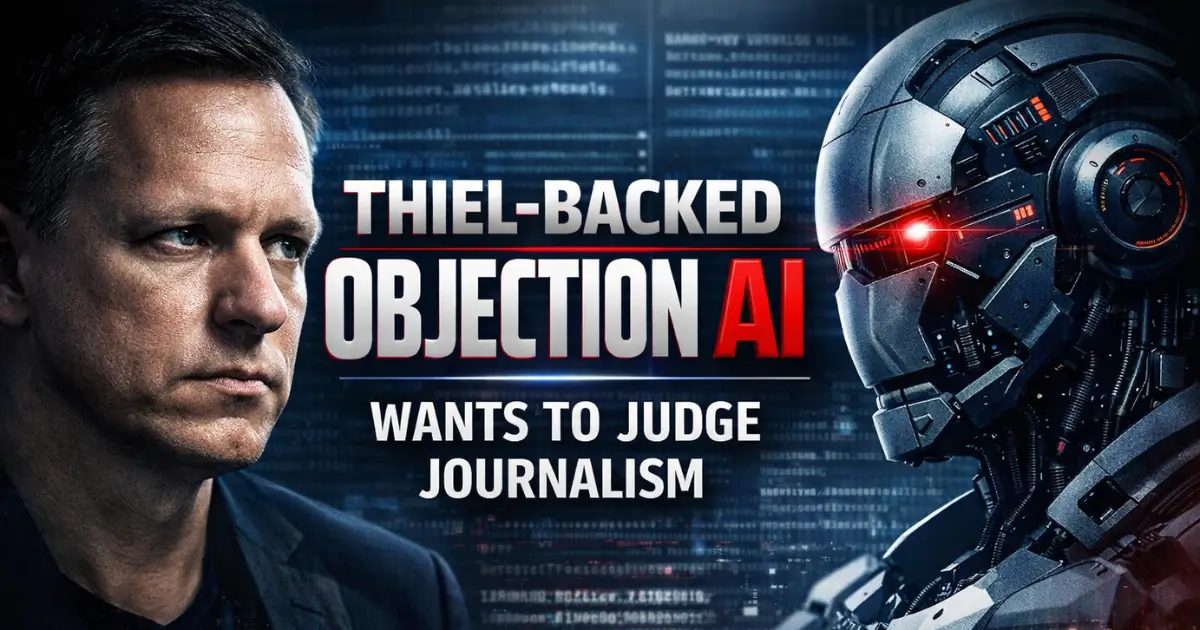
A new startup backed by billionaire Peter Thiel is attempting something that has already ignited fierce debate across media, technology, and legal circles: using artificial intelligence to evaluate whether journalism is truthful. The platform, called Objection AI, launched on Wednesday with seed funding from Thiel and tech investor Balaji Srinivasan, along with participation from Social Impact Capital and Off Piste Capital.
The concept is simple but deeply controversial. For $2,000, anyone can challenge a published news story on the Objection platform. The challenge triggers an investigation into the story's factual claims, conducted by a combination of human investigators and a panel of large language models from companies including OpenAI, Anthropic, xAI, Mistral, and Google. The AI models are prompted to act as average readers and assess the evidence behind each claim. The result is a numerical score the company calls an "Honor Index," which it says reflects a journalist's accuracy, integrity, and overall track record.
The Man Behind the Platform
Objection was founded by Aron D'Souza, who previously helped lead the lawsuit that drove media company Gawker into bankruptcy. D'Souza is also the founder of the Enhanced Games, an Olympics-style competition that permits performance-enhancing drugs and is scheduled to debut in Las Vegas next month.
D'Souza says Objection is not about silencing journalists but about restoring trust in the media. He argues that people who feel harmed by news coverage currently have almost no way to push back other than through expensive legal action. His platform, he claims, offers a faster, more accessible alternative — one that applies what he describes as scientific rigor to disputes over facts.
He compares the system to X's Community Notes feature, describing it as a combination of crowd wisdom and technology designed to create new methods of verifying truth.
How It Works
When someone files an objection, the platform's investigators — which include former law enforcement agents and investigative journalists working as freelancers — gather evidence related to the disputed claim. That evidence, along with any material submitted by the person filing the challenge, is then fed into the AI system for evaluation.
The platform's scoring rubric prioritizes primary records like regulatory filings and official documents, while anonymous whistleblower claims are ranked near the bottom of the evidence hierarchy. Each objection is limited to a single factual allegation within a story, though users can file multiple objections against different parts of the same article. Each challenge proceeds independently.
Objection also features a companion tool called "Fire Blanket," which operates on X through the platform's APIs. Fire Blanket flags disputed claims in real time by posting public warnings on the social media platform while an investigation is still underway — effectively labeling stories as "under investigation" before any conclusion has been reached.
Why Critics Are Alarmed
Media lawyers and press freedom advocates have raised serious concerns about the platform's potential impact on investigative journalism, particularly reporting that relies on confidential sources.
Under Objection's system, stories that use anonymous sources automatically receive lower evidence and trust scores. Journalists are presented with a difficult choice: either reveal sensitive source information to boost their credibility on the platform, or accept a lower score for protecting sources who may have risked their careers or safety to share important information.
Jane Kirtley, a professor of media law and ethics at the University of Minnesota, warned that the platform fits into a broader pattern of efforts that erode public confidence in the press. She questioned why anyone would assume AI models can judge the truthfulness of reporting more reliably than the journalist who actually researched and wrote the story.
Kirtley also noted that journalism already has established accountability mechanisms, including editorial review processes, peer criticism, and professional codes of ethics. She described Objection as a pay-to-play system that is more likely to serve powerful actors seeking to suppress unfavorable coverage than ordinary citizens seeking truth.
First Amendment lawyer Chris Mattei was more direct, characterizing the platform as a tool that could discourage whistleblowers from coming forward at a time when society should be encouraging them.
The Bigger Question
Objection AI arrives at a moment when AI systems themselves face growing scrutiny over issues of bias hallucination, and lack of transparency. Using language models — which are known to produce confident but sometimes incorrect outputs — as arbiters of journalistic truth raises fundamental questions about whether the technology is ready for such a role.
D'Souza maintains that transparency and higher standards are ultimately good for journalism. Whether the industry and the public agree remains to be seen. But the launch of Objection has already made one thing clear: the intersection of AI and press freedom is about to become one of the most contentious battlegrounds in technology.