
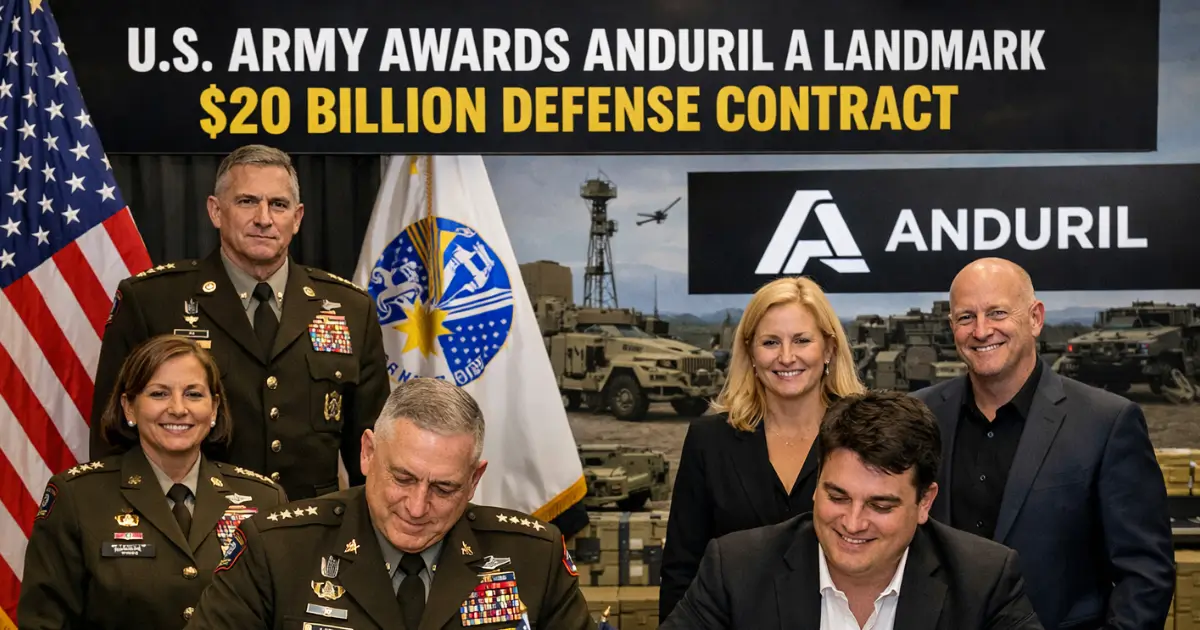
The U.S. Army announced on Friday, March 14, 2026, that it has signed a massive 10-year contract with defense technology startup Anduril Industries. The deal, potentially worth up to $20 billion, marks one of the largest single contracts ever awarded to a Silicon Valley-born defense company and signals a dramatic shift in how the Pentagon acquires technology.
A Decade-Long Partnership
The contract begins with a five-year base period, with the option to extend for an additional five years. It covers a wide range of Anduril's offerings, including hardware, software, infrastructure, and services. Perhaps most notably, the Army says the agreement consolidates more than 120 separate procurement actions for Anduril's commercial solutions into a single enterprise contract.
This consolidation is significant. Rather than managing dozens of fragmented purchasing agreements across different Army units, the military is now treating Anduril as a unified enterprise partner — a status traditionally reserved for legacy defense giants like Lockheed Martin, Raytheon, and Northrop Grumman.
Software as the New Battlefield Advantage
The announcement underscores the Pentagon's growing emphasis on software-defined warfare. Gabe Chiulli, the chief technology officer at the Department of Defense's Office of the Chief Information Officer, stated that the modern battlefield is increasingly defined by software, and that the military must acquire and deploy software capabilities with speed and efficiency.
Anduril has positioned itself at the center of this transformation. The company builds autonomous systems including drones, unmanned submarines, surveillance towers, and AI-powered command-and-control software. Unlike traditional defense contractors who rely on decades-old procurement cycles, Anduril develops products using a Silicon Valley approach — building first, then selling to the government, rather than waiting for lengthy contract specifications.
Palmer Luckey's Journey from VR to Defense
Anduril was co-founded by Palmer Luckey, who was previously known for selling VR startup Oculus to Facebook, now Meta. Luckey's path to defense tech was unconventional and controversial. Facebook fired Luckey after controversy erupted following a news report that he had donated to a pro-Trump political group.
Since then, Luckey has reinvented himself as a defense entrepreneur. According to a recent feature in The New York Times, Luckey and Anduril have been embraced by the second Trump administration, thanks to his vision for remaking the U.S. military with autonomous fighter jets, drones, submarines, and more. The company's name, like Palantir before it, is drawn from "The Lord of the Rings" — a fitting choice for a firm that sees itself as forging powerful tools for national defense.
Rapid Growth and Soaring Valuation
The financial trajectory of Anduril has been remarkable. The company brought in around $2 billion in revenue last year, a figure that puts it in the same conversation as established defense firms that have been operating for decades. And the growth story is far from over — separate reports suggest that Anduril is in talks to raise a new funding round at a $60 billion valuation.
If that valuation holds, it would make Anduril one of the most valuable private companies in the United States, rivaling firms like SpaceX and Stripe in the unicorn rankings. The $20 billion Army contract will only strengthen investor confidence in the company's long-term revenue pipeline.
A Turbulent Landscape for AI and Defense
The Anduril deal comes at a time when other major AI companies are navigating difficult relationships with the Pentagon. Anthropic has sued the Department of Defense over its designation as a supply chain threat following a failed contract negotiation. Meanwhile, OpenAI faced consumer backlash and at least one executive departure after signing its own Pentagon deal.
These contrasting stories highlight a growing divide in the tech industry. While companies like Anduril have built their entire identity around defense work, general-purpose AI firms face internal resistance and public scrutiny when they engage with the military. The ethical debate over AI in warfare shows no signs of settling down.
What This Means Going Forward
The $20 billion contract sends a clear message: the U.S. military is betting big on next-generation defense technology companies. For Anduril, this is validation of its model. For the broader defense industry, it is a wake-up call that the old way of doing business is rapidly changing. The question now is whether other tech startups will follow Anduril's path — or whether the political and ethical complexities of defense work will keep most of Silicon Valley on the sidelines.