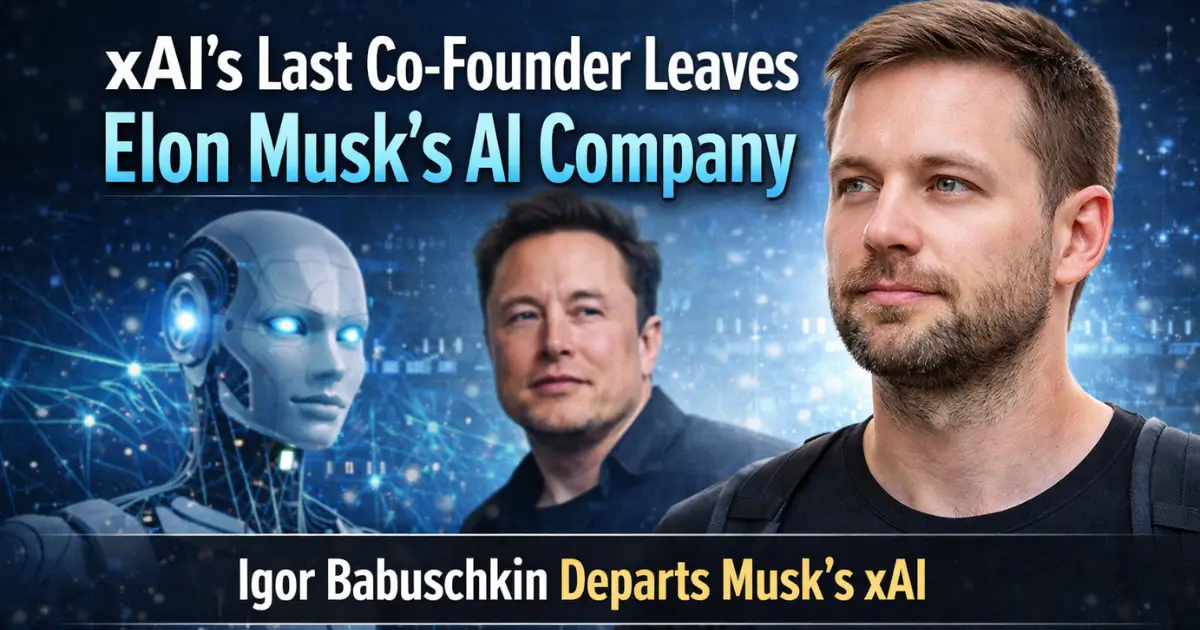
Elon Musk's artificial intelligence company xAI has now lost all 11 of its original co-founders. The final two — Manuel Kroiss and Ross Nordeen — left the company this week, according to Business Insider, marking the most dramatic founding team exodus in recent AI industry history. Kroiss reportedly told associates he was leaving, while Nordeen departed on Friday. With their exits, not a single person who helped build xAI from the ground up remains at the company.
Kroiss led xAI's pretraining team and reported directly to Musk. Nordeen, often described as Musk's "right-hand operator," came to xAI from Tesla and had previously been involved in planning the massive layoffs at Twitter after Musk's 2022 acquisition. Both held central roles in the company's day-to-day operations, making their departures particularly significant.
A Steady Unraveling
The exodus didn't happen overnight. Kyle Kosic, who led infrastructure, was among the first to leave in mid-2024, joining xAI's chief rival OpenAI. Christian Szegedy, a former Google engineer with deep expertise in computer vision, departed in February 2025. Greg Yang stepped back in January 2026 citing health reasons. But the real wave hit in February 2026 when Tony Wu, one of the most operationally important co-founders, announced his resignation on February 10. Within 24 hours, Jimmy Ba — a University of Toronto professor who directed research and safety — followed him out the door. Toby Pohlen left later that month. By mid-March, only Kroiss and Nordeen remained, and now they too are gone.
The SpaceX Merger and Corporate Reshuffling
The timing of these departures is closely tied to a massive corporate restructuring. In February 2026, SpaceX acquired xAI in an all-stock deal that valued SpaceX at $1 trillion and xAI at $250 billion, creating a combined entity worth $1.25 trillion — the largest corporate merger by valuation in history. The deal brought SpaceX, xAI, and X (formerly Twitter) together under a single corporate umbrella. SpaceX is now preparing for a potential IPO in mid-2026, with analysts projecting a target valuation of over $1.75 trillion, which would surpass Saudi Aramco's record-setting 2019 offering.
Musk Acknowledges the Problem
Musk himself has been unusually candid about xAI's struggles. He publicly stated that the company "was not built right the first time around" and is now "being rebuilt from the foundations up." At an all-hands meeting in February, he framed the departures as a natural consequence of the company's growth, suggesting some people are better suited for early-stage work than later phases. He later posted on X that xAI had been "reorganized to improve speed of execution" and that parting ways with some people was unfortunately necessary.
This frank admission, however, may have validated the co-founders' decisions to leave. If the company's own leadership acknowledges the product didn't succeed, the researchers who built it have little reason to stay for the rebuild — especially when competitors are offering extraordinary compensation packages. Reports indicate that Meta has offered packages worth up to $300 million over four years to retain top AI researchers, and OpenAI, Google DeepMind, and Anthropic are all aggressively expanding their teams.
What xAI Still Has — and What It Lacks
Despite the leadership drain, xAI is not without assets. The company's Colossus supercomputer, built with more than 200,000 NVIDIA H100 GPUs, remains one of the largest AI training clusters in the world. The company is also actively recruiting, including seeking finance specialists to train its Grok chatbot on financial markets. However, xAI still trails competitors like OpenAI and Anthropic in ecosystem breadth and scale. Grok remains heavily tied to X, relying primarily on data and behavioral patterns from the social media platform rather than building a broader product ecosystem.
The pattern of talent loss at xAI echoes what has happened across Musk's other companies. Twitter lost the majority of its senior leadership and roughly 80 percent of its workforce within months of his acquisition. Tesla's executive ranks have thinned as Musk's attention has been divided across multiple ventures. The common thread appears to be a management style that produces extraordinary results in hardware engineering but struggles in research-driven fields where top talent has abundant alternatives and little tolerance for instability.
Where xAI's departed co-founders end up will say as much about the AI industry's future direction as their leaving says about xAI's past. For now, Musk's grand AI ambition continues — just without any of the people who helped start it.