
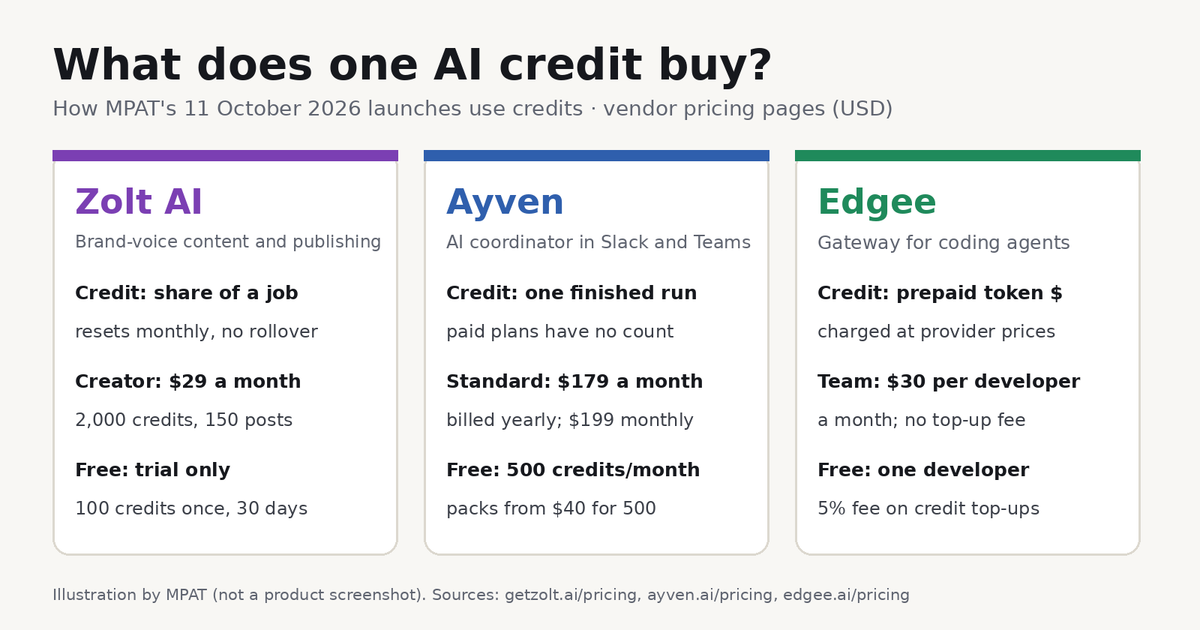
Short answer: a credit is whatever unit the vendor decides to count, so "500 credits" means something different on every pricing page. On MPAT's three 11 October 2026 launches, a Zolt AI credit is a share of each content job and resets monthly, an Ayven credit is one finished run and only exists on the free plan, and Edgee credits are prepaid dollars of model tokens.
This MPAT guide to credit-based AI pricing explains what each credit buys, where each free option stops, what happens when the balance runs out, and when a pack, a plan or a seat is the cheaper way to pay. Prices were read again on each vendor's own pricing page on 11 October 2026. It is compiled from those pages, not a hands-on test, and there are no scores or ratings.
What launched on MPAT on 11 October 2026?
Three products went live on the board on the same UTC day, each doing a different job:
Zolt AI (morning) learns a brand's voice, drafts social posts and other content, checks each draft against a quality gate and publishes after approval.
Ayven (afternoon) is an AI coordinator in Slack and Microsoft Teams that chases answers from the right people and files and tracks tickets in Jira, YouTrack and Asana.
Edgee (evening) is a gateway between coding agents such as Claude Code and Codex and the model providers, which routes requests under a budget, compresses tokens and reports cost per developer.
A social media manager, an operations lead and an engineering manager would each buy one of these, not all three. So this is not a feature roundup. What they share is the billing question every AI buyer now meets: the price page says "credits", and you need to know what one credit is, how many you will burn and what happens on the day they run out.
What does one credit actually buy?
USD, checked 11 October 2026 on the Zolt AI pricing page, the Ayven pricing page and the Edgee pricing page.
A share of any job; small jobs cost a few, big jobs more; costs listed on the in-app credits page before you spend | Trial: 100 credits once, 30 days, no card, no publishing | Creator $29/month: 2,000 credits, 150 published posts, 2 seats | 750 for $19, 2,250 for $49, 5,000 for $99; never expire | Buy a pack or wait for the monthly reset; nothing already made is removed | |
One finished run, whether it researches, writes a document or files a ticket | Free: 500 credits a month, resets monthly, no card | Standard $179/month billed yearly or $199 monthly: no credit count | 500 for $40, 2,000 for $100; never expire | Ayven pauses until the reset or a pack; "no surprise charges" | |
Prepaid dollars of model tokens at provider prices (only for tokens Edgee provides) | Free: $0 for one developer, no card; 5% fee on credit top-ups | Team $30 per developer a month: no top-up fee; seats include no tokens | Any amount; $100 costs $105 on Free, $100 on Team | Credits are prepaid; use your own provider key instead, and Team adds spending caps and alerts |
How do Zolt AI credits work?
Zolt AI uses credits as one balance for everything it makes. The Zolt AI pricing page lists Creator at $29 a month with 2,000 credits, Pro at $79 with 7,000 credits and Studio at $199 with 17,500 credits; annual billing gives two months free. Each plan also has a separate cap on published posts (150, 800 and 4,000 a month) and a seat count (2, 5 and 15).
Three rules matter for budgeting. Plan credits reset each billing period and do not roll over. Top-up packs never expire, so the vendor suggests them for one heavy month instead of a permanent upgrade. And a job that fails is not charged. Zolt does not publish a public cost per job; it says the in-app credits page lists them before you spend.
The free trial is a test, not a plan: 100 credits once, valid for 30 days, and publishing is not included. On MPAT's arithmetic from those numbers, plan credits cost about 1.1 to 1.5 cents each ($29 ÷ 2,000; $79 ÷ 7,000), while packs cost about 2 to 2.5 cents ($99 ÷ 5,000; $19 ÷ 750). Packs are the expensive way to buy credits; they only make sense when the rest of the year is quiet.
Where does Ayven's free plan stop?
Ayven is the clearest case of credits as a free-tier meter only. On the Ayven pricing page, the Free plan gives 500 credits a month, and each run Ayven finishes uses one, whatever the run did. Standard and Premium have no credit count at all. Team members use the account's plan at no extra cost, so there is no seat fee either.
What paid plans buy instead is concurrency, which Ayven calls slots. Free has 1 autonomous slot for background work and 1 interactive slot for direct messages in Slack or Teams. Standard keeps 1 autonomous slot and raises interactive slots to 3; Premium, at $358 a month billed yearly or $398 monthly, has 3 and 5. When free credits run out, Ayven pauses until the monthly reset or until you buy a pack.
That creates an odd middle ground. Two 2,000-credit packs cost $200 and give 4,000 runs that never expire, about the price of one month of Standard at $199 on monthly billing. A team that needs more runs but not more parallel work could stay on Free with packs; a team that needs Ayven answering several people at once needs Standard for the slots, not the runs. That comparison is MPAT's arithmetic from the pricing page, not an Ayven recommendation.
Are Edgee credits the same as other AI credits?
No. Edgee's credits are money, not a made-up unit. The Edgee pricing page says tokens provided by Edgee are charged at the model provider's prices, paid from prepaid credits. If you bring your own API key or subscription, such as Claude Pro or Max, you pay the provider directly and Edgee takes 0% commission on every plan.
The free plan's limit is therefore not a credit count. Free covers one developer at $0 with compression, rerouting strategies and a personal dashboard, but adds a 5% fee when you buy Edgee credits: $100 costs $105 before tax. Team, at $30 per developer a month, removes the fee and adds team dashboards, smart routing, plugins, spending caps and per-repo attribution. Seats include no tokens.
On MPAT's arithmetic, the top-up fee alone covers a Team seat only when one developer buys more than $600 of Edgee credits a month (5% of $600 is $30). Below that, Team is worth paying for the team features, not the fee saving. Edgee's token compression page reports 15 to 20% lower token bills from compression on live customer fleets, a number to measure on your own work rather than assume.
How do older credit-based tools on MPAT compare?
Two tools already listed on MPAT show how wide the range is. Raycast's pricing and AI credits give Pro 500 AI credits a month for $10 and Plus 3,000 for $20, so doubling the spend triples the allowance (MPAT check, 24 September 2026). CoreSpeed's credits and rate card fix the value at 1,000 credits to $1, with a 3,000-credit signup grant that expires after 90 days and Pro at $20 a month for 10,000 credits (MPAT check, 4 October 2026). CoreSpeed is closest to Edgee, where a credit is tied to a dollar; Raycast is closest to Zolt AI, where a credit is a vendor unit and the price per credit changes by tier.
How should you compare credit plans before you pay?
Find the unit. Ask what one credit is: a job, a run, a token dollar. If the vendor lists job costs only inside the app, start on the trial and read that page first.
Find the second limit. Zolt AI caps published posts, Ayven caps slots and Edgee charges per seat. The credit count is rarely the only ceiling.
Check expiry. Monthly plan credits on Zolt AI and Ayven's free credits reset; packs on both never expire. Use-it-or-lose-it credits make overbuying a plan costlier than it looks.
Check the run-out rule. Zolt AI and Ayven both say you wait for the reset or buy a pack, and Ayven adds "no surprise charges". Edgee credits are prepaid, and Team adds spending caps and alerts.
Price the credit. Divide the price by the credits on each tier and on each pack. The same vendor's credits can cost twice as much in a pack as in a plan.
FAQ
Is Zolt AI free?
Not beyond a trial. Zolt AI gives 100 credits once for 30 days with no card, without publishing. Paid plans start at $29 a month for Creator with 2,000 credits, checked 11 October 2026.
Do Ayven credits expire?
Free-plan credits reset each month. Purchased packs, 500 for $40 or 2,000 for $100, never expire and carry over if you change plans. Standard and Premium do not count credits.
Does Edgee charge for tokens I already pay for?
No. With your own provider key or subscription, Edgee charges 0% commission. You pay Edgee only for seats on Team and for tokens it provides, at provider prices plus 5% on the Free plan.
Do unused AI credits roll over?
It depends on the source. Zolt AI's monthly plan credits do not roll over; its packs never expire. Ayven's free monthly credits reset; its packs never expire. Edgee credits are prepaid funds for tokens rather than a monthly allowance.
Which is cheaper per credit, a plan or a pack?
Usually the plan. Zolt AI plan credits work out to about 1.1 to 1.5 cents each against about 2 to 2.5 cents in packs, on MPAT's arithmetic from the pricing page. Ayven packs cost 8 cents or 5 cents a credit, per Ayven.
Sources
Zolt AI plans, credit counts, post caps, seats, rollover and pack prices come from the Zolt AI pricing page. Ayven's free credits, slots, Standard and Premium prices and credit packs come from the Ayven pricing page. Edgee's seat price, top-up fee, BYOK rule and credit billing come from the Edgee pricing page, and its compression figure from the Edgee token compression page. All three were read on 11 October 2026. Raycast and CoreSpeed figures come from MPAT's own listings with the check dates shown above. Per-credit and break-even figures are MPAT's arithmetic, labelled where they appear.