
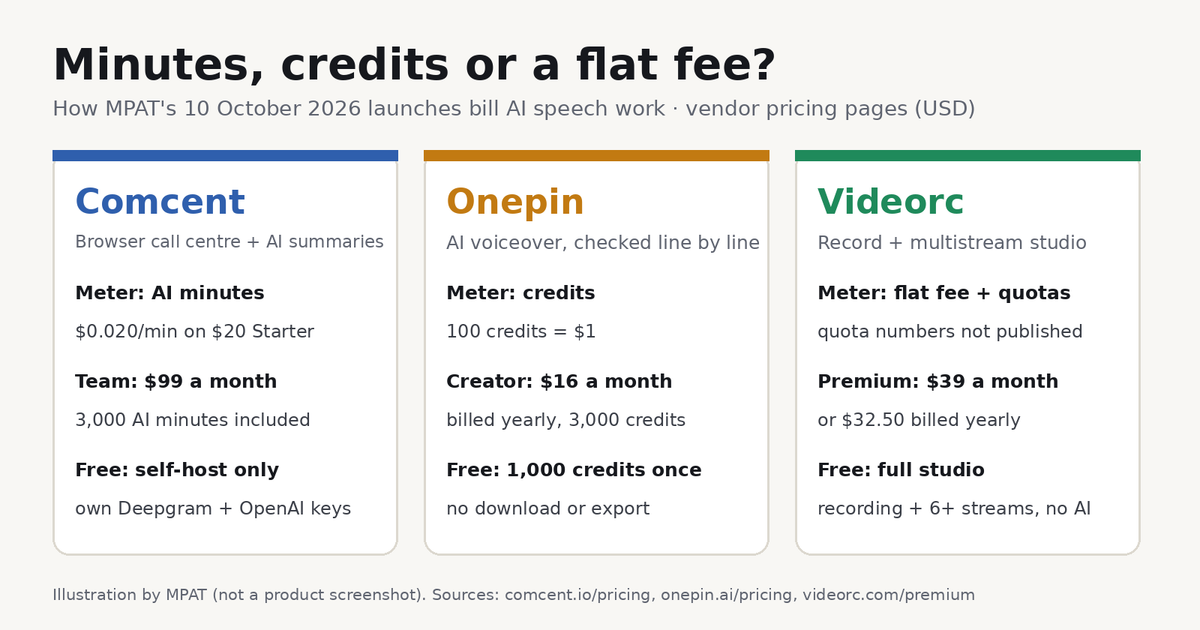
Short answer: MPAT's three 10 October 2026 launches all sell AI work on speech, but each one meters it differently. Comcent charges a monthly plan plus AI minutes, from $0.020 a minute on its $20 Starter plan. Onepin sells credits, 100 to the dollar, from $16 a month billed yearly. Videorc is one flat Premium fee, $39 a month, with unpublished monthly AI quotas.
This MPAT guide to AI voice tool pricing explains what each meter counts, where each free option stops, what happens when the allowance runs out, and why "minutes" on three pricing pages are not the same minutes. Prices were read again on the vendors' own pages on 10 October 2026, alongside today's three MPAT listings. It is compiled from those pages, not a hands-on test, and there are no scores or ratings.
What launched on MPAT on 10 October 2026?
Three products went live on the board on the same UTC day. They do different jobs, but all three put AI to work on a human voice or a synthetic one:
Comcent (morning) is a browser call centre that runs on your own phone carrier or SIP trunk. Its AI transcribes each call, summarises it, labels it and tracks promises agents made.
Onepin (afternoon) is an AI voiceover production tool from Podonos, Inc. It sends each script line to one of 33 text-to-speech models, checks the result and re-takes lines that fail.
Videorc (evening) is an open-source desktop studio for recording and multistreaming. Its paid AI tools listen to the creator's voice: live captions, a chat co-host called Orcle that can hear you on air, and Clean cut, which removes silences and retakes.
A support manager, a video producer and a streamer would each buy one of these, not all three. So this is not a feature roundup. The shared question is a billing one: when a tool does AI work on speech, are you paying for minutes, credits, seats or a flat fee, and which of those numbers will actually limit you?
How does each one charge for AI speech work?
Checked 10 October 2026 on the Comcent pricing page (USD, excluding taxes), the Onepin pricing page (USD) and the Videorc Premium page (USD).
No free cloud plan; the open-source Community Edition is free to self-host with your own AI keys | Starter $20/month (5 concurrent calls, AI at $0.020 a minute); Team $99/month includes 3,000 AI minutes | Minutes of call audio analysed by AI Insights, plus concurrent-call slots | Unlimited on every plan | Usage is deducted from a prepaid wallet; if the wallet cannot cover the plan, it lapses and calls stop | |
Free: 1,000 one-time credits (about 15 minutes of validated audio, per Onepin), no download or export | Creator $16/month billed yearly ($20 monthly) for 3,000 credits a month | Credits, 100 per US dollar, covering generation, routing and checks; each TTS model has its own rate | Unlimited on every plan | Paid plans bill overage at $0.010, $0.008 or $0.007 a credit; Free has no overage | |
Free studio: recording and multistreaming, no AI features, no watermark | Premium $39/month, or $32.50/month billed yearly | A flat fee; AI features run within monthly quotas shown in the app | One person per subscription | Quota numbers are not published; the terms warn that circumventing them can lead to throttling |
That is three models in one table: a plan plus a per-minute meter, a credit wallet, and a flat fee with an unpublished ceiling. Each puts the risk in a different place.
Are "AI minutes" the same minute on every pricing page?
No, and this is the most useful thing to check before comparing prices. The word "minute" counts four different things across today's launches and two older MPAT listings:
Comcent counts minutes of recorded call audio that AI Insights transcribes and summarises. A ten-minute call uses ten AI minutes, whoever spoke.
Onepin counts credits, not minutes. Its plan cards translate credits into "validated minutes" of finished voiceover as an estimate, and the real cost depends on the TTS model and the length of the script.
Videorc counts the minutes of recording audio you send to Clean cut against a monthly allowance, per its privacy policy, but the allowance itself is not published.
Opus Clip, already on MPAT, counts processing minutes by the length of the video you feed in, not the clips that come out. MPAT's 24 September 2026 check found 60 a month free and 150 on the $15 Starter plan.
So "3,000 minutes" on one page and "100 minutes" on another are not more and less of the same thing. Compare them against your own unit of work: calls a month, finished minutes of voiceover, or hours of recording.
What does an hour of AI work cost on each?
The figures below are MPAT's arithmetic from the published prices, not vendor quotes.
Comcent. On Starter, 60 minutes of AI Insights at $0.020 a minute is $1.20, on top of the $20 plan fee. Team's $99 includes 3,000 AI minutes, which is 50 hours of analysed calls; beyond that, an hour costs $0.90 at $0.015 a minute. On Scale it is $0.72 an hour at $0.012. Your carrier's talk charges are separate, because Comcent runs on your own trunk. The optional voice bot is billed on its own, from $0.08 a minute.
Onepin. Onepin estimates Creator's 3,000 credits at about 100 minutes of validated audio. By that estimate, a finished minute costs about $0.20 on monthly billing ($20 for 100 minutes) or $0.16 billed yearly. The estimates do not scale evenly between tiers, and model choice changes the cost. The Onepin pricing page and its models page list per-model rates, so run a preview estimate on your own script before buying.
Videorc. An hourly cost cannot be calculated, because the Clean cut allowance is not public. Live captions and Orcle have no per-minute price at all; you pay $39 a month and work within the quota the app shows. That is simple to budget, but you only see the ceiling after you sign up.
Where do the free options stop?
Comcent has no free cloud tier. The free route is the self-hosted Community Edition under AGPL-3.0, where you run the server and pay Deepgram and OpenAI directly with your own keys.
Onepin's Free plan gives 1,000 credits once, not every month, and you can play audio in the app but not download or export it.
Videorc's free plan is the whole recording and streaming studio, with no watermark and no time limit, but none of the AI.
What happens when the allowance runs out?
Comcent is prepaid. Per the pricing page, the plan fee and usage are deducted from a US-dollar wallet, with a minimum top-up of $25. If the wallet cannot cover the plan, the plan lapses and calls stop: no surprise bill, but a possible outage. Payments are non-refundable.
Onepin keeps working on paid plans and bills overage on the next invoice, at a lower per-credit rate on bigger plans. Unused credits do not roll over on self-serve plans, and fees are non-refundable unless an order form says otherwise.
Videorc does not sell overage. Its terms of service describe monthly quotas for AI features and say systematic attempts to get around them can lead to throttling or suspension. Cancelling takes effect at the end of the paid period, and refunds go through Creem, the merchant of record.
Does it matter who pays per seat?
Yes, for teams. Comcent and Onepin both give unlimited seats on every plan, so a team of twenty pays the same plan fee as a team of two; the cost follows calls or audio, not people. Videorc's Premium covers one person, which fits a solo creator but means a team of streamers pays per person. If several people will use the tool, a seat-free meter usually beats a flat per-person fee.
Which billing model fits which buyer?
Steady, high call volume: Comcent's Team or Scale plans, where included AI minutes cover a known load and overage is cheap per hour.
Bursty production work: Onepin's credits suit projects that come in batches, like a course or a dubbing job, if you estimate credits per script first. Remember that unused credits expire each month.
Regular solo streaming or recording: Videorc's flat Premium is the easiest to budget, provided the in-app quota covers your hours.
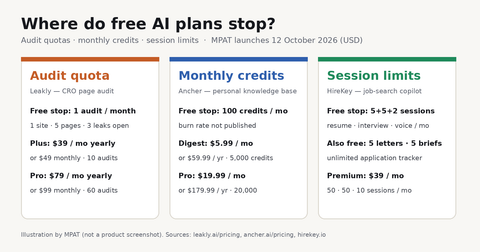
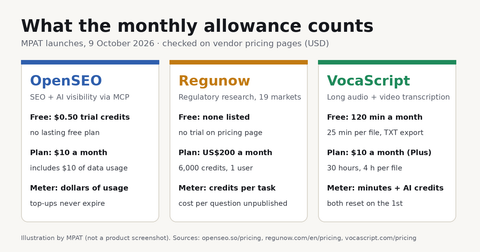
Just transcription: none of these is the cheapest route. VocaScript, on MPAT since 9 October 2026, has a free plan of 120 minutes a month and Plus at $10 for 30 hours.
FAQ
Which of today's launches has a free plan?
Onepin has a Free plan with 1,000 one-time credits and no export. Videorc's recording and streaming studio is free, but its AI features are not. Comcent has no free cloud plan; its open-source Community Edition is free to self-host with your own AI keys.
Is per-minute or credit pricing cheaper?
Neither is cheaper in general. Per-minute pricing like Comcent's is easier to predict when you know your call volume. Credits like Onepin's can be cheaper or dearer depending on the model and script length, so estimate before you buy.
Do unused AI minutes or credits roll over?
Onepin says unused credits do not roll over on self-serve plans. Comcent's wallet balance does not expire while the account is open, but included AI minutes are a monthly allowance. Videorc's quotas are monthly, and it publishes no roll-over rule.
Can I use my own AI provider keys to cut costs?
On Onepin, yes, from the Studio plan up; lines sent to your own provider key cost no Onepin credits. Comcent's self-hosted edition runs on your own Deepgram and OpenAI keys. Videorc does not offer this on its public pages.
Are these prices in US dollars?
Yes. All three list USD. Comcent's prices exclude taxes, and in India it charges in rupees through Razorpay at the day's exchange rate.
Sources
Comcent's plans, AI minute rates, wallet rules and refunds come from the Comcent pricing page. Onepin's plans, credits, minute estimates, overage rates, seats and roll-over rules come from the Onepin pricing page. Videorc's free and Premium features and price come from the Videorc Premium page, its quotas and cancellation from the Videorc terms of service, and the Clean cut minute count from the Videorc privacy policy. All were read on 10 October 2026. Opus Clip and VocaScript figures come from their MPAT listings, checked 24 September and 9 October 2026. Full listings are on the Comcent, Onepin and Videorc pages on the MPAT launch board.