
 Compiled by Amit Kumar
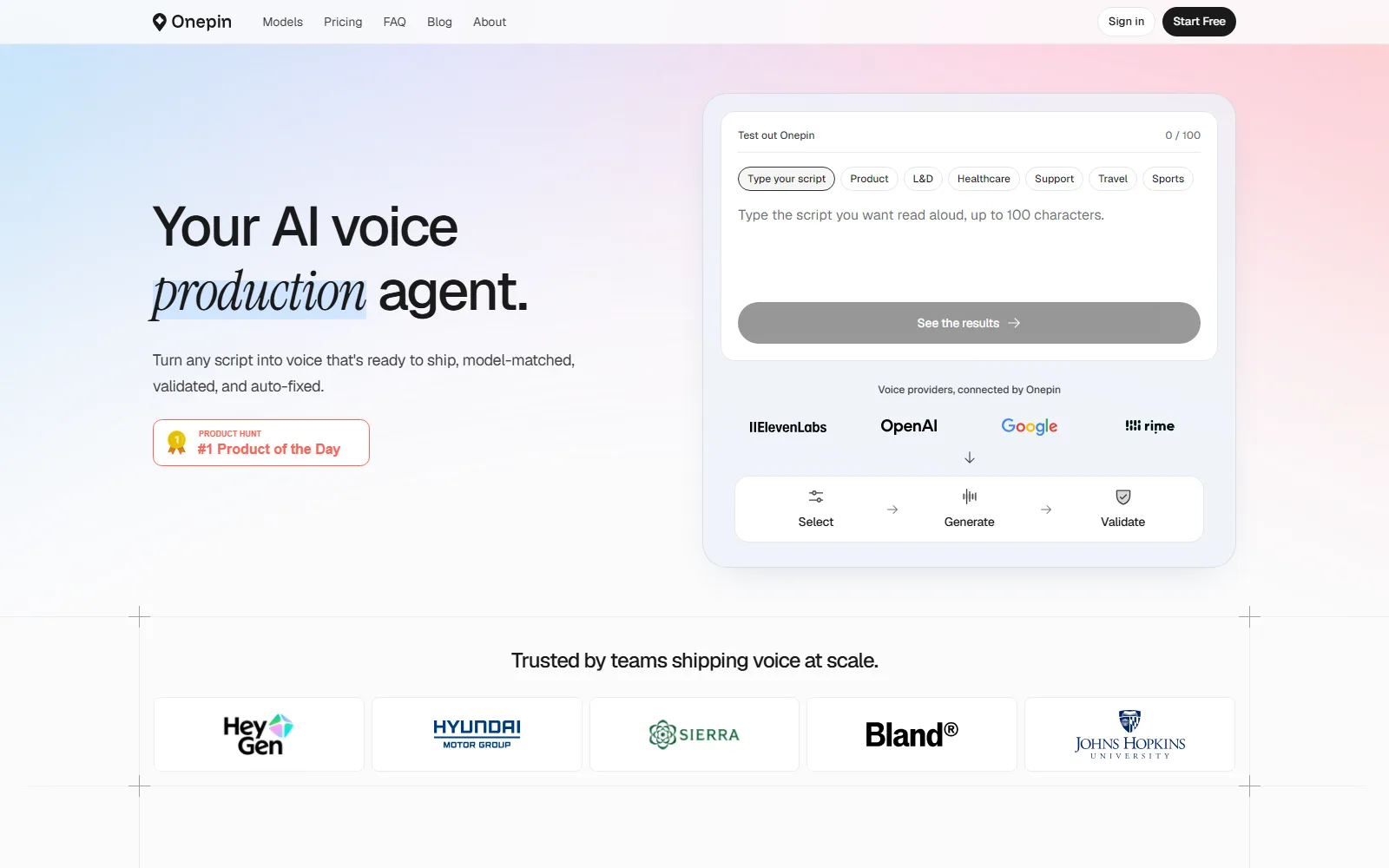
Onepin is a voiceover production tool for teams that publish synthetic voice. It sends each script line to a text-to-speech model, scores the audio and regenerates lines that fail. It suits video, course and dubbing teams. The Free plan gives 1,000 one-time credits, and paid plans start at $16 a month billed yearly.
Our read: Onepin sells quality control, not voices. Pricing is unusually open, with exact credits, overage rates, storage and retention for every self-serve plan, and seats are unlimited, so cost follows the audio you generate. The catch is the Free plan. It cannot download or export audio, so it is a preview, not a working tier. Fees are also non-refundable and Onepin can change per-model credit rates at any time.
We read the Onepin pricing page, the Onepin FAQ, the Onepin documentation, the Terms of Service and the Privacy Policy on 10 October 2026, and everything below comes from those vendor pages.
Onepin at a glance
Podonos, Inc. makes Onepin. You give it a script, and it expands numbers and dates, checks hard names and scores every line for accuracy, naturalness, noise and pronunciation. Billing is in credits, at 100 credits to the dollar, covering generation and checks together. The Free plan's 1,000 credits are about 15 minutes of validated audio, by Onepin's own estimate. Billed yearly, Creator costs $16 a month for 3,000 credits, Studio $80 for 15,000 and Scale $240 for 50,000.
What Onepin does
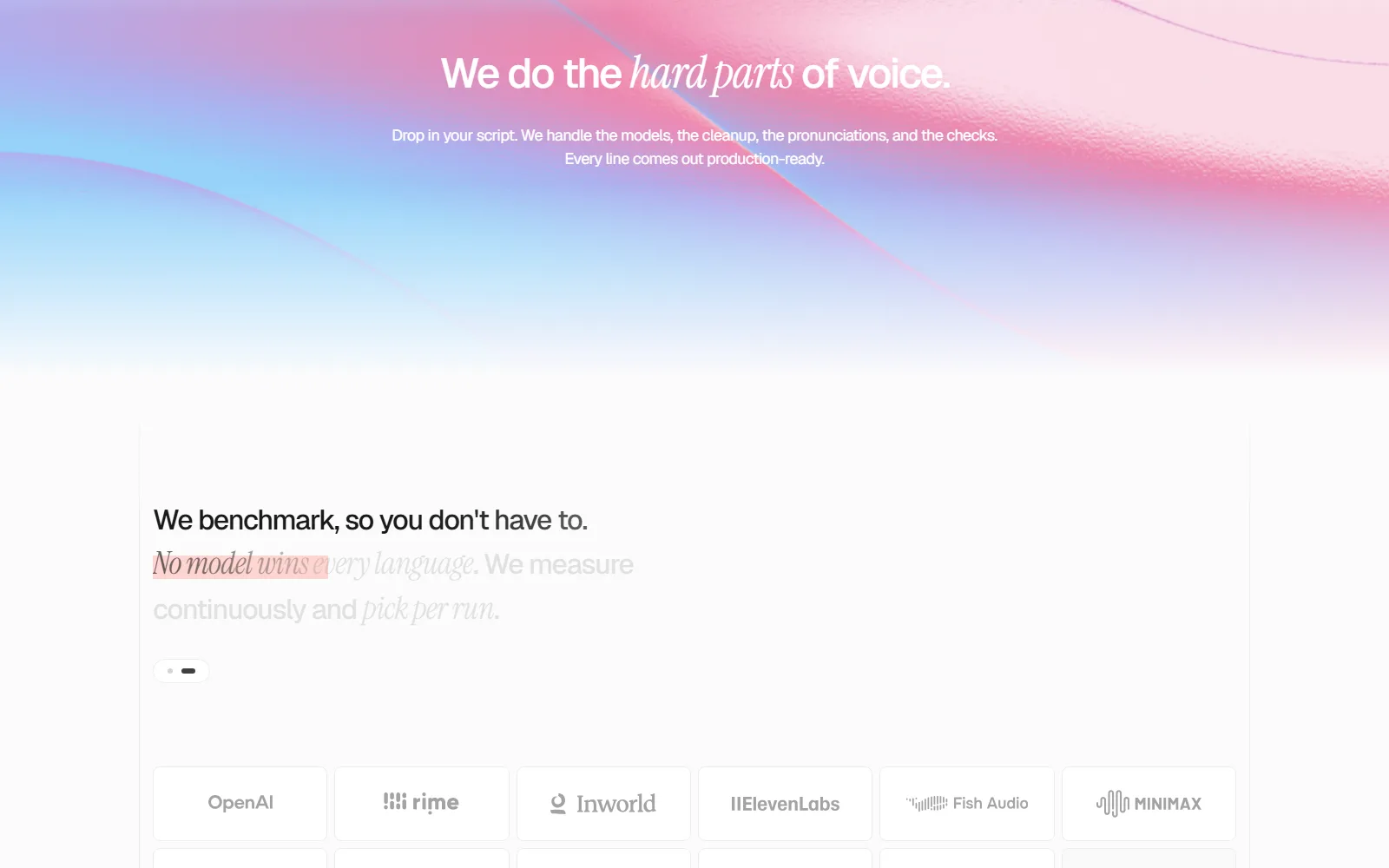
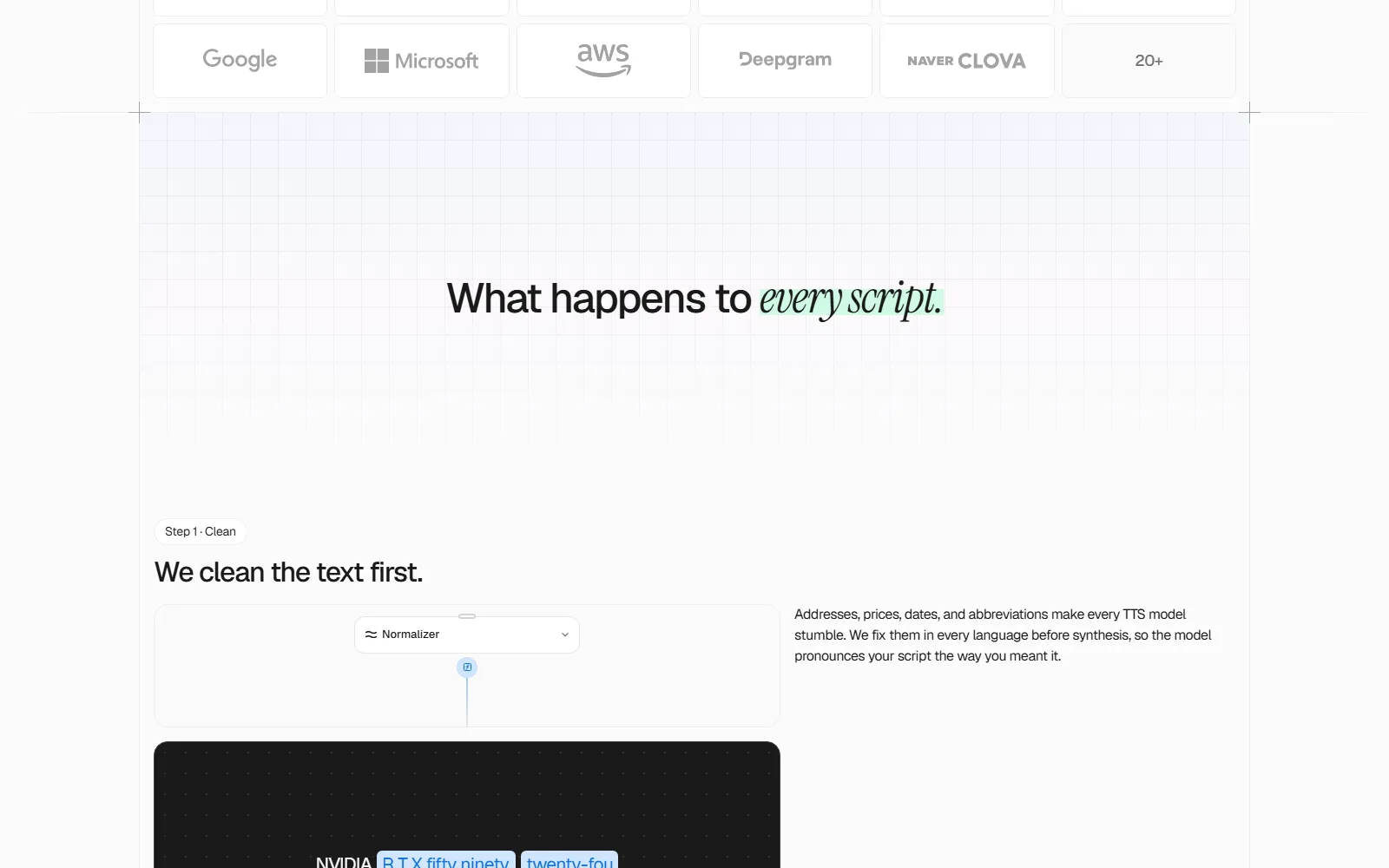
Onepin does not make its own voices. It sits on top of other text-to-speech engines and handles the work around them: choosing a model, cleaning the script, checking each take and redoing the ones that miss. The voices and models guide lists 33 models from 19 providers, including ElevenLabs, Cartesia, Microsoft Azure, Google Cloud, OpenAI, Deepgram, MiniMax and Murf AI. The homepage rounds that to "30+ engines".
A run moves through these steps, per the Onepin homepage and docs.
- Normalise the text. Numbers, prices, dates, addresses and abbreviations become spoken words before synthesis, so "$20" is read as "twenty dollars". Onepin says this step alone removes nearly half of TTS errors.
- Route each line. Auto-routing picks a model per language from Onepin's ongoing benchmarks. You can also assign a voice and model yourself.
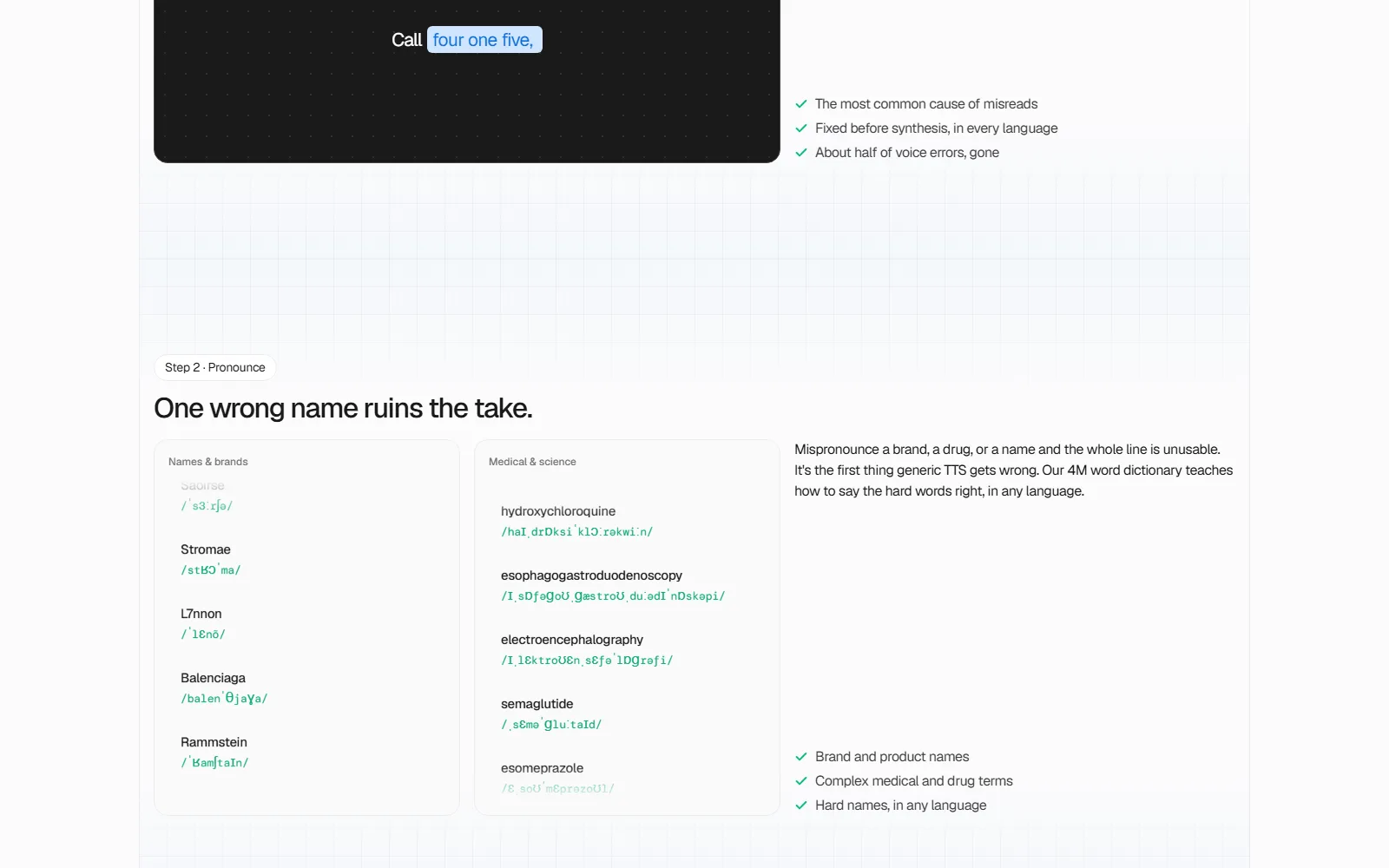
- Check pronunciation. The homepage cites a 4-million-word pronunciation dictionary for brand, drug and personal names. The pronunciation guide describes a chain that scores the audio sound by sound and re-synthesises only the wrong word inside the take. It is in beta and works for US and UK English only.
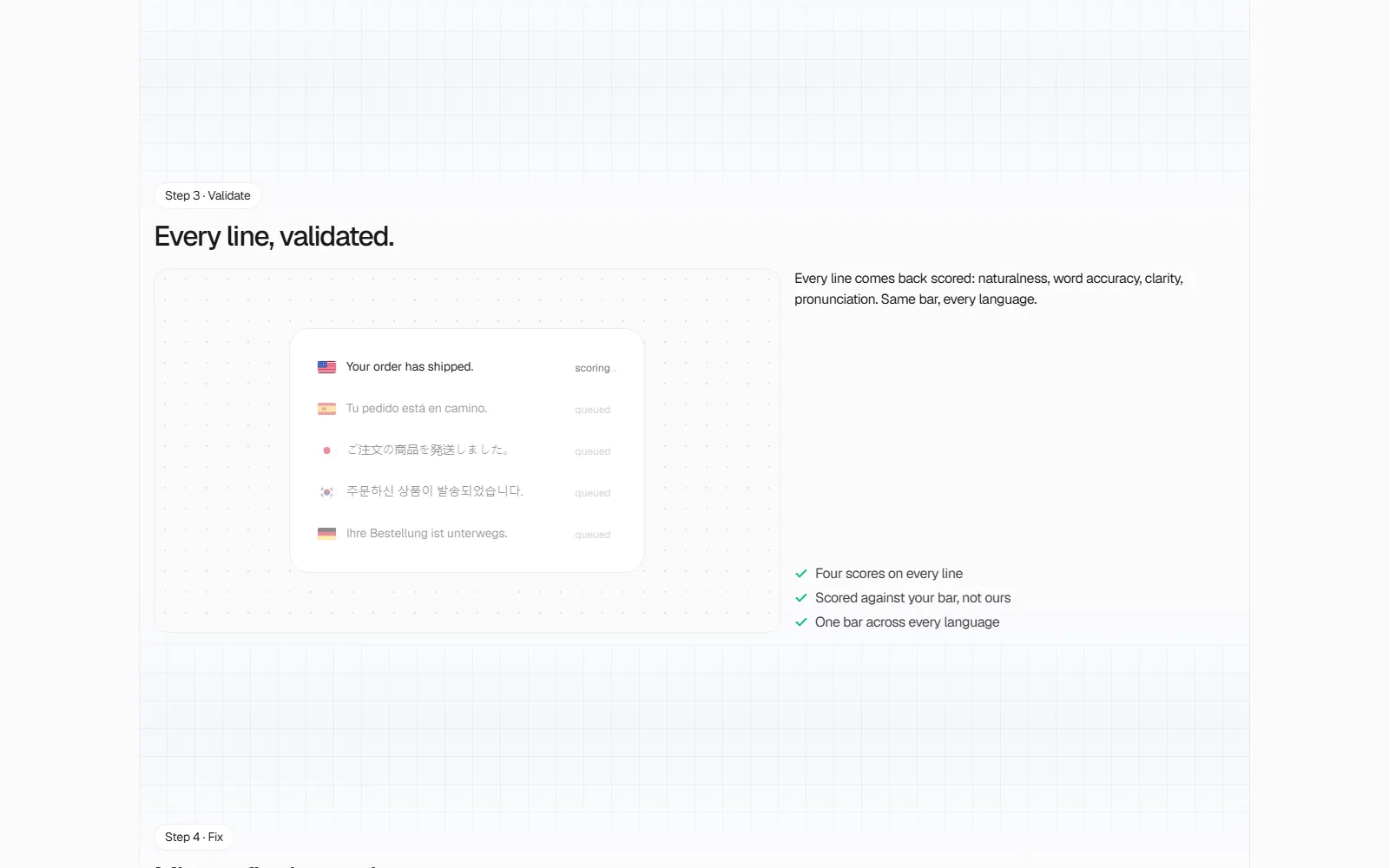
- Validate every line. The validation guide lists four checks: accuracy (did it say the words), naturalness, noise and pronunciation. Each has a score threshold and a retry budget. A line that runs out of retries ships as its best-scoring attempt, with its scores shown.
- Translate. The Translator step accepts up to 30 target languages with a voice per language, though Onepin lists 10 supported languages today. The export is a ZIP with a folder per language and a manifest file.
- Handle long scripts. You can upload .txt or .pdf scripts up to 10 MB each. A run with validators covers up to 10,000 lines, and each line comes back as its own audio file.
- Agent and developer access. A chat agent builds the workflow from a plain request. There is also a REST API, a Python SDK, a CLI and a remote MCP server for Claude Code, Cursor or ChatGPT, per the MCP server docs.
On Studio and above you can bring your own provider key. The bring-your-own-key guide says lines sent to that provider are billed by the provider, and Onepin charges no credits for that synthesis.
Who Onepin is for, and who should skip it
It fits teams that already use AI voice and lose time fixing it by hand: product-video and help-centre teams, e-learning studios, localisation and dubbing teams, and developers who generate voice inside their own apps. It earns its price when one wrong name or price in a line is a real problem and there are too many lines for anyone to listen to each one.
Skip it in four cases:
- You want a talking-avatar video. Onepin returns audio files, not video.
- You need voice cloning today. The FAQ says cloning is "on the way".
- Your scripts are mostly outside its 10 languages. The pronunciation repair is also English-only.
- You have strict European procurement rules. The FAQ says Onepin is "working toward" GDPR compliance.
How much does Onepin cost?
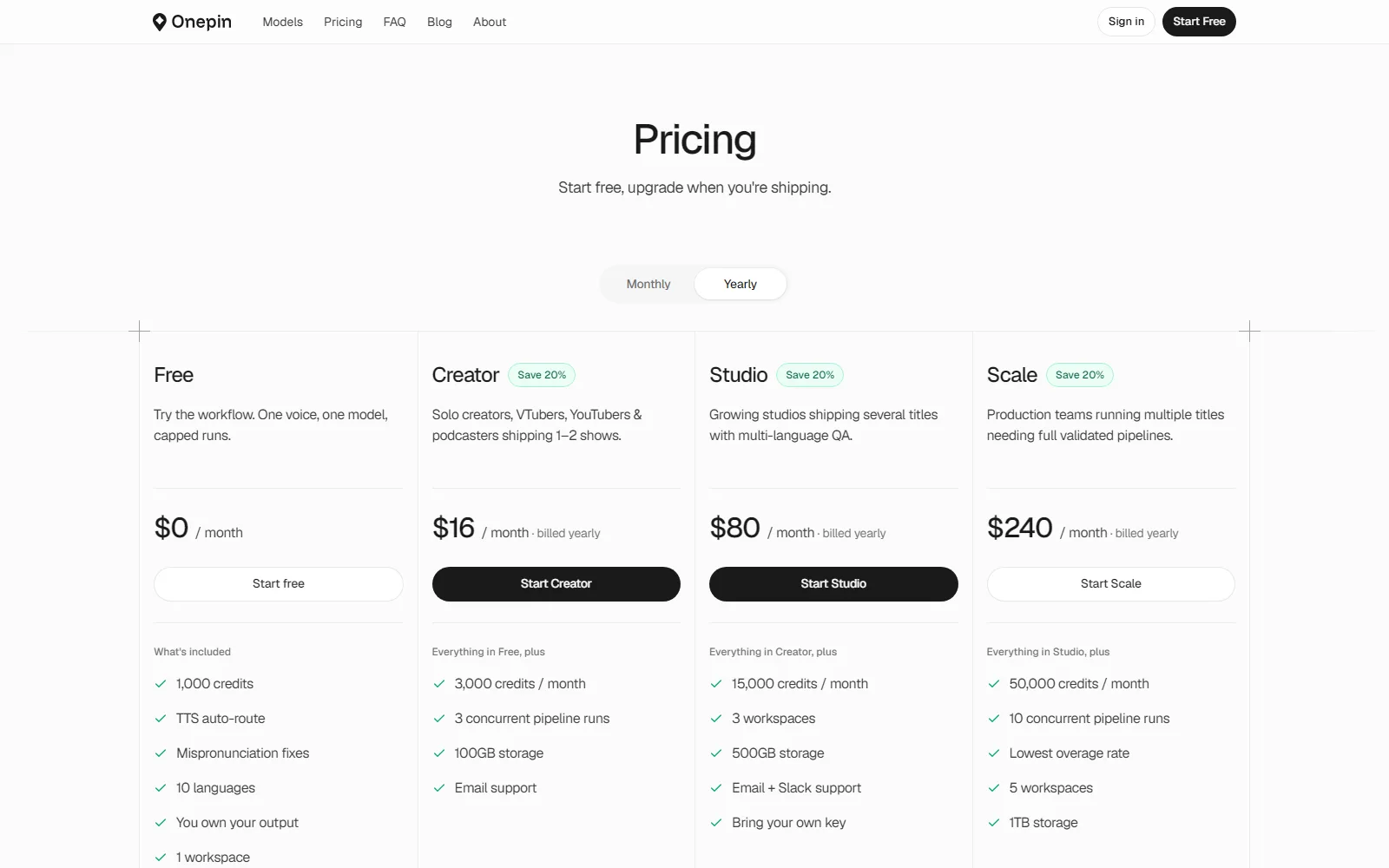
Onepin has a Free plan, three self-serve paid plans and a custom Enterprise tier. Yearly billing saves 20%, per the pricing page.
USD, checked 10 October 2026, from Onepin pricing
| Plan | Price | What you get | Where it stops |
|---|---|---|---|
| Free | $0, no card | 1,000 one-time credits (about 15 minutes of validated audio, per Onepin), 1 workspace, 1 GB storage, files kept 1 year | One run at a time, no download or export (playback in the app only), no overage, credits do not refill |
| Creator | $16/month billed yearly ($20 monthly) | 3,000 credits a month (about 100 minutes), 3 parallel runs, 100 GB, files kept 3 years, email support | Then $0.010 per credit; 1 workspace; no bring-your-own-key |
| Studio | $80/month billed yearly ($100 monthly) | 15,000 credits a month (about 9 hours), 5 parallel runs, 3 workspaces, 500 GB, bring your own key, email and Slack support | Then $0.008 per credit |
| Scale | $240/month billed yearly ($300 monthly) | 50,000 credits a month (about 30 hours), 10 parallel runs, 5 workspaces, 1 TB, shared SOC 2 report | Then $0.007 per credit |
| Enterprise | Custom | Pooled credits across workspaces, SAML SSO, 99.9% uptime SLA, DPAs and BAAs, custom retention, negotiated IP indemnity | Price on request |
The pricing page text shows the yearly prices. The monthly prices of $20, $100 and $300 come from the price data published on the same page, and they match its "Save 20%" label for yearly billing. Check the toggle before you pay.
A credit is Onepin's single unit for generation, routing and checks. Each model has its own rate. The Onepin models page lists, for example, 1,500 credits per million characters for Qwen-Audio 3.0 Flash, 3,920 for Cartesia Sonic 3.5 and 10,000 for Amazon Polly Long-Form. The minute estimates per plan are Onepin's and do not scale evenly between tiers, so the docs suggest a preview run that estimates credits before anything is generated. Unused credits do not roll over on self-serve plans.
The terms add three points. Fees are non-refundable unless an order form says otherwise. A downgrade takes effect at the end of the billing period. And Onepin can change per-model credit rates at any time, with notice in the product and on the pricing page, while plan price changes need 30 days' notice.
Is Onepin free?
Only to try. The Free plan needs no card and the 1,000 credits are one-time, not monthly. You can play audio in the app but not download or export it, and there is no overage, so once the credits are gone you move to a paid plan.
Does Onepin train on my scripts and audio?
The Privacy Policy says no: scripts, audio and voice recordings are not used to train Onepin's or third-party models, and only aggregate, de-identified metrics improve routing. It also says Onepin cannot guarantee the practices of every TTS provider it routes to. The subprocessor list (21 September 2026) names AWS, Google Cloud, Vercel, OpenAI, Google Gemini and Modal among others, mostly in the United States. The FAQ claims SOC 2 Type II compliance and regular penetration testing, and says GDPR compliance is still in progress.
Who makes Onepin?
Podonos, Inc., per the Terms of Service, which are governed by Delaware law. The about page names Soohyun Bae as founder and CEO and says the team first built Podonos to measure speech-AI quality. Onepin's Product Hunt listing went live on 10 October 2026, though the terms date the service to April 2026.
How Onepin compares with other tools reviewed here
Synthesia turns a script into a presenter-led video with AI avatars and dubs existing footage. Our 24 September 2026 check found a free Basic plan with 10 watermarked minutes a month, and Starter at $29 a month or $18 billed yearly. Pick Synthesia when you need the video and the presenter. Pick Onepin when you only need the voice track, with names, numbers and languages checked line by line.
HeyGen also makes avatar video and lip-synced translations, and it offers voice cloning, which Onepin still lists as coming. Our 14 September 2026 check found a watermarked free plan, and Creator at $29 a month or $24 billed yearly. HeyGen is a video studio with one credit balance. Onepin is audio only and routes across many voice engines rather than its own.
VocaScript works in the other direction: it turns audio and video into text. Our 9 October 2026 check found a free plan with 120 minutes a month and Plus at $10 a month. Use VocaScript to transcribe recordings, and Onepin to turn a finished script into voice.
Browse more voice AI tools if you want to compare further.
Sources
Plan prices, credits, minute estimates, overage rates, storage, retention and the billing FAQ come from the Onepin pricing page and the Onepin FAQ. Per-model credit rates come from the models page. The pipeline, validators, pronunciation chain, translation limits, long-form limits, bring-your-own-key billing and MCP access come from the Onepin documentation, including the long-form audio guide and the translation guide. Refunds, downgrades, rate changes and governing law come from the Onepin Terms of Service (last updated 20 August 2026), and data use from the Onepin Privacy Policy. The Enterprise uptime figure comes from the Onepin Service Level Agreement. All pages were read on 10 October 2026.