
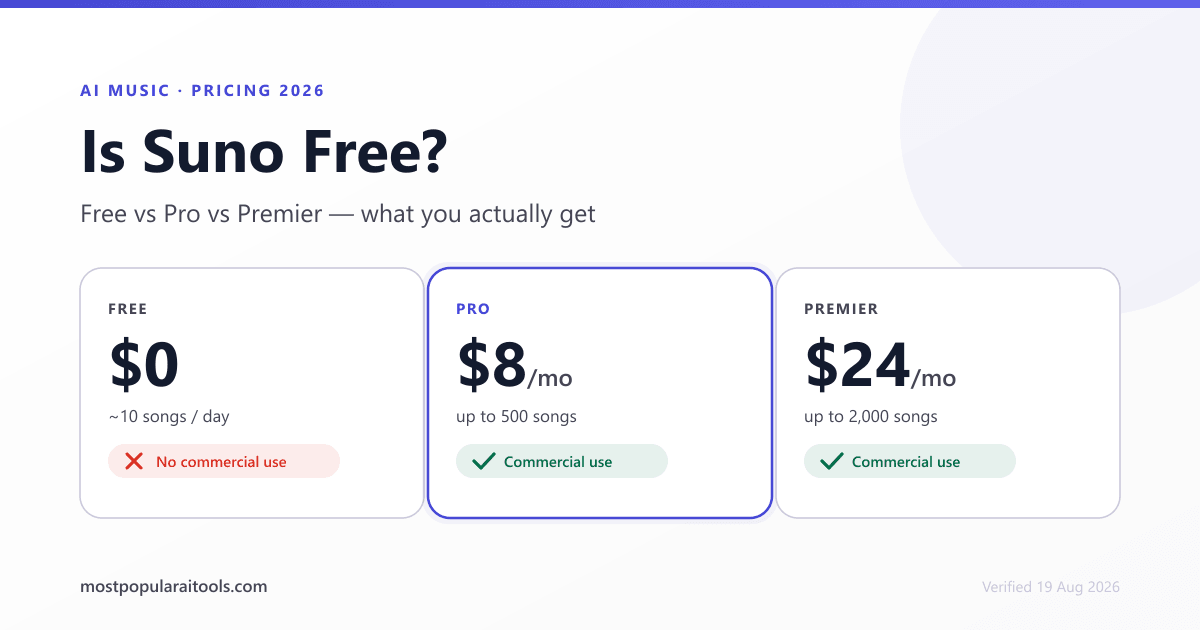
Short answer: yes, Suno is free — but you cannot legally release anything you make on the free plan. The free tier gives you 50 credits that renew every day, which is roughly ten songs. Commercial use rights only begin on the $8/month Pro plan. That single detail is the thing most people miss until after they have made something they like.
Here is exactly what each Suno plan costs, what you get, and who actually needs to pay. All figures below were checked against Suno's own pricing page on 19 August 2026.
Suno pricing at a glance
| Plan | Price | Credits | Songs | Commercial use |
|---|---|---|---|---|
| Free | $0/month | 50, renewing daily | ~10 per day | No |
| Pro | $8/month | 2,500 monthly | Up to 500 | Yes |
| Premier | $24/month | 10,000 monthly | Up to 2,000 | Yes |
Annual billing lowers both paid tiers — Suno advertises a $24 saving on Pro and $72 on Premier when you pay yearly.
What the Suno free plan actually includes
The free tier is a real product, not a trial that expires. You get:
- 50 credits that renew daily — about ten songs every day, which resets whether you use them or not
- Access to the v4.5-all model — capable, but not Suno's newest engine
- Standard features only
- Audio uploads up to 8 minutes
- A shared creation queue — you wait behind other free users at busy times
For learning the tool, testing ideas or making something for yourself, that is genuinely enough. Ten songs a day is more than most people will get through.
The catch: you cannot sell what you make on the free plan
This is the part worth reading twice. Commercial use rights are not included on the free tier. Songs you generate without a paid plan are for personal use only.
In practice that means a free-plan track should not be used for:
- Background music on a monetised YouTube channel
- Client work or any paid project
- Advertising, brand content or a product soundtrack
- Distribution to Spotify, Apple Music or other streaming platforms
If any of those describe your plan, the free tier is a sandbox rather than a solution, and Pro at $8/month is the real entry price.
Suno Pro — $8/month
Pro is the plan most paying users land on. It adds:
- The latest v5.5 model, Suno's most capable engine
- 2,500 credits per month — up to 500 songs
- Commercial use rights for new songs made while subscribed
- Priority queue, with up to 10 songs generating at once
- Two stem separation types, so you can split vocals from instrumentation
Stem separation is the underrated feature here. It turns a finished Suno track into editable parts, which is the difference between a song you have to accept as-is and one you can actually mix into a project.
Suno Premier — $24/month
Premier is built for volume and for people who want to produce rather than prompt:
- 10,000 credits per month — up to 2,000 songs
- Access to Suno Studio
- Three stem separation types
- Commercial use rights and priority queue, as on Pro
At three times the price of Pro for four times the credits, Premier only makes sense if you are consistently exhausting Pro's 2,500 credits or you specifically need Suno Studio.
How Suno credits work
Suno meters usage in credits rather than songs, and the two are not identical — regenerating, extending or re-rolling a track all draw down the same balance. Suno's own guidance is roughly 2,500 credits to 500 songs, so budget about five credits per finished track.
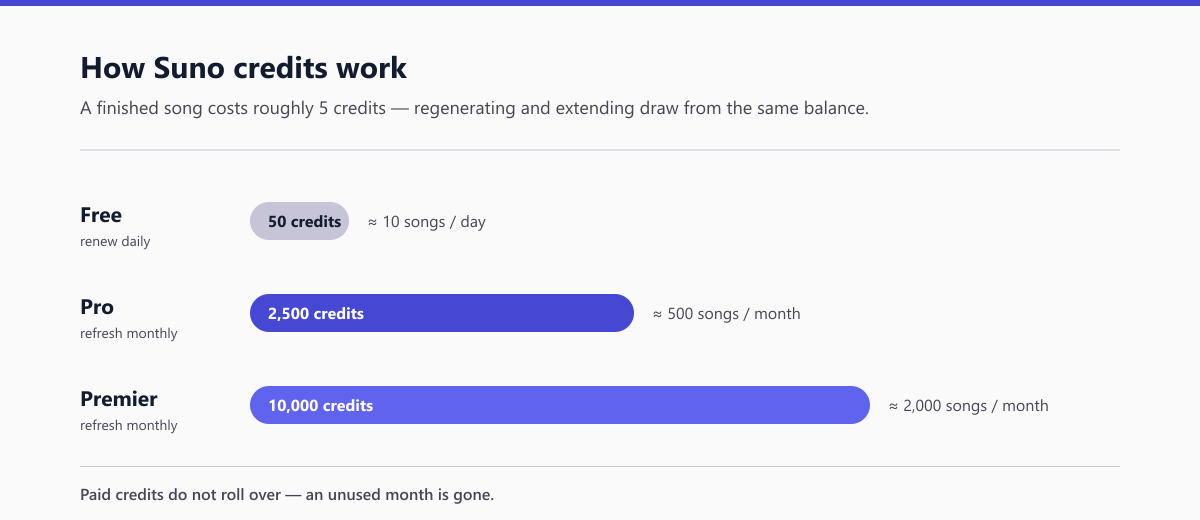
One important difference between the tiers: free credits renew daily, paid credits refresh monthly and do not roll over. An unused month on Pro is simply gone, so the plan suits steady use better than occasional bursts.
Is Suno Pro worth it?
Pay for Pro if you intend to publish anything — monetised video, client work, streaming releases — or if you want stem separation and the v5.5 model. The commercial-rights question alone settles it for most people, and $8/month is less than a single stock music licence.
Stay on free if you are experimenting, making music for yourself, or learning how prompting affects output. Ten songs a day is a lot of practice, and nothing stops you upgrading later when a project actually needs rights.
Consider Premier if you are producing music at volume — a content studio, a game project, or an agency running several client briefs at once.
Frequently asked questions
Is Suno free to use?
Yes. Suno's free plan gives 50 credits that renew daily, roughly ten songs, using the v4.5-all model. It does not expire, but it does not include commercial use rights.
How much does Suno cost per month?
Suno Pro is $8/month and Suno Premier is $24/month. Annual billing reduces both, with advertised savings of $24 on Pro and $72 on Premier.
Can I sell songs made with Suno?
Only on a paid plan. Commercial use rights apply to new songs created while subscribed to Pro or Premier. Anything generated on the free tier is for personal use.
How many songs can I make on Suno for free?
About ten per day. The free plan's 50 credits renew daily, and a finished song costs roughly five credits.
Do Suno credits roll over?
No. Paid credits refresh monthly and unused credits do not carry into the next month. Free credits renew daily on the same basis.
What is the difference between Suno Pro and Premier?
Pro gives 2,500 credits (up to 500 songs) and two stem separation types. Premier gives 10,000 credits (up to 2,000 songs), three stem separation types and access to Suno Studio. Both include commercial rights and the priority queue.
The bottom line
Suno's free plan is unusually generous for an AI music tool — ten songs a day, renewing, with no time limit. It is a genuinely good way to learn the tool. But it is a personal-use licence, and the moment your music leaves your own hard drive for anything commercial, you need Pro.
At $8/month that is an easy decision for anyone publishing content. The harder question is Pro versus Premier, and unless you are burning through 500 songs a month, Pro is the sensible stop.
You can see the full feature breakdown, pros and cons on our Suno tool page, or browse other AI audio and music tools in the directory.
Pricing verified against suno.com/pricing on 19 August 2026. AI tool pricing changes often — check the vendor's page before purchasing.