Compiled from HeyGen's own pricing, help, developer, legal and security pages plus the third-party sources named on the page. Checked on 14 September 2026. How these pages are made
What is HeyGen?
HeyGen is an AI video platform from HeyGen Technology, Inc., a Los Angeles company.
From a script, slides or a text prompt, it renders a video of a talking presenter: a stock avatar, an animated photo or a digital twin of you.
It also translates existing videos with lip-sync. Paid plans run on monthly credits.
Besides the Free plan it sells Creator, Pro, Business and Enterprise plans.
HeyGen at a glance
Category
AI video generator tools: avatar presenters and video translation
What it does
Turns a script, slides or a prompt into a video of a talking presenter, and translates existing videos with lip-sync.
Primary use
Presenter videos without filming, and localizing recorded videos.
Best for
Solo creators making short presenter videos, teams localizing recorded video, and training teams publishing to an LMS.
Pricing
Free plan (watermarked); paid plans from $29 a month ($24 billed yearly). Checked 14 September 2026.
Platforms
Web; iPhone (iOS 17.5 or later); Android; a separate iOS translation app; REST API, CLI and hosted MCP server.
One credit balance for avatar video, dubbing and developer tools; the avatar engine sets what a minute costs.Our summary of the published plans, not a score.
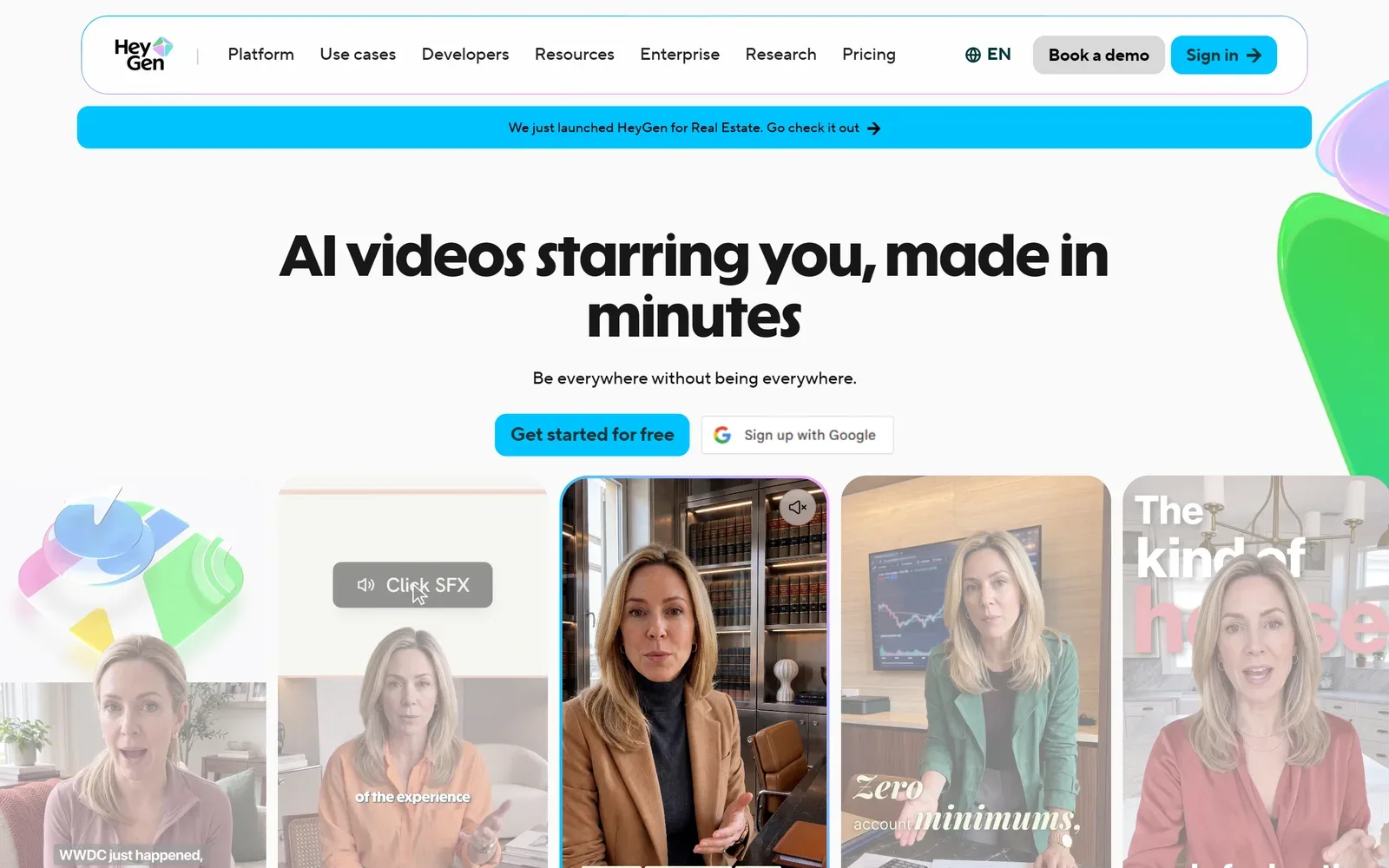
HeyGen's homepage on 14 September 2026. The tiles are HeyGen's own sample videos of one presenter.
Yes, within tight limits. HeyGen's $0 Free plan needs no credit card, but it is built for testing, not publishing.
Videos: up to 3 a month, depending on region, plus 3 Video Agent videos a month in the help center's plan list. Free accounts get no credits.
Length: up to 1 minute per video, one render at a time.
Watermark: a HeyGen logo that Free users can't remove.
Use: HeyGen's terms limit Free output to personal, non-commercial and internal evaluation: no selling, monetizing, advertising or client work.
Included: what HeyGen calls "limited trial access" to Avatar IV, Video Agent and lip-sync translation, plus 500+ stock video avatars, 1 custom video avatar, 1 voice clone, up to 3 photo avatars and 30+ languages.
How much does HeyGen cost?
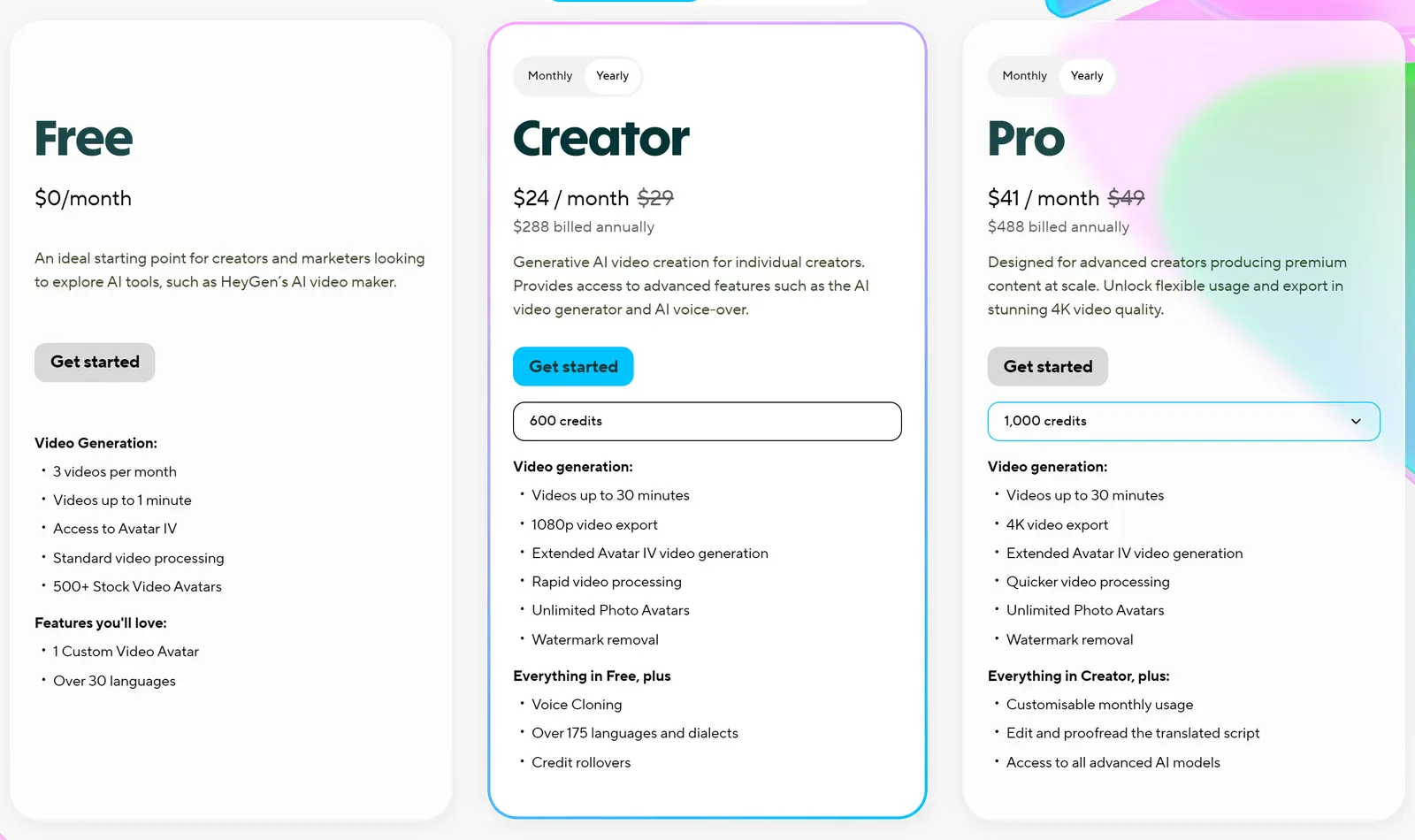
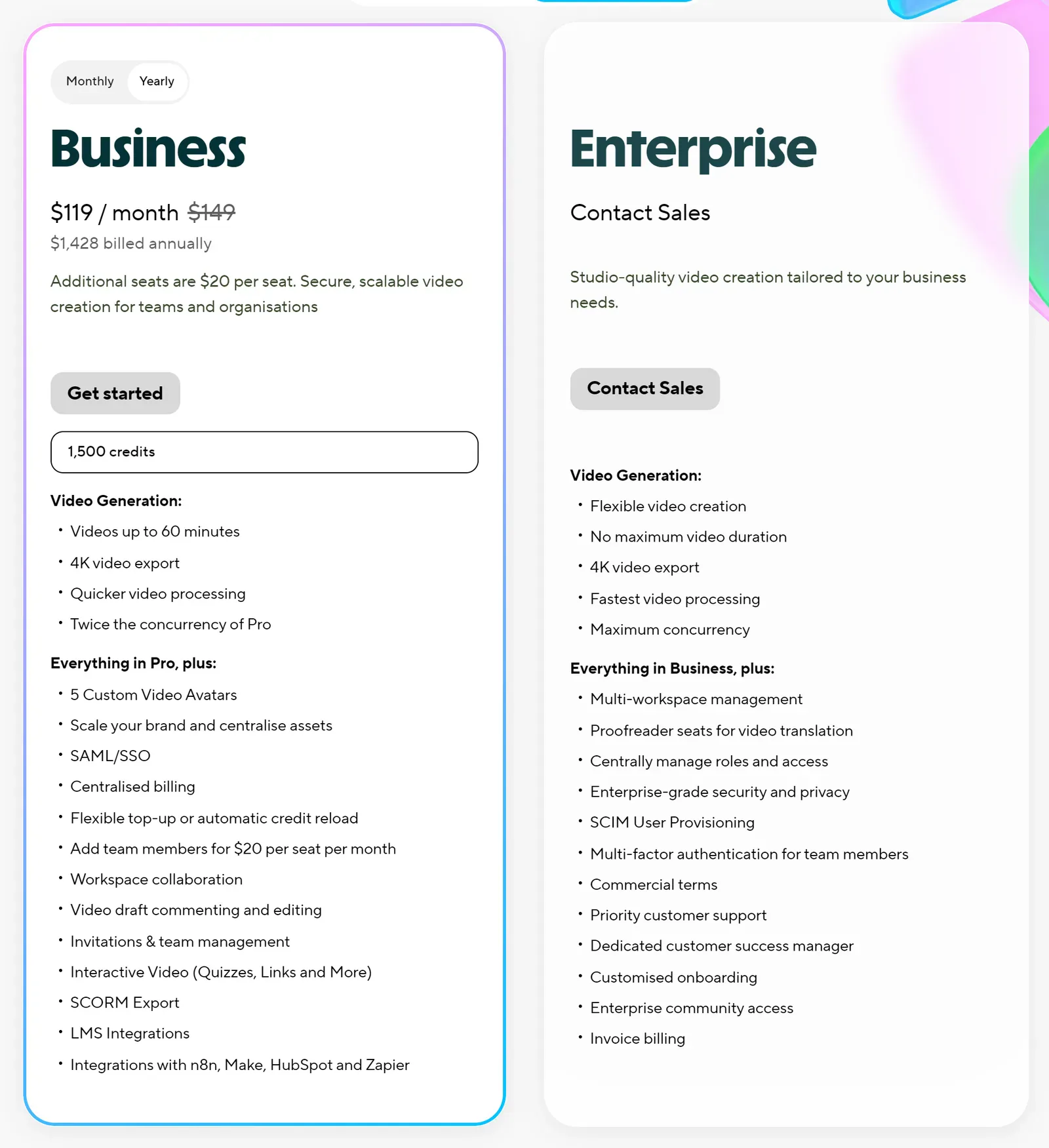
On 14 September 2026, Creator cost $29 a month ($24 billed yearly), Pro started at $49 ($41 billed yearly) and Business cost $149 ($119 billed yearly) plus $20 a month per extra seat.
Free is $0, and Enterprise is priced through sales. A finished minute costs from about $0.19 to $2.32 on Creator, depending on the avatar engine (our arithmetic, explained below).
HeyGen pricing by plan, in USD, checked 14 September 2026
Plan and price (monthly / yearly)
Credits a month
Limits and extras
Free: $0
None
1-minute videos, watermarked; non-commercial evaluation only
Creator: $29 / $24 ($288 a year)
600
30-minute videos, 1080p; watermark removal, unlimited photo avatars and voice cloning; no Seedance engine on plans bought after 17 August 2026
Pro: from $49 / $41 ($488 a year)
1,000, in ten tiers up to 100,000 for $4,300 a month
30-minute videos; 4K listed (see limitations); faster processing (HeyGen's claim), translated-script proofreading, all advanced models including Seedance 2.0
Business: $149 / $119 ($1,428 a year), plus $20 a month per extra seat
1,500, shared by all seats
60-minute videos (Avatar IV 30); 4K listed; 5 custom video avatars, SAML/SSO, SCORM export, LMS integrations, interactive video, top-ups or auto-reload; HubSpot, Zapier, Make and other integrations (plan access unclear elsewhere)
Enterprise: contact sales
Not published
No maximum video length; 4K; SCIM, audit log, enforced team 2FA, proofreader seats, a dedicated customer success manager, invoice billing
Cost per credit (our arithmetic, price ÷ credits, monthly / yearly): Creator $0.048 / $0.040; Pro $0.049 / $0.041, falling to $0.043 / $0.036 on the 100,000-credit tier; Business $0.099 / $0.079 for included credits, or $0.05 bought as top-ups.
HeyGen's individual plans on yearly billing, 14 September 2026. Struck-through figures are the monthly prices.
Yearly billing saves about 17% on Creator and Pro and about 20% on Business (our arithmetic against 12 monthly payments).
Refunds: HeyGen's terms call payments non-refundable except where the law requires, but its help center says web and Google Play purchases may be refunded within 15 days (14 for Apple), case by case.
HeyGen's Business and Enterprise plans on yearly billing, 14 September 2026.
How do HeyGen credits work?
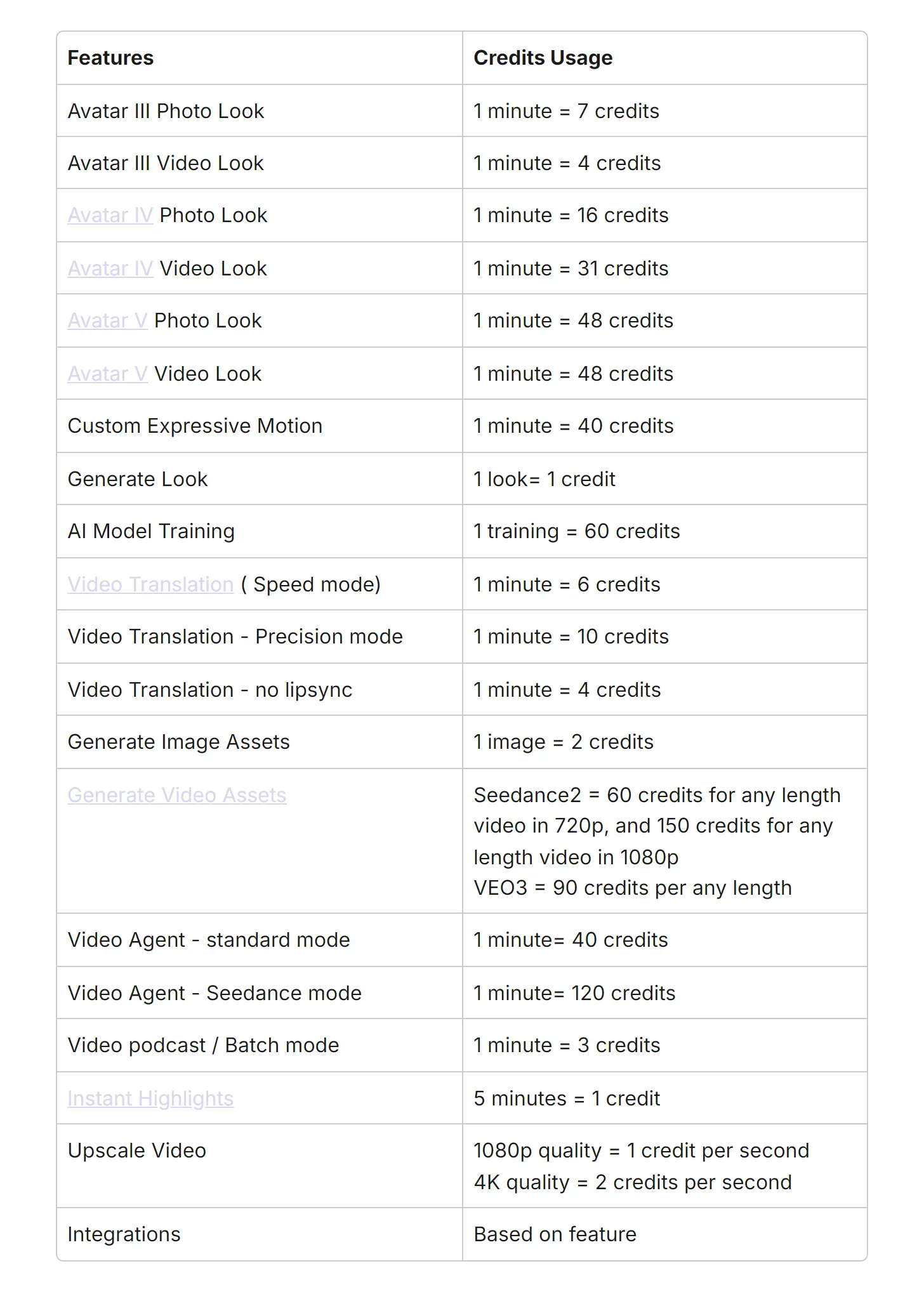
A credit is HeyGen's unit of rendering: on 14 September 2026 a minute of avatar video used 4 to 48 credits, depending on the look and engine.
The pricing page no longer lists per-model rates, saying only that usage "can vary based on which AI model is used, video duration, and the complexity of the generation"; the credit table in HeyGen's help center has them.
Two choices set the rate.
The look: a photo look animates a still image, while a video look is built from at least 2 minutes of footage of a consenting person, as your digital twin is.
The engine: in HeyGen's model comparison, Avatar IV is the default, Avatar V is the opt-in engine HeyGen calls its highest fidelity, and Avatar III is the older engine with a dedicated photo-to-video pipeline. Avatar V uses 48 credits a minute, 12 times Avatar III's video-look rate (our arithmetic).
What a credit buys, and how the rates changed
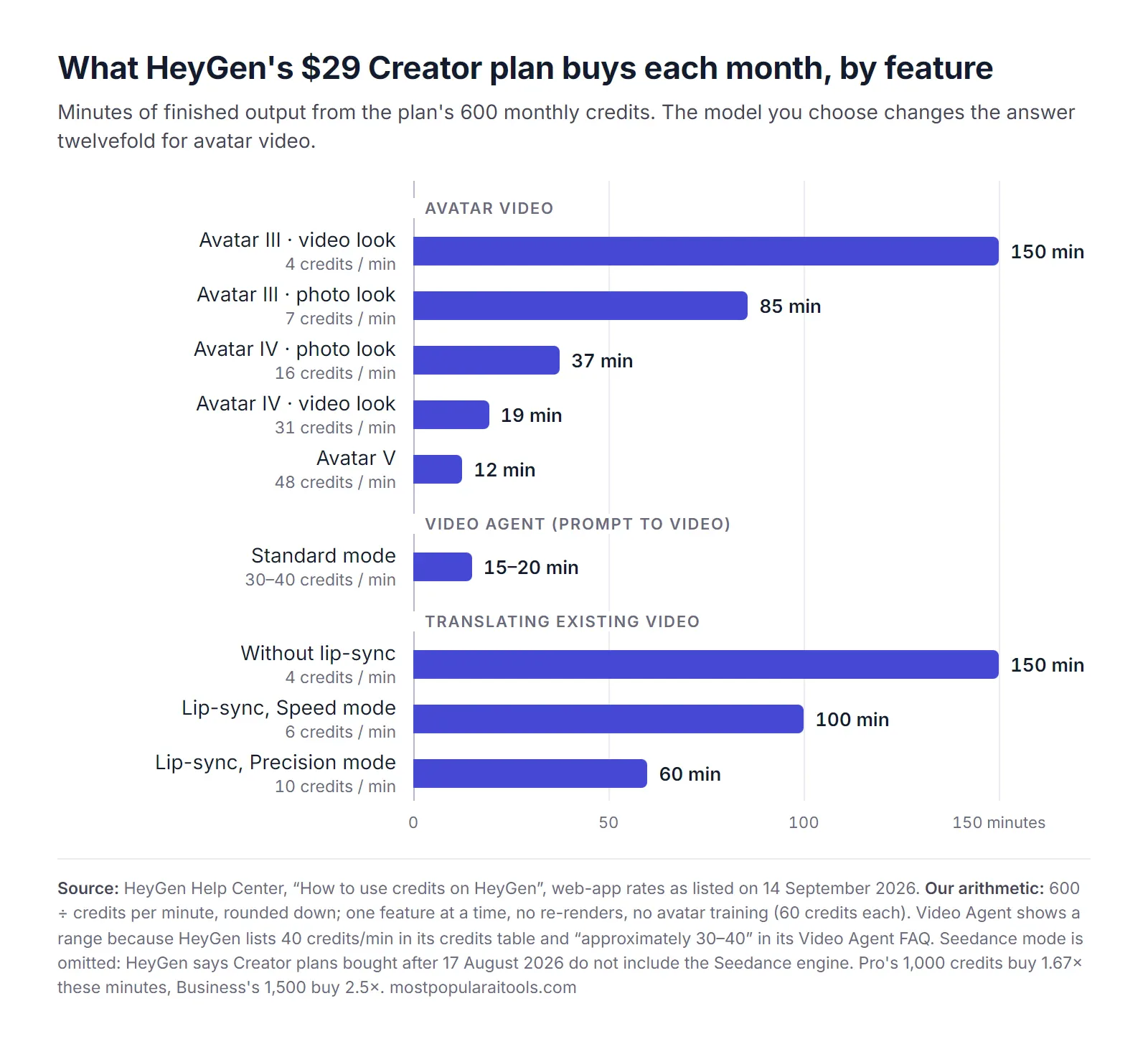
Our arithmetic: 600 credits divided by HeyGen's credits per minute on 14 September 2026, rounded down, one feature at a time, no re-renders. Pro's 1,000 credits buy 1.67 times these minutes; Business's 1,500 buy 2.5 times.
A realistic month on Creator (our arithmetic): four 3-minute videos of your digital twin use 48 credits on Avatar III video look (8% of 600), 372 on Avatar IV video look (62%, leaving about 7 minutes for re-renders) or 576 on Avatar V (96%, too few for even one 3-minute re-render).
HeyGen says a script change re-renders the affected avatar scene and that it bills only the seconds of avatar generated, but it gives no worked example for a script fix.
HeyGen credit rates before and after the late August / early September 2026 change, and the minutes Creator's 600 credits buy (our arithmetic, rounded down)
Feature
Credits a minute, before
Now (14 Sep 2026)
Creator minutes
Avatar III
3
4 (video look) / 7 (photo look)
200 → 150 / 85
Avatar IV
20
16 (photo look) / 31 (video look)
30 → 37 / 19
Avatar V
20
48
30 → 12
Translation, no lip-sync
2
4
300 → 150
Translation, Speed lip-sync
5
6
120 → 100
Translation, Precision lip-sync
10
10
60 → 60
Earlier rates come from HeyGen's pricing FAQ archived on 26 August 2026 and help articles archived on 7 and 16 August; no HeyGen page we found dates the change, and some third-party guides still quote the old figures.
Video Agent is left out because those pages gave it 20, 30 or 40 credits a minute.
Outside the chart, Custom Expressive Motion adds 40 credits a minute on Avatar IV, and Video Agent's Seedance mode costs 120 a minute; Seedance is the video engine behind that mode, Avatar Shots, cinematic mode and B-roll generation.
HeyGen's help-center credit table, captured 14 September 2026 (vendor-stated rates). On a small screen, the rate table above lists the same avatar and translation rates, and the chart shows the minutes they buy on Creator.
What a finished minute costs on each plan
Cost per finished minute in USD, monthly / yearly billing (our arithmetic: plan price ÷ plan credits × credits a minute, one render)
Engine (credits a minute)
Creator
Pro 1,000
Business, one seat
Avatar III, video look (4)
$0.19 / $0.16
$0.20 / $0.16
$0.40 / $0.32
Avatar IV, photo look (16)
$0.77 / $0.64
$0.78 / $0.65
$1.59 / $1.27
Avatar IV, video look (31)
$1.50 / $1.24
$1.52 / $1.26
$3.08 / $2.46
Avatar V (48)
$2.32 / $1.92
$2.35 / $1.95
$4.77 / $3.81
Video Agent, standard (40)
$1.93 / $1.60
$1.96 / $1.63
$3.97 / $3.17
Translation, Speed lip-sync (6)
$0.29 / $0.24
$0.29 / $0.24
$0.60 / $0.48
Pro's 100,000-credit tier is only about 12% cheaper per credit than its 1,000-credit tier, so the engine matters far more than the tier.
Bought as top-ups, Business credits bring Avatar IV video look down to $1.55 a minute.
When credits roll over, expire or get spent again
Monthly plans: unused credits roll over one extra cycle (up to about 60 days) while you stay subscribed.
Yearly plans: monthly allocations accumulate until renewal.
Canceling: paid access runs to the end of the cycle, then unused credits expire. There's no automatic prorated refund, extra avatars are locked rather than deleted, and HeyGen says your content is kept.
Pausing: the whole credit balance expires.
App-store subscriptions (Apple or Google): credits expire after 30 days, with no rollover.
Re-renders: changes that re-render the avatar (script, voice, avatar or animation) spend credits again; image, layout, caption or timing edits don't. Previews are audio only, with a credit estimate "when available".
No charge: videos that fail or are canceled mid-way, HeyGen says.
How does HeyGen work?
You pick a presenter (a stock avatar, a photo avatar or your digital twin) or let Video Agent plan the video, add a script, slides, a prompt or recorded audio, choose a voice and language, and generate.
Avatars: stock, photo and your own digital twin
Stock: 500+ video avatars on Free and 700+ on paid plans, per the pricing page.
Photo avatars: 3 on Free, unlimited on paid plans. HeyGen says Avatar IV can animate any image, including cartoon and non-human faces.
Digital twins: at least 2 minutes of continuous footage (up to 5 recommended) plus a consent video under 30 seconds from the same person. Avatar V twins can come from a 15-second recording in the web app.
Video Agent turns a prompt into a video, handling the script, avatar selection, scenes and rendering, according to HeyGen; Chat Mode lets you refine its plan before anything renders.
Translation. Upload a video of up to 5 GB, or a YouTube or Google Drive link, with speech in one language, and pick up to 10 target languages per job, as audio-only dubbing or Speed or Precision lip-sync.
Only speech is translated, not on-screen text, and lip-sync may slip when the speaker's head turns away from the camera (beyond 30 degrees in one HeyGen guide, 45 in another).
Voices and slides. 300+ stock voices (per HeyGen's avatars page and voice docs), voice cloning, and voices imported from providers such as ElevenLabs.
PPT, PPTX or PDF files up to 50 MB (first 50 slides) become videos, with PowerPoint speaker notes as the script.
HeyGen also lists Canva, Adobe Express, HubSpot, Zapier and Make apps, among others.
For developers: API, CLI and MCP server
HeyGen's REST API v3 launched in April 2026 (POST /v3/videos for avatar videos, POST /v3/video-agents for Video Agent); v1 and v2 retire on 31 October 2026.
HeyGen also offers an official CLI for macOS and Linux (Windows "coming soon") and a hosted MCP (Model Context Protocol) server that lets AI assistants make videos.
Billing by route: API-key calls, including the CLI whenever an API key is set, draw on a separate pay-as-you-go balance in US dollars; the MCP server and OAuth logins use plan credits.
Per-minute API prices: HeyGen's API pricing help article, last updated in June 2026 and possibly older than September's web-rate change, lists Avatar IV at $4 a minute of 1080p output, Video Agent at $2 and Speed lip-sync at $2. Against Creator's plan credits on monthly billing, that is about 2.7 times the cost of Avatar IV video look ($1.50), about 7 times Speed lip-sync ($0.29) and about the same as Video Agent ($1.93) (our arithmetic).
Enterprise-only: HeyGen's API help says creating custom digital twins and proofreading through the API need an Enterprise API account.
Limits: 10 concurrent jobs on pay-as-you-go and 20 on Enterprise; no requests-per-minute figures are published.
LiveAvatar is a separate product
HeyGen's real-time conversational avatars, formerly Interactive Avatar, now run on LiveAvatar, a separate platform with its own plans and credits (paid plans from $19 a month on 14 September 2026); HeyGen plans, avatar slots and avatars don't carry over.
HeyGen use cases
Workflows as HeyGen's help center documents them, with our credit arithmetic.
Turn a slide deck into an LMS training module (Business or Enterprise, for SCORM 1.2 or 2004 export and interactive quizzes): two 30-minute modules use 1,860 credits on Avatar IV video look, 360 more than Business's 1,500 ($20 in 100-credit top-ups), or 240 on Avatar III (our arithmetic). Speaker notes become the script only for PPT and PPTX files.
Localize a recorded webinar or product demo (Creator or above; Speed lip-sync, 6 credits a minute): a 30-minute video into one language uses 180 credits, 30% of Creator's 600 (our arithmetic). Translated videos run up to 30 minutes on Creator and Pro, 60 on Business and 5 hours on Enterprise; HeyGen doesn't say how multi-language jobs are counted.
Record once, then publish as your digital twin (Creator or above; Avatar IV video look at 31 credits a minute or Avatar V at 48): one 3-minute video uses 93 credits on Avatar IV, 144 on Avatar V (our arithmetic). Extra custom avatar slots cost $29 a month.
Prompt a short explainer with Video Agent (Creator or above; standard mode, 40 credits a minute): a 2-minute explainer uses 80 credits (our arithmetic). Planning and chat in Chat Mode use no credits.
Animate a photo, mascot or illustrated character (Creator or above for commercial use; Avatar IV photo look, 16 credits a minute): a 1-minute clip uses 16 credits. Photo-to-video scripts are capped at 5,000 characters.
HeyGen pros and cons
Pros
The Free plan needs no credit card and includes limited trial access to Avatar IV, 1 custom video avatar and 1 voice clone.
Self-serve Business ($149 a month) puts SCORM export, LMS integrations, interactive video and SAML/SSO on one plan; Synthesia and DeepBrain AI Studios list SCORM and SSO only on Enterprise.
One plan credit balance covers avatar video, Video Agent and lip-sync translation, and monthly plans roll unused credits over for one extra cycle.
One translation job can target up to 10 languages, as audio-only dubbing or Speed or Precision lip-sync.
Developers get REST API v3, an official CLI and a hosted MCP server that bills plan credits rather than a separate API balance.
Cons
Credit rates changed in late August / early September 2026: Avatar V went from 20 to 48 credits a minute, so Creator's 600 credits now buy about 12 minutes of it instead of 30.
Credits expire when you pause or cancel, and Creator and Pro can't buy top-ups on the web.
There is no visual preview before rendering, and every avatar re-render spends credits again.
Free videos carry a HeyGen watermark and may be used only for personal, non-commercial evaluation.
HeyGen names no ISO certification and stores all customer data in the US; its terms grant it an irrevocable license to your content that includes AI training, though its privacy policy lets you ask by email to opt out (Enterprise data is excluded by default).
HeyGen's own pages contradict each other on a dozen plan details, from the free video quota to Avatar V's maximum length and whether Business includes SSO.
Is HeyGen safe to use?
HeyGen Technology, Inc. is a US corporation.
It publishes terms of service, a privacy policy and a security page, requires consent videos for video-based digital twins (with one Enterprise exception, below) and says it is SOC 2 Type II certified.
Can you use HeyGen videos commercially?
Yes, on paid plans.
On Creator, Pro and Business, HeyGen's terms say you own your inputs and outputs and commercial use isn't restricted, unless HeyGen terminates your account for a violation; then you must stop using the outputs and delete them.
HeyGen can also remove or block content at its discretion, without notice, and its terms and moderation policy require you to:
disclose AI-generated content where the law requires it, and never present output as entirely human-made;
stay away from political campaigning, lobbying and election content;
get consent before uploading images of people, never impersonate anyone, and get explicit consent for any avatar of a real person, public figures included.
Your data, likeness and consent
The terms for paid plans grant HeyGen a royalty-free, transferable, sublicensable, worldwide, irrevocable license to your content, including for AI training.
The privacy policy lets users opt out of that training by emailing privacy@heygen.com and describes no self-serve setting.
HeyGen's security page says Enterprise data is excluded from training by default, AI subprocessors are contractually barred from training on customer data, and all customer data is stored in the United States on AWS.
Deleted data stays in disaster-recovery backups for 60 days.
For digital twins, HeyGen's biometric privacy notice says it matches face geometry between the consent recording and the avatar footage; consenting to training on that biometric data is optional, but withdrawing consent doesn't remove data already built into trained models.
HeyGen's API docs let Enterprise accounts that sign an indemnity agreement skip consent collection. Anyone depicted can ask for removal at moderation@heygen.com.
Security claims and legal terms
HeyGen's security page names SOC 2 Type II, GDPR, CCPA, the EU-US Data Privacy Framework and the EU AI Act, but no ISO certification and no HIPAA compliance.
HeyGen says SOC 2 reports are available to customers on request; its trust center lists SOC 2 and SOC 3 reports and a penetration test report without naming the auditor.
Its terms require binding arbitration, with an opt-out within 30 days of first accessing HeyGen, and waive class actions.
What are HeyGen's limitations?
4K on the newest engines: listed from Pro upward, but HeyGen's developer changelog lists 4K for Avatar IV and V as temporarily unavailable on the API since June 2026, and its model table marks 4K unavailable for both. No HeyGen page says whether the web app has the same gap.
Concurrent renders: Free 1, Creator and Pro 3, Business 6, Enterprise 20. HeyGen says the regular queue is "just under 24h on average during weekdays".
Moderation: automated checks can mark a video Pending, which support can't expedite, or Rejected, which can go to manual review.
Seats: one user license on Free, Creator and Pro; extra Business seats add users but no credits.
Where HeyGen's pages disagree, and what we could not verify
HeyGen's pages conflict on these points, and this page doesn't pick a side:
Free videos a month: 3 (pricing page) vs 1–3 by region (help center).
Free export resolution: 720p (help center) vs 1080p (heygen.com/faq).
Free translation: 1-minute videos (pricing table) vs 3 videos of up to 3 minutes (translate page).
SAML/SSO: on the self-serve Business card and plan table vs "for enterprise customers" (security page); an Okta help article also puts SCIM on a "Business Plus" plan that isn't sold. Confirm SSO in writing before buying Business for it.
Custom twins on Creator and Pro: 1 (plan guide; "1+" in the pricing table) vs 5 (mobile article, Digital Twin FAQ and limits table).
Avatar V: up to 3 minutes a video (help article) vs 30-minute single-pass videos (July 2026 release post) and "no cap" (Avatar V page); and whether it works with photo looks (the credit table prices one; the Avatar V article says it doesn't).
Video Agent standard rate: 40 credits a minute (rate table) vs about 30–40 (Video Agent FAQ).
Translated-script proofreading: Pro and above (pricing table) vs all paid plans (help article).
Mid-cycle upgrades: "prorated" (pricing FAQ) vs a worked example charging the full difference (plan guide).
Custom digital twins through the API: Enterprise only (API pricing help) vs a webcam consent flow "available to all customers" (August 2026 consent docs).
Integrations: a Business feature (pricing page) vs billed in plan credits with no plan named (help center).
Counts: 175+ translation languages vs 177+, 170+ or 100+; 700+ stock avatars on paid plans vs 1,100+; 300+ stock voices vs 1,000+ AI voices (pricing table).
Not verifiable from public pages on 14 September 2026: the yearly price of an extra Business seat; whether failed renders are reliably left uncharged in practice; any paid-plan trial (none found, but absence can't be proven); and what a Free account, which has no credits, can make through the MCP server.
What users report about HeyGen
HeyGen's ratings on review platforms (user opinion, not verified fact)
HeyGen's claimed Trustpilot profile asks customers to review (65% of reviews are five-star, 17% one-star), and G2, whose live page was unreadable, labels some reviews "Seller invite".
Capterra's customer service sub-rating is 4.6. G2's most-tagged positives are ease of use and quality; its most-tagged negatives concern cost.
Recurring themes, with the number of separate reviews or forum posts found:
Rate or plan changes mid-subscription: 14 sources between 19 August and 7 September 2026. HeyGen's archived and current rate tables confirm the rates changed; individual legacy-plan users also report new charges.
Credits spent on re-renders and failed generations: 12 sources, mostly April to September 2026. HeyGen confirms re-renders cost credits and says failed renders aren't charged.
Billing and cancellation: 9 sources report cancellation friction, charges after canceling or refused refunds; others report easy cancellations and refunds.
Credits or content lost after canceling or downgrading: 4 sources. HeyGen confirms credits expire and says content is kept.
Video Agent ignoring instructions: 9 sources from August and September 2026, 8 of them Trustpilot reviews, many invited.
Output quality: 6 sources describe inconsistent lip-sync (others praise it), 8 complain about non-English voice quality, and 8 couldn't get realistic custom avatars, though realism also draws praise.
Cybernews's hands-on review (updated 4 November 2025, with an affiliate disclosure) found Spanish dubbing natural, Arabic more synthetic, and processing that slowed from about two minutes to about four hours.
What to use instead, by job
For a solo creator who needs a talking presenter, DeepBrain AI's AI Studios Personal plan costs the same as Creator, and the plans that cost less, at least billed yearly, carry trade-offs: Synthesia's Starter ($14–$18 a month billed yearly) includes 120 minutes of video a year, D-ID's Pro plan ($29, or $16 billed yearly) keeps an "AI" watermark, and for Vidnoz Starter ($26.99 a month, no watermark) what its credits buy couldn't be verified.
Entry prices and free options in USD, checked 14 September 2026 (HeyGen Creator: $29 / $24)
Tool
Entry paid plan: monthly / yearly
Free option as published
Synthesia
Starter: $19–$29 / $14–$18, by region and offer
Basic: 10 minutes of video a month, 9 stock avatars, no downloads
Colossyan
Professional: monthly price not confirmed / $59
Starter: 20 minutes a month, watermark, no SCORM exports
D-ID
Lite: $5.90 / $4.70 (watermark, personal use); Pro, first commercial plan: $29 / $16
14-day trial: 3 minutes, watermark, personal use
DeepBrain AI (AI Studios)
Personal: $29 / $24
Up to 3 videos of up to 1 minute, 720p
Vozo AI
Creator: $29 / $22
20 one-time points, about 2 lip-sync minutes (Vozo's estimate)
Fliki
Standard (US prices): $28 / $21
3 credits a month, 720p, watermark
Synthesia, for training teams facing security or procurement checks
A business avatar video platform for training and internal communications, with AI dubbing.
Key difference:Synthesia's trust center lists SOC 2 Type II plus ISO/IEC 27001, 27701 and 42001; HeyGen names SOC 2 Type II and no ISO standard. Both are vendor statements.
Major limitation: SCORM, SAML/SSO and team collaboration are Enterprise-only, and self-serve plans have one editor plus guests. Synthesia's Starter plan includes 10 minutes of video a month with no rollover.
Choose it instead when: procurement requires ISO certifications. For SCORM plus SSO, compare HeyGen Business ($149 a month) with Synthesia Enterprise, priced through sales.
Colossyan, for SCORM courses on a smaller budget
An AI avatar video maker with a built-in course builder, including quizzes.
Key difference: SCORM export starts on Colossyan's Professional plan at $59 a month billed yearly, with 5 exports a month, against $119 for HeyGen Business. Extra members cost $30 a month each, up to 3 editors, so three editors cost $119 a month billed yearly, the same as one HeyGen Business seat (our arithmetic). Colossyan offers EU or US data residency on Enterprise.
Major limitation: Professional caps API use at 360 minutes a year, and unused minutes don't roll over.
Cheaper still:Vidnoz's Starter plan ($26.99 billed monthly, $19.99 yearly) lists SCORM export and no watermark, and its self-serve Business plan ($74.99 monthly, $56.99 yearly) lists SAML/SSO.
D-ID, for developers embedding avatars through an API
An avatar video studio with an API, AI agents and video translation.
Key difference: API access comes with every plan on D-ID's Studio pricing page, from the 14-day trial up; D-ID's per-minute API prices weren't verified. Pro, the first plan with a commercial license, includes 15 minutes of video a month.
Major limitation: the trial and Lite carry a D-ID watermark and a personal-use license, and Pro adds an "AI" watermark. Videos cap at 30 minutes even on Enterprise, self-serve translations at 5 minutes, and team collaboration and SAML/SSO are Enterprise-only.
DeepBrain AI Studios, for one- or two-person teams that want 4K
DeepBrain AI's workspace for avatar video, AI dubbing, text-to-speech and generative video.
Key difference:AI Studios' Team plan costs $69 a seat a month ($55 billed yearly), with 60-minute videos, 5 custom avatars, 4K and 240 dubbing minutes a month. On monthly billing, that undercuts HeyGen Business only for one seat ($69 vs $149) or two ($138 vs $169); three seats cost $207 vs $189 (our arithmetic, assuming HeyGen's $149 includes one seat and each extra seat costs $20).
Major limitation: SCORM export, interactive quizzes and SAML SSO are "Exclusive to Enterprise"; the dubbing table lists 73 languages against 150+ in its marketing; unused credits don't roll over.
Vozo AI, for translating videos that contain on-screen text
A video translation tool with dubbing, lip-sync and translation of on-screen text.
Key difference: its Visual Translate feature translates text shown on screen; HeyGen translates speech only.
Major limitation: no stock avatar presenter; API access is Enterprise-only; and on Vozo's pricing page, Creator's 150 monthly points equal about 15 lip-sync minutes by Vozo's estimate.
If lip-sync doesn't matter: ElevenLabs' Dubbing Studio re-voices audio in 90+ languages, with a commercial license from its $6-a-month Starter plan, but ElevenLabs' dubbing does not lip-sync.
Fliki, for narrated videos without a presenter
A text-, script- and blog-to-video tool that pairs AI voices with stock visuals.
Key difference: it is built around voiceover on visuals, and on Fliki's pricing page all avatars and API access start on Premium, at $88 a month ($66 billed yearly, US prices).
Major limitation: plans and prices differ by region.
Is HeyGen worth it? Our read of its published plans and terms
Yes, if your videos fit the credit arithmetic and you choose the engine deliberately; less so if you mostly render with its newest engines or need predictable costs.
Individual plans can't buy web top-ups, so heavy Avatar V or Video Agent users must move up Pro tiers (the cheapest route per credit) or switch to Business.
Our reasoning from the pricing page, credit table, documentation and terms listed in Sources, and the user ratings above. It does not judge output quality.
Choose HeyGen if
The minutes in the Creator chart above cover your month on the engine you'll use.
You localize recorded talking-head videos into several languages with lip-sync.
You run training and want the Business bundle described in the pros on a self-serve plan. It is one of the stronger cases in HeyGen's plans, but confirm SSO in writing first: HeyGen's security page describes SSO as for enterprise customers.
You want AI assistants to make videos through the MCP server on plan credits you already pay for.
Look elsewhere if
You need a cost per minute that stays put: the per-model rates changed recently (see the cons) and now appear only in the help center. Synthesia and Colossyan state their allowances in minutes of video, which is easier to budget (our reading).
You mainly want Avatar V on Creator, where 600 credits buy about 12 minutes a month. Pro's 1,000 credits buy about 20 minutes for $49 (our arithmetic), or Avatar IV video look stretches Creator to 19.
You want Free-plan videos for clients, ads or monetized channels; Creator is the entry plan that allows it.
On-screen text in your videos must be translated: Vozo AI does that.
Procurement requires ISO 27001 or 42001 certification, or EU data residency: Synthesia lists the certifications (vendor-stated), and Colossyan offers EU residency on Enterprise.
You pause or cancel between projects, or subscribe through Apple or Google: credits expire on pause or cancel, and app-store credits after 30 days. A monthly web plan keeps unused credits one extra cycle.
Your product needs users to create digital twins through the API, or needs API 4K from Avatar IV or V: twin creation through the API is Enterprise-only, and that 4K is paused. Ask HeyGen's Enterprise sales, or compare D-ID, which includes API access on every plan.
Several people will share one Business plan. Its 1,500 credits are about 48 minutes of Avatar IV video look a month for all seats together, and five seats on monthly billing cost $229 for that same pool (our arithmetic). Budget top-ups at $5 per 100 credits, render long modules on Avatar III, or compare Colossyan's per-member pricing.
Its biggest strength and biggest weakness
Strength: breadth on self-serve plans. One credit balance covers presenters, prompt-to-video, dubbing and developer access, and Business bundles training features that some rivals keep for Enterprise (see the pros).
Weakness: cost predictability. A minute's cost depends on the engine, the rates moved without appearing on the pricing page, and re-renders and lapsed credits add to the bill; the user reports above point the same way.
HeyGen FAQ
Does HeyGen have a free trial?
No. HeyGen doesn't advertise a timed trial of its paid plans; its Free plan, which needs no credit card, is how HeyGen suggests you test it.
The cheapest paid test is the mobile-only weekly Creator plan: $10 for 150 credits, about 4 minutes of Avatar IV video look or 3 of Avatar V by our arithmetic.
Does the HeyGen free plan add a watermark?
Yes. Free-plan videos carry a HeyGen logo watermark that free users can't remove.
HeyGen's help center says every video carries the logo by default and paid users can switch it off when they submit a video, and the pricing table shows watermark removal from the Creator plan upward.
How much does a HeyGen credit cost, and can I buy more?
By our arithmetic, a credit costs about 3.6 to 4.9 cents on Creator and Pro and 7.9 to 9.9 cents as part of Business.
On the web only Business can buy extra credits, at 5 cents each; HeyGen tells Creator and Pro users to move to a larger plan or tier.
In the mobile app, once Creator credits run out, packs of 60, 150 or 250 credits cost $5, $10 or $15, valid for 12 months.
Is HeyGen really unlimited?
Not for anyone subscribing today. HeyGen moved to credit plans in May 2026 and stopped selling Legacy Unlimited plans after 15 May.
Existing legacy subscribers keep their plan while it stays active, but canceling or switching is permanent.
On those plans Avatar III videos and audio-only dubbing stay unlimited, while Avatar IV, Avatar V and lip-sync translation use credits at the credit plans' per-minute rates.
No plan, Enterprise included, has unlimited Avatar IV.
Does HeyGen have an API, and is it free?
Yes, but it isn't free.
HeyGen's FAQ page says API pay-as-you-go starts at $5 with no monthly commitment, and its help center says there have been no free API credits since February 2026 and that pay-as-you-go credits expire after 12 months.
API credits are bought in US dollars, separately from plan credits, and Free users can buy them too.
Is HeyGen a Chinese company?
No. HeyGen is a US company today, though it started in China. Its contracting entity is HeyGen Technology, Inc., a US corporation headquartered in Los Angeles.
Joshua Xu and Wayne Liang founded it in Shenzhen in 2020 as Surreal; it became Movio after moving to Los Angeles in 2022 and HeyGen in April 2023.
The South China Morning Post reported that the Shenzhen entity was dissolved at the end of 2023.
Sources and references
HeyGen's own pages, read on 14 September 2026. Competitor and rating pages are linked where the page cites them.
Amit Kumar runs Most Popular AI Tools, where he tests and writes about AI software for video, audio, writing, design and productivity. When he covers a tool, he checks its pricing, credits and plan limits against the vendor's own pages, so readers know what a plan includes before they pay. He also leads the site's SEO and AI-focused content strategy.
Free alternatives to HeyGen
Chosen by an editor, each with the reason, the source for its free status and the date it was verified.
No free alternative to HeyGen is listed yet.
Discussion
No comments yet. Say what HeyGen is good at, or where it falls down.
Be the first to comment.
We value your privacy
We use essential cookies to run this site. With your consent we also use analytics and marketing cookies to understand traffic and improve your experience. You can accept, reject, or choose what to allow. See our Privacy Policy.


 Compiled by Amit Kumar