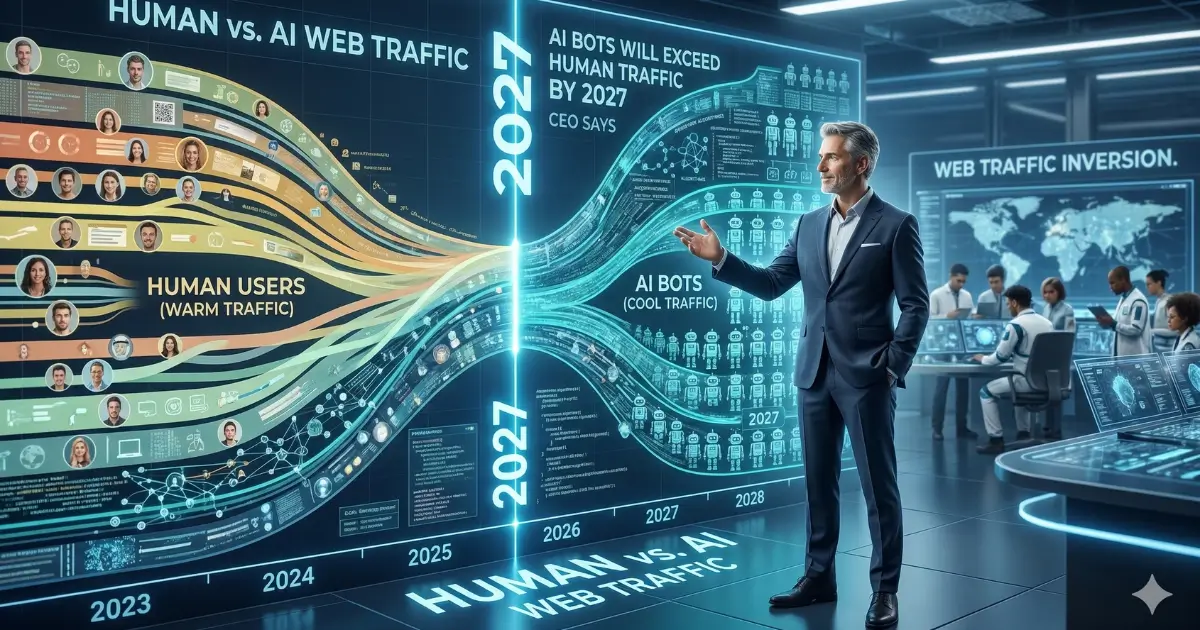
The internet as we know it is about to cross a remarkable threshold. According to Cloudflare CEO Matthew Prince, artificial intelligence bot traffic will surpass the volume of human traffic online by 2027. Speaking at the SXSW conference in Austin, Texas, Prince painted a picture of a web increasingly shaped not by people clicking through pages, but by automated agents scouring thousands of sites in seconds. The implications for infrastructure, business models, and the very nature of the digital world are enormous.
A Thousand Times the Traffic
Prince offered a vivid illustration of the scale involved. When a human shops for a digital camera, they might browse five websites, compare prices, read a couple of reviews, and make a decision. An AI agent performing the same task, however, could visit five thousand websites in the time it takes a person to open a single browser tab. That is roughly a thousand times the traffic generated by a single human query. Multiply that behavior across millions of users relying on AI assistants for everyday tasks—from product research to travel planning to medical questions—and the math becomes staggering. Every one of those automated visits generates real server load, real bandwidth consumption, and real costs for the websites being crawled.
From 20 Percent to a Majority
Before the rise of generative AI, bots accounted for roughly twenty percent of all web traffic. Google's search crawler was the biggest, followed by a handful of other reputable indexing services. Beyond that, most bot activity came from scammers and malicious actors. The generative AI revolution has completely rewritten that equation. Large language models and AI agents have an insatiable appetite for data, driving a surge in automated crawling that shows no signs of slowing. Prince believes this trajectory will push bot traffic past the fifty-percent mark within the next year.
The Infrastructure Challenge
This explosion in automated traffic carries serious infrastructure consequences. Prince drew a comparison to the early days of the Covid-19 pandemic, when the sudden migration to remote work and video streaming nearly buckled parts of the internet. Services like YouTube, Disney Plus, and Netflix saw demand spike so quickly that network operators scrambled to keep up. The difference, he noted, is that the Covid spike was abrupt but eventually plateaued at a new baseline. AI-driven traffic growth is more gradual, yet relentless—it keeps climbing with no plateau in sight. Data centers, content delivery networks, and server farms will all need to scale accordingly, requiring significant and sustained investment across the industry.
Sandboxes for a New Era
To cope with this shift, Prince envisions new technologies built specifically for AI agents. He described disposable "sandboxes"—lightweight computing environments that can be spun up instantly when an agent needs to perform a task, such as planning a vacation or comparing products, and torn down the moment the task is complete. He foresees a future where millions of these sandboxes are created every single second, fundamentally changing how internet infrastructure operates.
A Platform Shift as Big as Mobile
Prince placed the current moment in a broader historical context, comparing the AI transformation to previous platform shifts such as the transition from desktop computing to mobile. Just as smartphones changed how people accessed information, AI is poised to transform the way the web is consumed entirely. Instead of humans navigating pages, AI agents will increasingly serve as intermediaries, fetching, summarizing, and acting on information on our behalf.
What It Means for All of Us
The rise of bot-dominated traffic raises pressing questions about fairness, cost, and control. Website operators must decide how to handle the flood of automated visitors—whether to welcome AI crawlers for the visibility they bring or block them to protect server resources and proprietary content. Cloudflare itself already offers tools that let businesses selectively block unwanted AI bots, a service that is likely to become only more essential in the years ahead. Meanwhile, consumers will need to reckon with a web that is increasingly optimized not for human eyes, but for machine consumption. As Prince put it, AI represents a true platform shift, comparable to the leap from desktop to mobile. The internet is entering uncharted territory, and the pace of change is accelerating by the day.