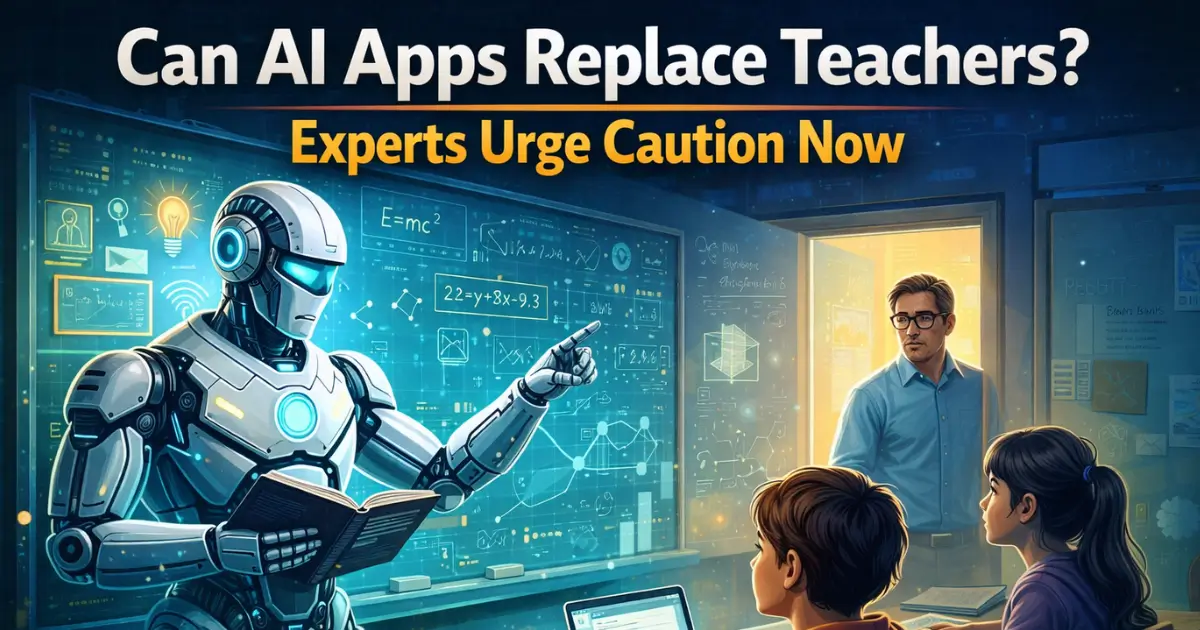
A new wave of AI-driven schools is ditching certified teachers entirely, replacing them with apps and adult "guides." But education experts across North America are raising serious red flags about student privacy, learning quality, and the irreplaceable value of human connection in the classroom.
The Alpha School Model: Two Hours of AI, No Teachers
Imagine a school day where students spend just a couple of hours learning math, language, or science through AI-driven apps, without support from certified teachers, while spending a larger block of time on life skills, field trips, and passion projects. That's the pitch from Alpha School, a U.S.-based private school network that has been grabbing headlines and sparking heated debate across the education world.
Alpha Schools now has over 1,000 students enrolled across 22 campuses in Texas, Florida, California, and other states, and plans to expand to more than 35 locations this fall — including new campuses in Chicago, Atlanta, Puerto Rico, and North Carolina.
How Does It Actually Work?
Students spend the first two hours of each day learning core academics exclusively through AI software on computers — no textbooks, no homework, and no traditional teachers. After that, they shift into hands-on workshops focused on life skills, teamwork, and project-based learning. Past projects have included students running their own food trucks, participating in TEDx Youth Talks, and even managing Airbnbs.
Instead of certified teachers, Alpha uses adult "guides" who focus on motivation, emotional support, and life-skills coaching. If a student struggles with the core curriculum, academic experts can join via a virtual call.
Canadian Experts See a Rebranded Old Idea
Canadian education experts see the model as a mix of pre-existing learning approaches wrapped in newer AI technology — one that may work for certain students but warrants careful consideration around privacy, well-being, and learning outcomes.
Beyhan Farhadi, an assistant professor at the University of Toronto with expertise in online learning and ed-tech policy, isn't buying the hype. Calling it a "boutique" approach for a very select few, Farhadi noted the model has struggled to expand and argued that AI allows for a rebranding of approaches that have previously failed to deliver on their promises at scale.
Stanford Research Raises a Critical Warning
A 2026 Stanford review of more than 800 academic papers found that while AI can help improve student performance, the benefits become less clear when students are later asked to work without AI support. In other words, students may learn to lean on the technology rather than build lasting skills.
Stanford researchers also found that while AI assistance helped students on immediate creative tasks, it led to significantly worse performance on follow-up tasks when the AI was removed — with students beginning to believe the AI was more creative than them.
The Human Connection Problem
A recent survey found that educators' top worry about AI in the classroom was that it could lead to a lack of human interaction. Additionally, AI tools still generate hallucinations — confidently presenting misinformation — and perform inconsistently across different tasks.
One teacher at a Stanford education event put it bluntly, saying the classroom is taking on an almost sacred dimension now — a place where people gather to be young and human together, grow up together, and learn to argue in a complicated world.
What the Numbers Say About AI in Schools
AI adoption in education has accelerated rapidly, with 85% of teachers and 86% of students using AI tools during the 2024-25 school year. But usage doesn't mean replacement. Teachers report that AI has improved their methods (69%) and enabled more personalized learning (59%), while half of students say AI makes them feel less connected to their teachers.
Could It Work for Some Students?
Some experts acknowledge the model could benefit certain learners — for example, a motivated high school student looking to quickly complete a prerequisite course before university. But as a full replacement for traditional schooling, the consensus is clear: proceed with extreme caution.
The Bottom Line
AI is transforming education, but the idea of scrapping teachers entirely remains deeply controversial. As Stanford experts put it, in an increasingly tech-centered world, human connection in the classroom isn't a nice-to-have — it's indispensable. The Alpha model may work as a niche experiment, but experts warn against treating it as the future of schooling for all children.