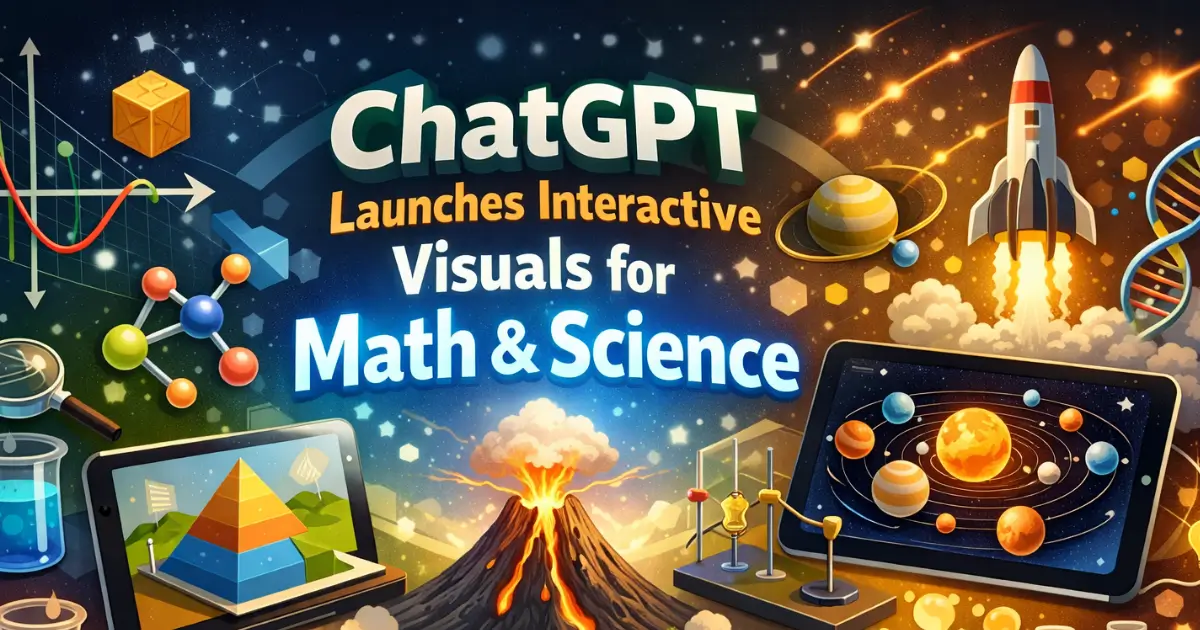
OpenAI has introduced a new feature in ChatGPT called dynamic visual explanations, designed to transform how users learn math and science. Instead of receiving static text-based answers, users can now interact with live visual modules that respond to their inputs in real time. The feature is available to all logged-in ChatGPT users starting today and covers more than 70 math and science topics.
How Dynamic Visual Explanations Work
The concept behind the feature is straightforward but powerful. When a user asks ChatGPT a question related to a supported math or science topic, the chatbot responds not only with a written explanation but also with an interactive visual module embedded directly in the conversation. Users can adjust numbers, drag variables, and manipulate elements within the visual, and the results update instantly on screen.
For example, when exploring the Pythagorean theorem, a user can adjust the lengths of a triangle's two shorter sides and watch the hypotenuse recalculate and redraw in real time. Similarly, a question about the area of a circle produces an interactive module where changing the radius immediately shows how the area changes. This hands-on approach is a significant departure from the traditional AI chatbot experience of reading a paragraph of text and hoping the explanation sticks.
Over 70 Topics Available at Launch
At launch, the feature supports a wide range of math and science subjects. These include foundational concepts like linear equations, the binomial square, the difference of squares, compound interest, and exponential decay. On the science side, topics span across physics and chemistry, including Coulomb's law, Hooke's law, Ohm's law, Charles' law, kinetic energy, and the lens equation. OpenAI has confirmed that it plans to expand the library of interactive topics over time, though no specific timeline has been announced for additional subjects.
A Shift From Answers to Engagement
What makes this launch particularly noteworthy is the subtle but meaningful shift it represents in ChatGPT's role. Since its debut, ChatGPT has primarily been a tool that delivers answers — users ask a question, and the AI provides an explanation or solution. Dynamic visual explanations push the tool in a different direction by asking users to engage with the material themselves. Rather than passively reading about how a formula works, users are invited to explore it by changing inputs and observing outcomes.
Whether this approach leads to deeper understanding will depend on how students and educators incorporate it into their learning routines. But the design signals that OpenAI sees ChatGPT's future in education as more than just a faster way to get homework answers.
AI's Growing Role in Education
The feature arrives at a time when AI's impact on education is one of the most debated topics in the technology and academic worlds. Critics have long warned about the risks of overreliance on AI tools, arguing that students may use them as a shortcut rather than a genuine learning aid. At the same time, adoption has been massive. According to OpenAI, more than 140 million people use ChatGPT every week specifically for help with math and science — subjects that have traditionally been among the most challenging for learners.
Dynamic visual explanations appear to be OpenAI's answer to at least some of these concerns. By building interactivity into the learning experience, the company is attempting to position ChatGPT as a tool that encourages exploration rather than simple answer retrieval.
Building on Existing Educational Features
This is not ChatGPT's first move into dedicated educational functionality. Last year, OpenAI launched study mode, a feature that guides users through problems step by step rather than simply providing the final answer. The company also introduced QuizGPT, which allows users to create flashcards and have ChatGPT quiz them on any topic ahead of exams. Dynamic visual explanations add another layer to this growing educational toolkit, combining written explanations with hands-on visual interaction.
Competition Is Heating Up
OpenAI is not alone in this space. Google's Gemini introduced its own interactive diagrams and visual learning tools back in November 2025, signaling that the race to become the go-to AI learning platform is well underway. As both companies continue to invest in educational features, students and educators stand to benefit from an increasingly rich set of AI-powered learning tools.
The Bottom Line
Dynamic visual explanations represent a meaningful step forward in how AI can support learning. By making abstract mathematical and scientific concepts tangible and interactive, ChatGPT is moving beyond the role of a simple question-answering machine. The feature is live now for all logged-in users, and with OpenAI committed to expanding the topic library, it is likely to become an increasingly central part of how millions of people study math and science in the months ahead.