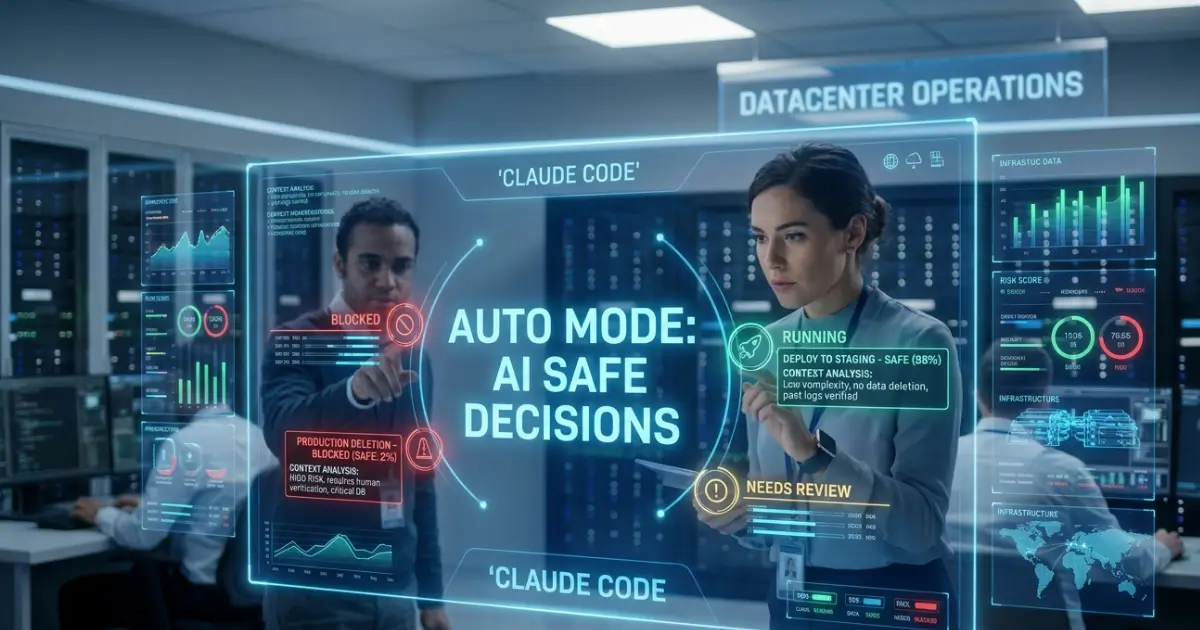
Anthropic is giving its AI coding tool more autonomy — but not unlimited autonomy. The company has introduced "auto mode" for Claude Code, a new feature currently in research preview that allows the AI to independently execute actions it deems safe while blocking anything it flags as risky. It's Anthropic's latest attempt to solve one of the central tensions in AI-assisted development: how to let an AI agent move fast without letting it break things.
The Problem With Babysitting AI
Anyone who has spent time with AI coding assistants knows the frustration. Current tools tend to offer two extremes: either they pause and ask for permission at every step, turning what should be an efficient workflow into an endless series of confirmation prompts, or they run completely unsupervised, leaving developers to hope nothing goes sideways. Neither option is ideal. The first kills productivity, the second introduces real risk.
Anthropic says auto mode is designed to eliminate that binary choice. Instead of requiring developers to manually approve each action or blindly trust the AI, the feature uses built-in safety checks to evaluate every action before execution. If the system determines an action is safe — meaning it aligns with what the user requested and shows no signs of being manipulated — it proceeds automatically. If something looks off, it gets blocked.
How It Works
The safety layer screens for two primary concerns. First, it checks whether the AI is attempting to do something the user never asked for — an important safeguard against the model going off-script. Second, it watches for prompt injection attacks, a growing security concern in which malicious instructions are hidden inside content the AI processes, tricking it into performing unintended actions.
The feature is essentially a more controlled version of Claude Code's existing "dangerously-skip-permissions" command, which hands the AI complete decision-making authority with no safety net. Auto mode adds the missing guardrail layer on top of that full autonomy, aiming to give developers the speed benefits of unsupervised execution without the associated risks.
That said, Anthropic has not published the specific criteria its safety layer uses to distinguish safe actions from risky ones. For a developer community that increasingly depends on these tools for production work, that opacity could be a sticking point. Developers will likely want more transparency about what exactly triggers a block before they trust the feature with anything consequential.
Part of a Bigger Picture
Auto mode doesn't exist in isolation. It follows a series of recent Anthropic releases that collectively point toward a more agentic vision for Claude — one where the AI doesn't just assist but actively takes ownership of tasks.
Earlier this month, Anthropic launched Claude Code Review, an automated tool designed to catch bugs in AI-generated code before they reach the codebase. The company also released Dispatch for Cowork, which lets users assign tasks to AI agents that handle work independently. Auto mode fits neatly into this trajectory: each release gives the AI a little more room to operate without constant human oversight.
This mirrors a broader industry trend. GitHub's Copilot, OpenAI's coding tools, and a growing roster of startups are all pushing toward AI agents that can execute multi-step development tasks autonomously. The competitive pressure to ship these capabilities is intense, and Anthropic clearly doesn't want to fall behind.
Guardrails and Limitations
Despite the push toward autonomy, Anthropic is being cautious about the rollout. Auto mode currently works only with the company's latest models — Claude Sonnet 4.6 and Opus 4.6 — and is available as a research preview rather than a production-ready feature. Anthropic recommends running it in isolated, sandboxed environments that are kept separate from production systems, limiting potential damage if the AI misjudges a situation.
The feature will roll out to Enterprise and API users in the coming days, giving Anthropic a controlled audience of technically sophisticated users who can stress-test the system and provide feedback.
The Balancing Act Continues
The fundamental question auto mode raises isn't new, but it's becoming more urgent as AI tools grow more capable: how much control should we hand to an AI, and how do we verify that its judgment is sound? Anthropic is betting that a middle path exists between full human oversight and full AI autonomy. Whether developers agree — and whether the safety layer proves robust enough in practice — will determine if auto mode becomes a standard feature or a cautionary experiment.