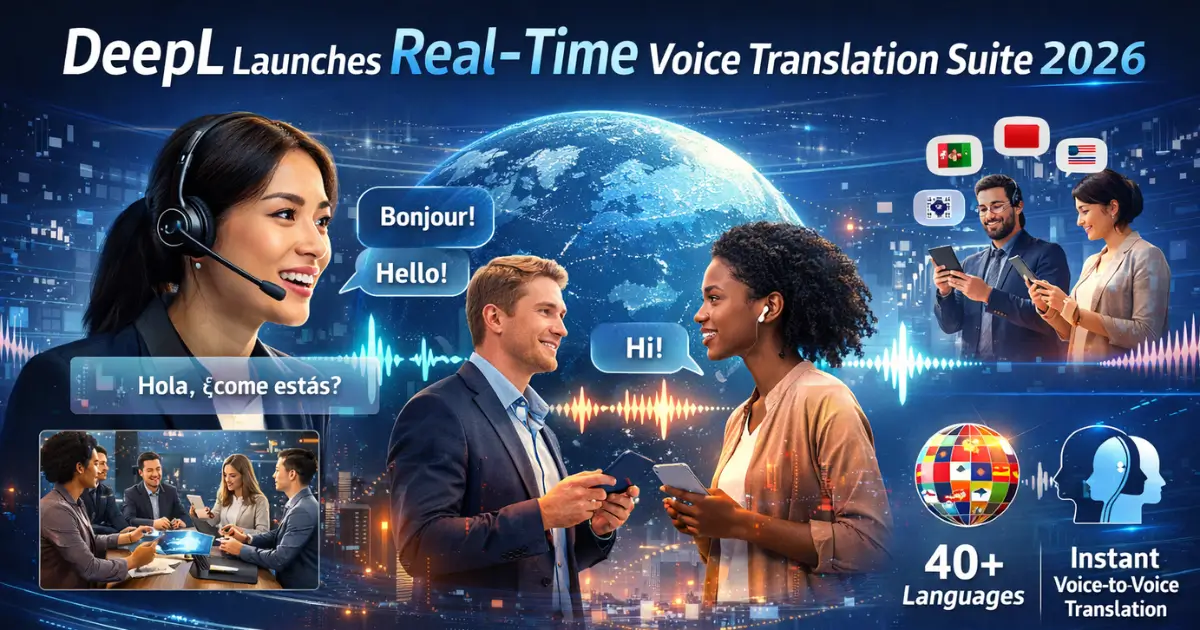
DeepL, the German translation company best known for its text and document translation tools, has officially entered the voice translation market. The company announced a full voice-to-voice translation suite on Wednesday, covering real-time meetings, mobile conversations, group sessions, and an API for developers to build custom solutions on top of the technology.
What DeepL Is Launching
The new suite includes several products designed for different use cases. For meetings, DeepL is releasing add-ons for platforms like Zoom and Microsoft Teams. Listeners can either hear real-time translated audio while others speak in their native languages, or follow translated text on screen. This feature is currently in early access, with organizations invited to join a waitlist.
For in-person or remote conversations, DeepL has built a mobile and web-based product that handles two-way voice translation in real time. There is also a group conversation tool designed for settings like training sessions and workshops, where participants can join through a QR code and follow along in their preferred language.
On the developer side, DeepL is releasing an API that allows businesses to integrate its voice translation technology into their own platforms. The company specifically highlighted call centers as a key use case, where a translation layer could help companies offer support in languages where hiring qualified staff is difficult and expensive.
Why Voice Translation Matters Now
DeepL CEO Jarek Kutylowski explained that after years of building industry-leading text translation, voice was the natural next step. He told reporters that existing real-time voice translation products were not good enough, and that the main challenge was reducing latency while maintaining accuracy.
The system currently works by converting speech to text, applying translation, and then converting the result back to speech. DeepL believes its years of experience in text translation give it a meaningful edge in the quality of that middle step. Going forward, the company plans to develop an end-to-end voice translation model that skips the text conversion entirely, which could significantly reduce delay and improve naturalness.
The technology can also learn custom vocabulary, including industry-specific terms and personal names — a critical feature for enterprise customers in fields like healthcare, legal, and manufacturing where specialized language is the norm.
A Crowded but Growing Market
DeepL is not entering an empty field. Several well-funded startups are already working on adjacent problems in voice AI. Sanas, which raised $65 million last year, uses AI to modify call center workers' accents in real time. Dubai-based Camb.AI focuses on dubbing and localizing video content for media companies. And Palabra, backed by Reddit co-founder Alexis Ohanian's firm, is building a real-time speech translation engine that preserves both meaning and the speaker's original voice.
What sets DeepL apart is its control over the entire voice-to-voice stack and its established reputation in text translation, which already serves hundreds of thousands of businesses worldwide. The company is essentially leveraging a decade of enterprise translation experience to enter a new modality.
The Enterprise Angle
The timing of this launch is significant. As AI tools reshape how companies operate globally, real-time voice translation addresses one of the most practical barriers to international collaboration: language. Multinational teams that currently rely on English as a default could instead communicate in their native languages, with AI handling the translation seamlessly in the background.
For call centers in particular, this could be transformative. Instead of hiring native speakers for every supported language, companies could deploy a smaller team with DeepL's translation layer handling the linguistic gap in real time.
Kutylowski noted that AI is reimagining what customer service will look like over the coming years, with translation being a core part of that transformation.
What Comes Next
DeepL has not disclosed pricing for the voice suite, and the meeting add-ons remain in early access for now. The company's long-term ambition is clear: build a single platform that handles all forms of translation — text, documents, and now voice — for businesses of every size.
Whether DeepL can maintain its quality edge as it moves from text to voice will determine how effectively it competes against both established players and well-funded startups. But for a company that built its reputation on being better than Google Translate, the bar it sets for itself has always been high.