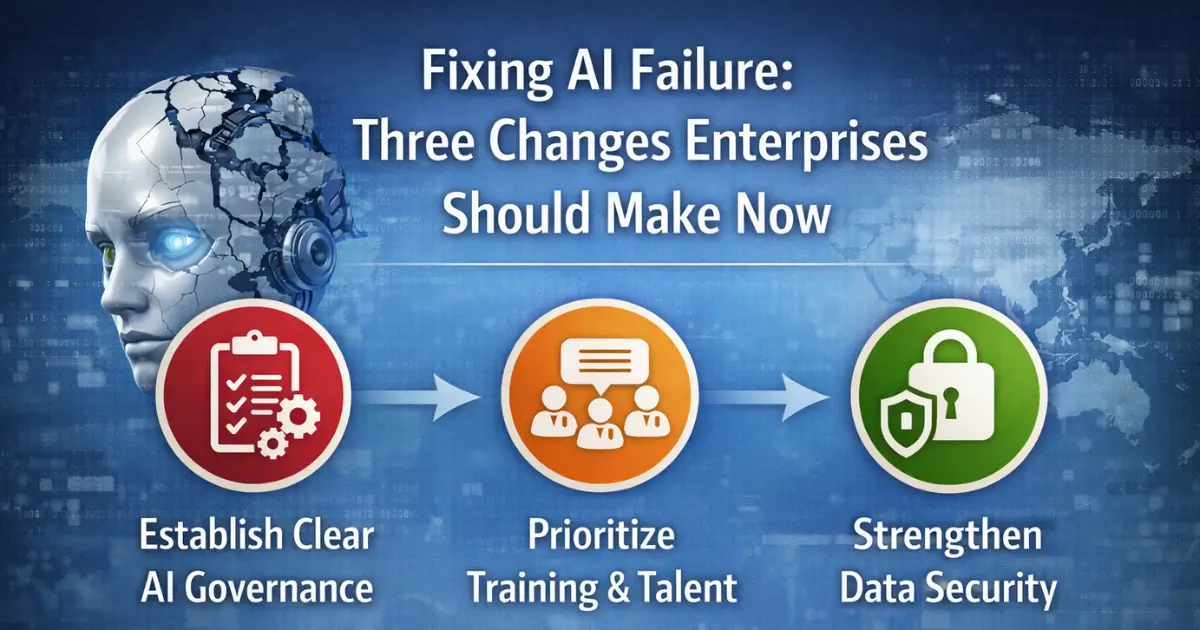
As companies worldwide invest heavily in artificial intelligence, many enterprises are discovering that launching successful AI projects is more difficult than expected. Despite major spending on advanced models, data infrastructure and automation tools, a large number of AI initiatives still fail to deliver measurable business results.
Industry experts say the problem often lies not in the technology itself but in how organizations implement and manage AI systems. Analysts now suggest that companies must rethink internal processes, decision-making structures and employee training to ensure artificial intelligence delivers real value.
According to technology analysts, enterprises that fail to adapt their internal operations risk turning AI projects into expensive experiments rather than productive business tools.
The Growing Problem of AI Project Failures
Over the past few years, artificial intelligence has become a major priority for businesses across industries including finance, healthcare, retail and manufacturing. Companies are using AI for automation, predictive analytics, customer service and operational efficiency.
However, many organizations have struggled to translate AI experiments into real-world success. In some cases, AI systems are developed by technical teams but never fully integrated into daily business workflows.
Experts say one of the main reasons is a disconnect between engineering teams and business departments. While data scientists may build powerful models, other teams may not fully understand how to use them effectively.
As a result, companies may invest significant resources in AI development but fail to achieve practical outcomes.
1. Improving AI Literacy Across Teams
One of the most important steps for solving AI failure is improving AI literacy across the entire organization.
Many companies limit AI knowledge to data scientists and machine learning engineers. However, product managers, designers, executives and operations teams also need a basic understanding of how AI systems work and what they can realistically achieve.
Experts say organizations should focus on helping employees understand how AI supports their specific roles, rather than attempting to turn every employee into a technical expert.
When teams share a common understanding of AI capabilities and limitations, collaboration becomes easier and AI systems are more likely to be used effectively.
Improved communication between technical and non-technical teams can also help organizations design AI tools that solve real business problems.
2. Setting Clear Rules for AI Decision-Making
Another major issue in enterprise AI projects is the lack of clear governance around how AI systems make decisions.
Some organizations rely too heavily on human approvals, slowing down automation and reducing efficiency. Others allow AI systems to operate with minimal oversight, which can introduce risks.
Experts recommend creating clear policies defining when AI systems can operate independently and when human intervention is required.
For example, AI systems might be allowed to recommend operational changes but require human approval before implementing them. In other cases, AI tools may automatically handle routine tasks while complex decisions remain under human control.
Establishing clear governance structures can help companies balance efficiency with accountability.
3. Creating Standard Processes for AI Deployment
Another common reason AI projects fail is the absence of standardized procedures for deploying and managing AI systems.
Many organizations treat AI initiatives as experimental projects rather than integrated business tools. Without clear workflows, teams may struggle with issues such as testing, monitoring and maintaining AI systems after deployment.
Experts suggest developing cross-department playbooks that define how AI systems are built, tested, deployed and monitored.
These guidelines can help ensure that AI systems remain reliable and that teams know how to respond if problems arise.
By creating consistent processes, companies can turn AI from isolated experiments into stable operational tools.
AI Success Depends on People, Not Just Technology
While artificial intelligence continues to advance rapidly, experts emphasize that successful adoption depends as much on organizational readiness as on technical capability.
Companies that encourage collaboration between engineers, product teams and business leaders are more likely to see positive results from AI investments.
Building strong communication channels and aligning AI projects with real business goals can significantly improve the chances of success.
The Road Ahead for Enterprise AI
Artificial intelligence is expected to play an increasingly important role in business operations over the coming years. From automation and analytics to decision-making support, AI systems are transforming how companies operate.
However, analysts say enterprises must recognize that AI is not simply a technology upgrade. It requires changes in company culture, employee training and operational processes.
Organizations that invest in both technology and organizational readiness will be better positioned to unlock the full potential of artificial intelligence.
As AI adoption continues to expand, companies that address these challenges early may gain a significant competitive advantage in the rapidly evolving digital economy.