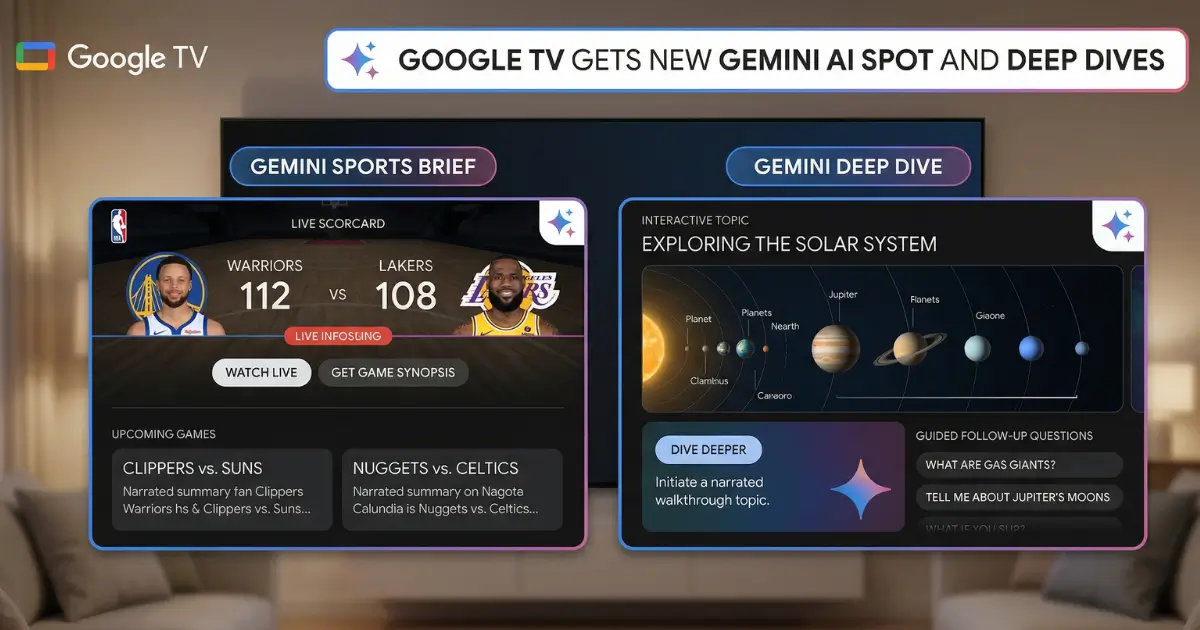
Google is pushing deeper into AI-powered television with three new Gemini features for Google TV, announced on Tuesday. The update brings visual responses, narrated topic explorations, and sports game summaries to the big screen turning the TV into something closer to a conversational assistant than a passive display.
The features are rolling out now to users in the United States and Canada. Google has also confirmed plans to expand Gemini's capabilities to Australia, New Zealand, and the United Kingdom this spring, with additional countries to follow.
Visual Responses Bring Answers to Life
The most notable addition is visual responses a feature that pairs Gemini's answers with on-screen images, scorecards, and video content rather than delivering text-only replies.
For example, asking about the current score of a Warriors game will now pull up a live scorecard along with information about where to watch the game. Asking for a recipe will prompt Gemini to display relevant video tutorials alongside its spoken answer.
This is a meaningful upgrade from the text-based interactions that defined Gemini's early integration with Google TV. By combining voice responses with visual elements, Google is making the AI assistant feel more natural on a screen that users are accustomed to watching rather than reading.
Deep Dives Turn Your TV Into a Classroom
The second feature, called deep dives, allows users to explore complex topics in more detail directly from their television. First previewed at CES 2026 in January, the feature delivers narrated visual breakdowns on a wide range of subjects from health and wellness to economics and technology.
A user could ask something like "What are the effects of cold plunging?" and receive a structured, narrated explainer with accompanying visuals. The format is designed to feel more like a short documentary segment than a standard voice assistant response.
Users can trigger deep dives either by selecting a "Dive deeper" option that appears after a standard Gemini response, or by navigating to the Gemini tab on the home screen and choosing the "Learn" option. The feature effectively positions Google TV as an on-demand educational tool an interesting play for a device that most people associate with streaming entertainment.
Sports Briefs for Fans Who Cannot Watch Every Game
The third addition is sports briefs narrated, AI-generated summaries of recent games designed for fans who want to stay current without watching every live broadcast.
Users can request timely overviews of events across major leagues including the NBA, NHL, and MLB. The summaries cover highlights, key moments, and important updates, delivered in a narrated format that allows viewers to catch up quickly.
The feature builds on a foundation Google laid last year with the launch of news briefs AI-generated summaries of the day's top headlines. Sports briefs apply the same concept to a domain where real-time information and rapid updates are especially valued by users.
For sports fans who follow multiple teams or leagues, the feature could eliminate the need to jump between apps or scroll through highlight reels. Instead, a single voice command delivers a concise, personalised recap.
A Steady Expansion Since Launch
Gemini first arrived on Google TV in September 2025 through a limited release on select TCL televisions. Since then, Google has expanded the integration to more hardware and steadily added capabilities.
Earlier updates gave users the ability to adjust TV settings through natural language fixing dim screens or correcting audio imbalances by simply asking, rather than navigating through menus. Users can also search their Google Photos library by voice and apply AI-powered styles and effects to their images.
The new features announced on Tuesday represent the most significant expansion of Gemini's role on Google TV to date. Taken together, they signal that Google views the television not merely as a screen for streaming content but as a platform for AI interaction a device where users can ask questions, learn about topics, and stay informed through conversation rather than clicks.
The Bigger Picture
Google's investment in Gemini-powered TV features comes at a time when every major technology company is racing to embed AI assistants into as many surfaces as possible. Amazon has been expanding Alexa's capabilities on Fire TV, Apple has been integrating Apple Intelligence across its devices, and Samsung has been pushing its own AI features through Tizen-powered smart TVs.
For Google, the television represents a natural extension of a strategy that already spans phones, laptops, cars, and smart speakers. The question is whether users will embrace the idea of having an AI conversation with their TV or whether they will continue to reach for their phones when they want to ask a question. These new features are Google's bet that the big screen can earn a place in that habit.