AI is transforming nearly every corner of healthcare, from diagnostics to drug discovery. But one stubborn obstacle keeps slowing progress: the lack of reliable, representative data — especially for rare diseases, unusual conditions, and edge cases where patient information is scarce, siloed, or ethically restricted.
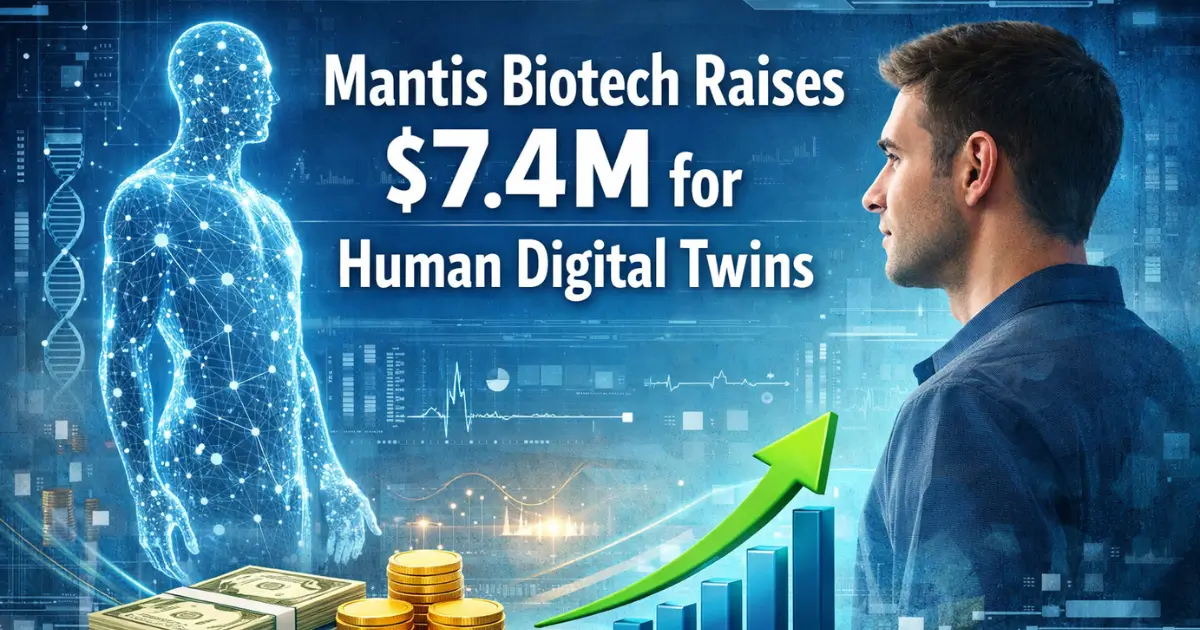
New York-based Mantis Biotech believes it has the answer. The company is building a platform that integrates disparate data sources to create synthetic datasets used to construct "digital twins" of the human body — physics-based, predictive models of anatomy, physiology, and behavior.
The startup recently raised $7.4 million in seed funding led by Decibel VC, with participation from Y Combinator, Liquid 2, and several angel investors. The funding will be used for hiring, marketing, and go-to-market efforts as Mantis scales its technology beyond its initial use cases.
How It Works
Mantis' platform collects data from a wide range of sources including textbooks, motion capture cameras, biometric sensors, training logs, and medical imaging. It then uses an LLM-based system to route, validate, and synthesize these data streams before running everything through a physics engine to generate high-fidelity digital representations. These representations can then be used to train predictive models.
The physics engine is a critical component, according to founder and CEO Georgia Witchel, because it grounds the synthetic data in realistic anatomical physics — ensuring the digital twins behave the way actual human bodies would under real-world conditions.
Witchel illustrated the concept with a practical example. She explained that if someone needed hand-pose estimation data for a person missing a finger, no publicly available labeled dataset exists for that. But with Mantis' physics model, generating that dataset becomes straightforward — simply remove the finger from the model and regenerate the data.
Solving Medicine's Data Gap
AI models trained on large datasets hold enormous promise for genomics research, clinical documentation, diagnostics, drug discovery, and even synthetic data generation. But they often struggle with edge cases like rare diseases, where reliable and representative data is extremely limited.
Ethical and regulatory constraints make this even harder, as patient data often cannot be included in public datasets or used for AI training. Mantis' digital twins offer a potential workaround by creating virtual human models that can be tested, manipulated, and studied without any privacy concerns.
Witchel's vision is bold. She wants researchers and developers to treat these digital twins the way a child treats a toy — freely experimenting without hesitation. She believes this mindset shift could unlock breakthroughs in biomedical research, surgical robotics training, and predictive healthcare.
Early Traction in Professional Sports
Before expanding into broader healthcare, Mantis has found its first major success in professional sports. The startup counts an NBA team among its main clients, using digital twins to model athlete performance and predict injury risks.
Witchel explained that the platform creates digital representations of athletes showing how specific movements — such as jumping — have changed over time. These models correlate physical performance with variables like sleep patterns, training load, and arm movement frequency to identify early warning signs of potential injuries.
She gave the example of predicting whether a specific NFL player might develop an Achilles injury based on recent performance, training load, diet, and career duration. This kind of predictive modeling, powered by synthetic data and physics-based simulation, is exactly what makes Mantis' approach unique.
What's Next
Mantis plans to continue developing its technology and eventually release the platform to the general public, targeting preventative healthcare. The company is also working to serve pharmaceutical labs and researchers conducting FDA trials, aiming to provide insights into how patients respond to treatments.
The broader vision is clear: as AI becomes more embedded in medicine, the quality and availability of data will determine how far it can go. Mantis is betting that synthetic, physics-grounded digital twins can fill the gaps that real-world data cannot — enabling safer drug trials, smarter diagnostics, and more personalized care, all without compromising a single patient's privacy.
For a seed-stage startup, the ambition is enormous. But with $7.4 million in the bank, Y Combinator's backing, and a growing client base in professional sports, Mantis Biotech is off to a promising start.