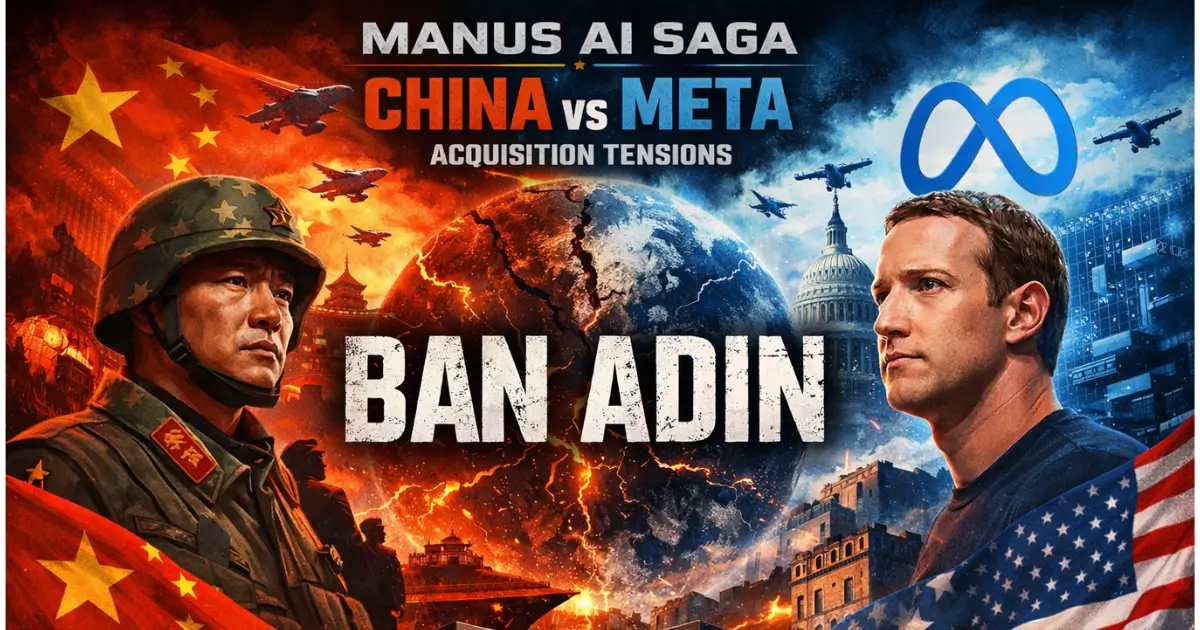
In the high-stakes race between Washington and Beijing to dominate artificial intelligence, few stories have captured the tension quite like Manus. The Chinese AI startup, once celebrated as one of the country's most promising tech ventures, quietly relocated to Singapore last year and sold itself to Meta for two billion dollars. It was a bold move — and one that was almost guaranteed to provoke a fierce response from Beijing.
That response has now arrived. According to the Financial Times, Manus co-founders Xiao Hong and Ji Yichao were summoned earlier this month to a meeting with China's National Development and Reform Commission and informed they would not be leaving the country for the foreseeable future. No formal charges have been filed. Beijing is calling it a routine regulatory review into whether the Meta acquisition violated foreign investment rules. But there is nothing routine about it.
From Viral Demo to Half-Billion Valuation
Manus first caught the world's attention in the spring of last year with a slick demo video. The AI agent it showcased could screen job candidates, plan vacations, and analyze stock portfolios — and the company boldly claimed its technology outperformed OpenAI's Deep Research. The tech world took notice immediately.
Within weeks, Benchmark, one of Silicon Valley's most prestigious venture firms, led a seventy-five million dollar funding round that valued Manus at five hundred million dollars. The investment itself raised eyebrows. Senator John Cornyn publicly questioned whether American investors should be subsidizing a Chinese AI company that could ultimately be used to challenge the United States economically and militarily.
But the market didn't care. By December, Manus had attracted millions of users and was generating over one hundred million dollars in annual recurring revenue. That kind of growth made it an irresistible target for acquisition.
Zuckerberg Makes His Move
Mark Zuckerberg, who has bet Meta's entire future on artificial intelligence, saw the opportunity and seized it. Meta acquired Manus for two billion dollars — a staggering price for a company barely a year old. The deal immediately became one of the most talked-about acquisitions in the AI industry.
But Manus had been preparing for this kind of move long before Meta came calling. The company had spent much of the previous year actively distancing itself from China. It relocated its headquarters and core team from Beijing to Singapore, restructured its ownership to remove Chinese ties, and after the deal was announced, pledged to cut all connections with its Chinese investors and shut down operations in China entirely. By every outward measure, Manus was trying to reinvent itself as a Singapore company with no strings attached to Beijing.
Beijing Remembers
If anyone at Manus thought this strategy would go unnoticed, they badly misjudged the Chinese government. Beijing has a phrase for what Manus did — "selling young crops." It refers to homegrown technology companies that move abroad and sell themselves to foreign buyers before they have fully matured, taking their intellectual property and talent with them. For a government pouring billions into building a domestic AI ecosystem, this kind of defection is intolerable.
China has never been subtle about punishing those who cross it. When Jack Ma mildly criticized Chinese regulators in 2020, he vanished from public life for months. Ant Group's blockbuster IPO was killed overnight. Alibaba was slapped with a massive fine. Beijing then spent two years systematically dismantling its own booming tech sector, erasing hundreds of billions in market value. The message was clear — no one operates outside the state's reach.
A Gamble That May Not Pay Off
The Manus founders appear to have bet that relocating to Singapore and selling to an American buyer would put them beyond Beijing's grasp. For a while, it may have seemed like the gamble was paying off. The deal closed, the money changed hands, and life went on.
But the summoning of Xiao Hong and Ji Yichao to meet with Chinese regulators suggests that Beijing has not forgotten and has no intention of letting this go quietly. The co-founders are now stuck in China, waiting for answers about an inquiry that could drag on indefinitely.
What Comes Next
The Manus saga is far from over. It sits at the intersection of the two most powerful forces shaping the technology industry today — the US-China AI rivalry and the enormous sums of money being wagered on whoever wins it. For Chinese AI founders watching from the sidelines, the lesson is sobering. You can relocate your company, restructure your ownership, and sell to an American tech giant. But if Beijing decides you took something that belongs to China, no amount of corporate restructuring will save you.
The founders of Manus wanted out. Whether they actually get out remains an open question.