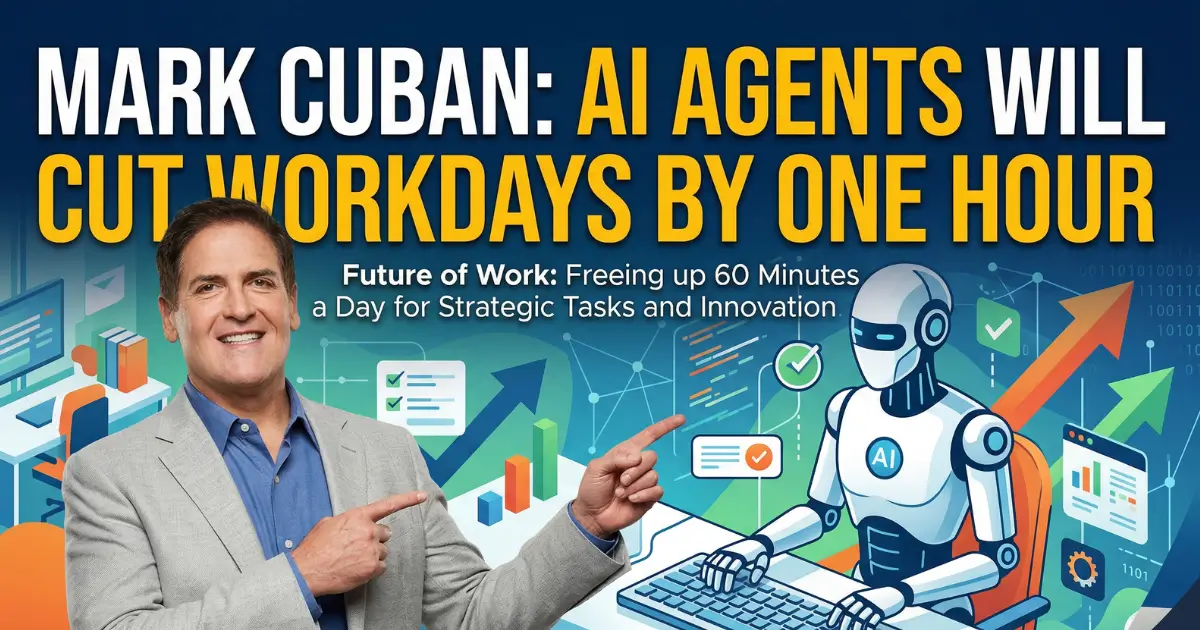
Billionaire entrepreneur Mark Cuban believes artificial intelligence agents are on the verge of shaving a full hour off the average workday but he warns that the technology is still far from replacing human workers altogether.
The former Shark Tank star and Dallas Mavericks owner has become one of the most prominent voices in the AI-and-jobs debate, consistently pushing back against doomsday predictions while urging workers to embrace the technology as a productivity tool. His latest prediction that AI agents could trim roughly an hour from a typical eight-hour shift falls squarely within his broader thesis: AI will reshape work, not eliminate it.
The Economics Don't Add Up for Full Replacement
Cuban's optimism about shorter workdays comes with a critical caveat: the economics of AI deployment still favour human workers for most tasks. In a recent post on X, he responded to a viral clip from the All-In podcast in which investors Jason Calacanis and Chamath Palihapitiya revealed that deploying AI agents can cost more than $300 per day per agent adding up to over $100,000 annually.
Cuban described that economic reality as the "smartest counter" to predictions of mass job displacement. He laid out a detailed cost-benefit framework, arguing that employers must weigh the total token costs of AI agents plus developer and maintenance expenses against the fully loaded cost of a human employee. In his example, running eight AI agents at $300 per day in token costs, plus $200 in daily maintenance, would amount to $2,600 more than double the $1,200 daily cost of a human worker.
For Cuban, this math explains why AI is better suited to trimming workloads rather than eliminating headcount entirely.
Agents Still 'Space Out' Like Hungover Interns
Beyond costs, Cuban has repeatedly questioned whether current AI technology is reliable enough to handle critical business functions. He argues that humans possess a contextual awareness that AI fundamentally lacks. A toddler who pushes a cup off a high chair quickly learns the consequences, Cuban noted. AI agents can predict the cup will fall but have no understanding of the broader context or what happens next.
He has also highlighted the inconsistency problem. AI execution paths can vary unpredictably, with no guarantee the system will perform the same task the same way twice. Cuban refers to this as agents that "space out," comparing them to college interns who show up hungover, make mistakes, and refuse to take responsibility.
These limitations, in his view, make AI ideal for handling repetitive, time-consuming tasks the kind of work that can realistically save an hour a day while leaving critical decision-making to humans.
Learn AI or Get Left Behind
While Cuban tempers the panic around mass layoffs, he has been equally blunt about the need for workers to adapt. He has predicted that AI fluency will become a baseline professional skill as fundamental as email or Excel within five years. He has compared the current moment to the personal computer revolution of the 1980s, noting that today's workers have a much easier path to learning AI than earlier generations had to adopting PCs, which cost the equivalent of $16,000 in today's dollars.
Cuban has urged college graduates and young professionals to learn how to build simple AI agents that automate tasks companies typically leave undone things like processing spreadsheets, checking receipts, or editing documents.
A Broader Industry Debate
Cuban's measured stance stands in sharp contrast to more alarming forecasts from other tech leaders. Anthropic CEO Dario Amodei has suggested AI could disrupt half of entry-level white-collar jobs within one to five years. OpenAI's Sam Altman has warned that superintelligence capable of replacing CEOs may be only a couple of years away. Meanwhile, several major companies have already begun citing AI as a justification for workforce reductions, a practice some analysts have labelled "AI washing."
For now, Cuban's prediction of a one-hour workday reduction offers a pragmatic middle ground: AI will make workers more productive without rendering them obsolete. The question is not whether AI will change the workplace but whether workers and companies are prepared to change with it.