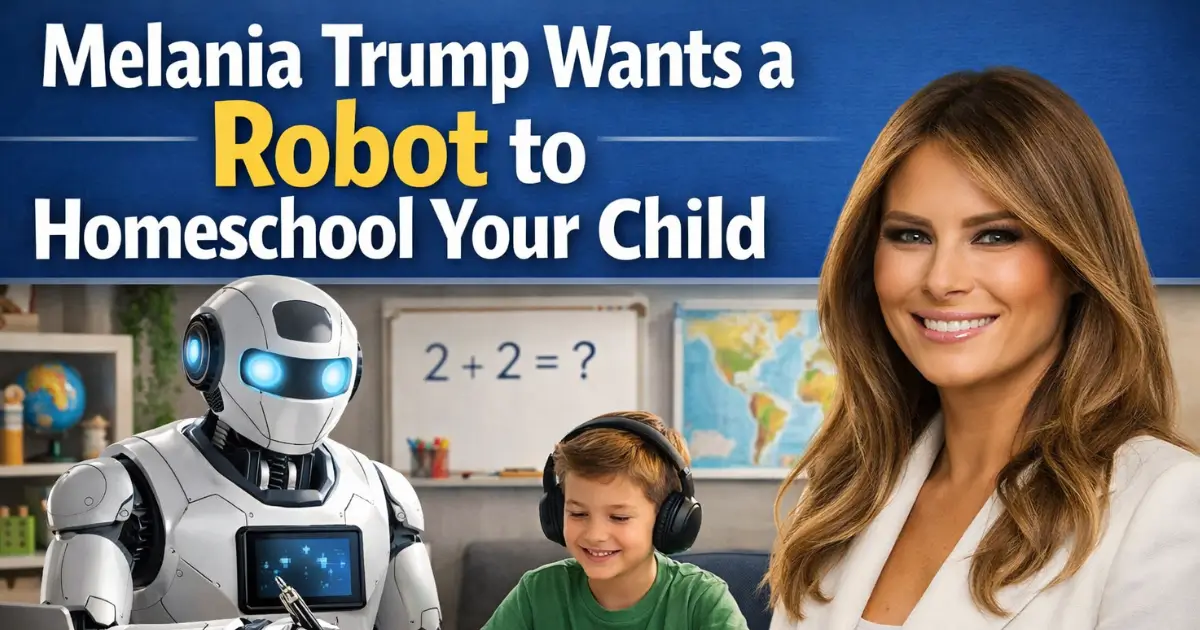
On Wednesday, the White House played host to one of the more surreal spectacles in recent political memory. First Lady Melania Trump walked down a red carpet alongside a humanoid robot built by the robotics company Figure AI. The machine delivered a brief speech, declaring itself grateful to be part of a historic movement to empower children through technology and education. Moments later, it quietly exited the room.
The event was the launch of the First Lady's new global initiative, "Fostering the Future Together," a summit that brought together leaders from forty-five nations to discuss how artificial intelligence and emerging technology could reshape children's education around the world.
Meet "Plato," Your Child's Future Teacher
At the heart of the First Lady's remarks was a bold and futuristic vision. She asked attendees to imagine a humanoid robot educator named "Plato" — a tireless, endlessly patient machine capable of delivering personalized instruction across every classical discipline. Literature, science, art, philosophy, mathematics, history — all of humanity's accumulated knowledge, she said, would be available instantly in the comfort of a child's home. According to the First Lady, such a robot would adapt to each student's individual needs and, over time, help children develop deeper critical thinking and independent reasoning abilities.
The Reality Gap
It is, by any measure, a dramatic proposition. And it is one that sits uncomfortably alongside the current state of both robotics and educational technology, neither of which is remotely close to producing anything resembling a competent humanoid teacher. Today's most advanced humanoid robots can walk, carry objects, and perform scripted interactions, but they are a far cry from the adaptive, intellectually nimble tutors the First Lady described. The same is true of AI-driven educational tools, which remain useful supplements to human instruction rather than replacements for it.
Silicon Valley's School of the Future
Still, the idea that technology can automate learning and eventually sideline human educators has been gaining traction in Silicon Valley. A growing number of tech entrepreneurs and investors have thrown their weight behind "microschools" and AI-first educational models that promise to teach children faster and more efficiently than traditional classrooms.
The most prominent example is the Alpha School, a network of private schools that uses artificial intelligence to accelerate student learning. The schools have attracted considerable media attention and, more importantly, the enthusiastic support of the Trump administration. Education Secretary Linda McMahon, who is simultaneously working to dismantle the very department she leads, recently visited an Alpha School campus and praised the model. The administration described the school as reimagining K-12 education by equipping students with practical AI skills and preparing them for a technology-driven workforce.
A Troubling Contradiction
The timing and context of the First Lady's summit only deepened the contradictions. The event took place on the same day the Trump administration announced a separate technology advisory council populated by high-profile Silicon Valley executives. Meanwhile, the administration has continued its sustained assault on the traditional public education system, pressing ahead with plans to abolish the Department of Education and slashing funding for public schools across the country.
For critics, the juxtaposition is troubling. On one hand, the government is actively undermining the infrastructure that educates the vast majority of American children. On the other, it is championing private, technology-driven experiments that remain unproven at scale and accessible only to families who can afford steep tuition fees. Alpha School, for instance, charges around fifty-five thousand dollars per student annually — hardly a model for universal education.
What Robots Cannot Teach
There are deeper philosophical objections as well. Education is not simply the transmission of information. A good teacher does far more than deliver facts. Teachers build relationships with students, model empathy, foster social skills, provide emotional support, and help shape character. These are dimensions of learning that no algorithm or robot can replicate, no matter how sophisticated the underlying technology becomes. Reducing education to a data-delivery problem misunderstands what schools are actually for.
The Road Ahead
None of this means that AI has no role to play in education. Used thoughtfully, intelligent tutoring systems can help students practice skills, fill gaps in understanding, and learn at their own pace. The danger lies not in using technology as a tool but in treating it as a substitute for the deeply human work of teaching.
The First Lady's robot walked off the stage on Wednesday, but the questions it raised are not going anywhere. As governments and tech companies push to reshape education in the image of Silicon Valley, the stakes could not be higher. The choices made now will determine not just how children learn but what kind of society they grow up to inhabit.