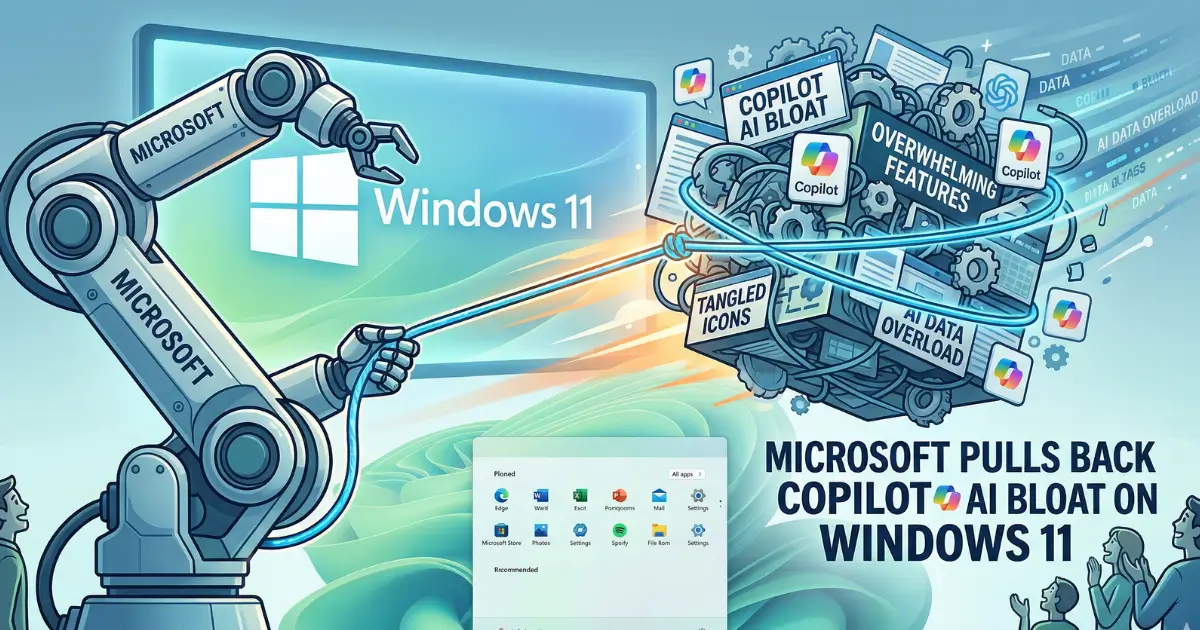
Microsoft is finally listening. After months of growing user frustration over the aggressive integration of its Copilot AI assistant across Windows 11, the company announced on Friday that it will be pulling back. The changes include reducing the number of Copilot entry points in several core applications, a move that signals a broader rethinking of how — and where — artificial intelligence belongs inside the world's most widely used desktop operating system.
Less Copilot, More Focus
The rollback begins with four familiar apps: Photos, Widgets, Notepad, and the Snipping Tool. All four will see their Copilot integrations reduced as Microsoft adopts what it calls a more intentional approach. Pavan Davuluri, the company's executive vice president of Windows and Devices, wrote on the official Windows blog that the goal is to focus AI experiences on areas where they are genuinely useful rather than scattering them across every surface of the operating system. Under the heading of integrating AI where it is most meaningful, Davuluri acknowledged that the company has spent months listening to its community about how they would like to see Windows improved.
A Pattern of Retreat
This is not the first time Microsoft has been forced to rethink its Copilot ambitions. Earlier this month, Windows Central reported that the company had quietly shelved plans to bring Copilot-branded AI features into system-level areas of Windows 11, including the Settings app and File Explorer. Those integrations were abandoned before they ever reached users, suggesting that internal testing or early feedback had already raised red flags. Even before that, Microsoft delayed the launch of Windows Recall, an AI-powered memory feature for its Copilot Plus PCs, for over a year while it tried to address serious privacy concerns. Recall finally launched last April, but security researchers continue to find vulnerabilities in the feature, keeping the controversy alive.
Consumer Pushback Is Real
The pullback reflects a broader shift in public sentiment toward artificial intelligence. While many people recognise AI as a useful tool in the right context, enthusiasm is giving way to caution. A Pew Research study published earlier this month found that half of American adults are now more concerned than excited about AI, up from 37 percent in 2021. For a company that has staked a significant portion of its product strategy on AI integration, these numbers matter. Users do not want AI features forced into every corner of their experience. They want choice, control, and the confidence that the tools they rely on will not become vehicles for features they did not ask for.
Beyond Copilot: Quality of Life Improvements
The Copilot changes are part of a larger set of quality-focused updates to Windows 11. Microsoft also announced that users will soon be able to move the taskbar to the top or sides of the screen, a customisation option that had been missing and frequently requested. File Explorer is getting speed improvements, the Widgets experience is being refined, and the Feedback Hub is being updated to make it easier for users to share their input. The company is also streamlining its Windows Insider Program, the community of testers who provide early feedback on upcoming features. Together, these changes paint a picture of a company trying to rebuild trust with a user base that has grown weary of updates that prioritise flashy AI features over basic functionality and reliability.
The Bigger Lesson for the Industry
Microsoft's course correction carries a lesson that extends well beyond Redmond. Across the technology industry, companies have raced to embed AI into their products, driven by competitive pressure, investor expectations, and the genuine belief that AI can improve user experiences. But the backlash against AI bloat is growing. Users are pushing back against AI-generated summaries they did not request, chatbots that appear uninvited, and features that add complexity without adding value. The companies that will win the AI era are not necessarily those that integrate the technology most aggressively, but those that do so most thoughtfully.
A Step in the Right Direction
Microsoft's decision to scale back Copilot's presence in Windows 11 is a welcome acknowledgement that more AI does not always mean a better product. By focusing on areas where the technology delivers genuine utility and removing it from places where it simply adds noise, the company is taking a step toward the kind of measured, user-first approach that the industry badly needs. Whether this represents a lasting shift in philosophy or a temporary retreat remains to be seen, but for now, Windows users have reason to feel heard.