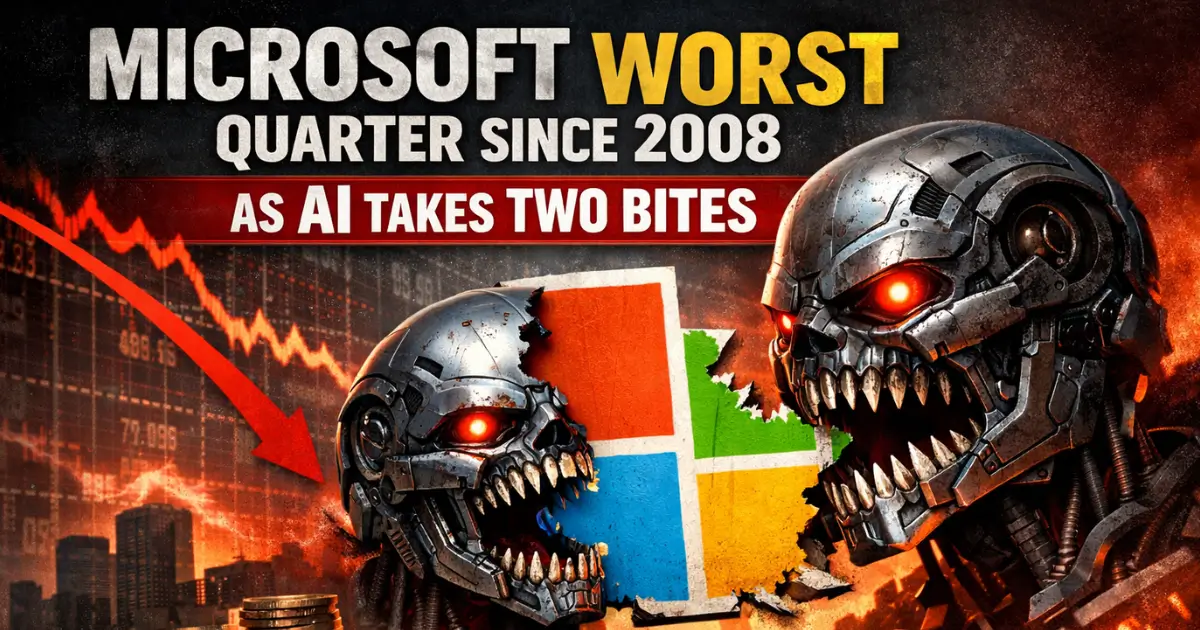
Microsoft Corporation finds itself caught at the intersection of two powerful forces threatening the technology sector, pushing the software giant's stock toward its worst quarterly performance since the 2008 global financial crisis.
The company's shares are down 25% in the first quarter, on pace for its biggest loss since the 27% drop in the fourth quarter of 2008. The sell-off has erased roughly $1.3 trillion from the company's market capitalization since its October 2025 peak, sending shockwaves through Wall Street.
The Double Threat: Spending and Disruption
Microsoft is being squeezed from two directions simultaneously. The first pressure point is unprecedented capital expenditure on AI infrastructure. With a projected $120 billion in capital spending for fiscal year 2026, including a record $37.5 billion in the most recent quarter alone, investors are growing impatient for tangible returns.
The money is flowing into building enormous data centers, securing limited power supplies, and ramping up production of Microsoft's custom "Maia" AI chips. While CFO Amy Hood has highlighted an $80 billion backlog in Azure orders, the company remains "capacity-constrained," unable to fulfill all the demand.
The second threat comes from AI startups like Anthropic and OpenAI, which are creating agents that could replace products made by companies like Microsoft. Investors are selling software stocks broadly over fears that this new generation of AI could render existing enterprise tools obsolete.
The OpenAI Complication
Adding to Microsoft's troubles is a growing rift with its most important AI partner. In February 2026, OpenAI launched "Frontier," its new enterprise agent platform, and signed a $50 billion exclusive cloud deal with Amazon, arguing the platform falls outside its original contract with Microsoft. The move has stunned the industry and raised serious questions about the long-term defensibility of Microsoft's multi-billion dollar investment.
This underscores a central risk: the company has bet heavily on a partnership it may not fully control. As OpenAI pursues its own commercial interests, the alignment between the two companies appears to be fraying at precisely the moment when investors need reassurance.
A Broader Market Reckoning
Microsoft's struggles are not occurring in isolation. The entire sector is experiencing what analysts call an "AI reckoning" a transition from the unbridled euphoria of 2024 to a "valuation digestion" phase, where massive capital requirements are colliding with slower-than-anticipated returns.
The big five tech companies' aggregate capex is projected to grow by more than $100 billion in 2026 to almost $500 billion. Analysts estimate that at current adoption rates, it may take nearly a decade for these companies to recoup their infrastructure investments.
Microsoft's gross margin has also fallen to a three-year low of approximately 68%, and the gap between its share price and its 200-day moving average is now the widest since 2008.
Is This a Warning or an Opportunity?
Despite the gloomy picture, not everyone is bearish. Microsoft's most recent quarter delivered $81.27 billion in revenue, a 17% year-over-year gain that beat estimates. The company remains the dominant player in enterprise software and cloud computing.
The central debate is whether Microsoft's AI infrastructure bet is genius or a capital allocation problem the market is now pricing in. The question is not whether AI will transform business, but whether Microsoft is spending too much, too fast.
For now, the market's verdict is clear: the era of blind faith in AI spending is over. Investors want results, not promises and until Microsoft delivers them, the stock may continue to feel the pressure.