Most enterprise AI projects fail not because companies lack the technology, but because the models they use don't understand their business. These models are often trained on the internet, rather than decades of internal documents, workflows, and institutional knowledge. That gap between general-purpose AI and business-specific needs is exactly where French AI startup Mistral sees its biggest opportunity.
Introducing Mistral Forge
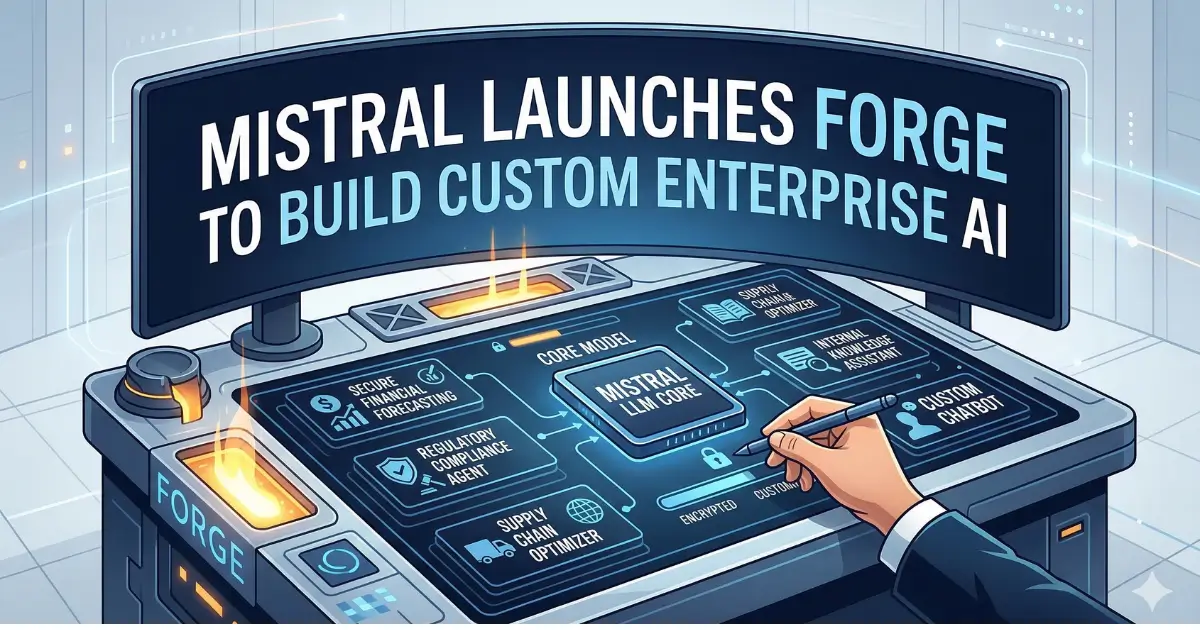
On Tuesday, Mistral announced Mistral Forge, a platform that lets enterprises build custom AI models trained on their own data. The company unveiled the platform at Nvidia GTC, Nvidia's annual technology conference, which this year is heavily focused on AI and agentic models for enterprise use.
The move represents a direct challenge to OpenAI and Anthropic, both of which have dominated consumer-facing AI but face growing competition in the corporate space. Mistral CEO Arthur Mensch says the company's laser focus on enterprise is paying off, with the company on track to surpass $1 billion in annual recurring revenue this year.
How Forge Is Different
Several companies in the enterprise AI space already claim to offer similar capabilities, but most focus on fine-tuning existing models or layering proprietary data on top through techniques like retrieval augmented generation (RAG). These approaches don't fundamentally retrain models.
Mistral, by contrast, says it is enabling companies to train models from scratch. This could address some limitations of more common approaches — for example, better handling of non-English or highly domain-specific data, and greater control over model behavior. It could also allow companies to train agentic systems using reinforcement learning and reduce dependence on third-party model providers.
Mistral's head of product, Elisa Salamanca, told TechCrunch that Forge lets enterprises and governments customize AI models for their specific needs.
Built on Open-Weight Models
Forge customers can build their custom models using Mistral's wide library of open-weight AI models, which includes smaller models such as the recently introduced Mistral Small 4. According to Mistral co-founder and chief technologist Timothée Lacroix, Forge can help unlock more value from its existing models. He explained that when building smaller models, trade-offs are necessary, and the ability to customize them lets users choose what to emphasize and what to drop.
Forward-Deployed Engineers
A key differentiator for Forge is human support. For teams that need more than guidance, Forge comes with Mistral's team of forward-deployed engineers who embed directly with customers to surface the right data and adapt to their needs — a model borrowed from the likes of IBM and Palantir.
Salamanca noted that the platform already includes tooling and infrastructure for generating synthetic data pipelines, but understanding how to build proper evaluations and ensuring the right amount of data is something enterprises usually lack expertise in — which is exactly what the forward-deployed engineers bring to the table.
Early Adopters and Key Use Cases
Mistral has already made Forge available to partners including Ericsson, the European Space Agency, Italian consulting company Reply, and Singapore's DSO and HTX. Early adopters also include ASML, the Dutch chipmaker that led Mistral's Series C round last September at an €11.7 billion valuation.
According to Mistral's chief revenue officer Marjorie Janiewicz, key use cases include governments needing models tailored to their language and culture, financial players with high compliance requirements, manufacturers with customization needs, and tech companies that need to tune models to their code base.
The Bigger Picture
With Forge, Mistral is making a bold statement in the increasingly crowded AI market. While competitors race to build the most powerful general-purpose models, Mistral is betting that enterprises don't want the smartest AI — they want the most relevant one. If Forge delivers on its promise of truly custom-trained models, it could shift the enterprise AI conversation from who has the best model to who has the best fit.