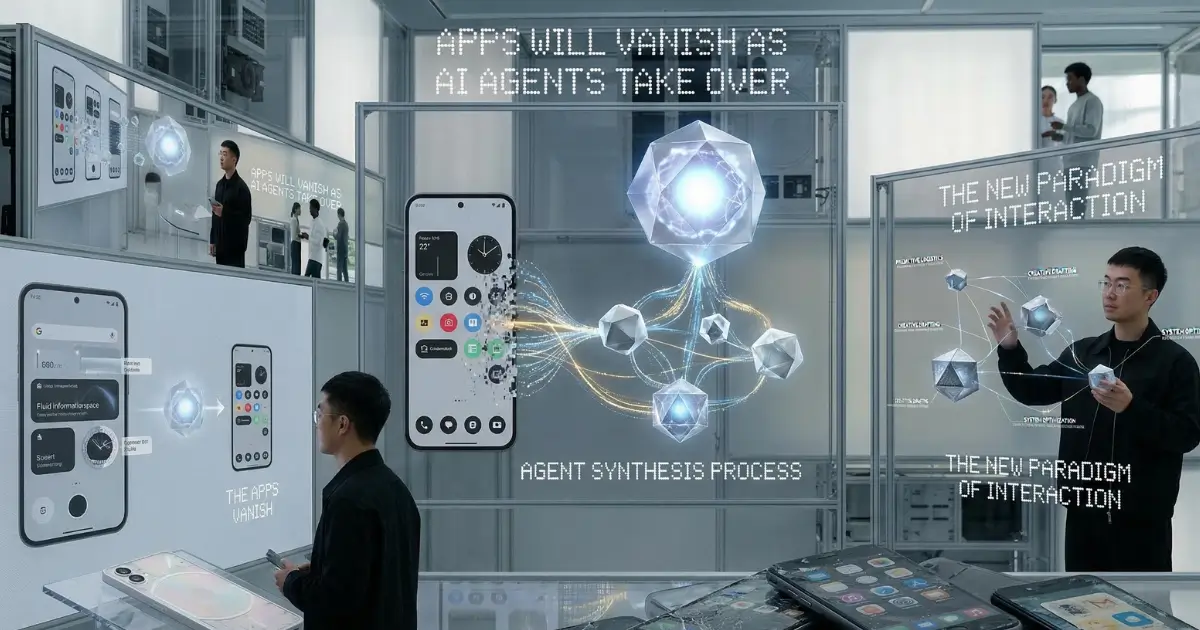
Carl Pei, co-founder and CEO of consumer electronics brand Nothing, is envisioning a future beyond the iPhone — one powered not by apps but by AI agents that act on the user's behalf. Speaking at the SXSW conference in Austin this week, Pei laid out a bold prediction: the app-based smartphone experience that has dominated mobile computing for nearly two decades is heading for extinction.
Apps Are Living on Borrowed Time
Pei stated bluntly that apps are going to disappear, warning founders and startups that if their core value resides in a standalone app, disruption is inevitable. His argument is rooted in frustration with how little the fundamental smartphone experience has evolved since the original iPhone launched.
He pointed out that today's phones still rely on lock screens, home screens, and full-screen apps downloaded from an app store — a user experience that closely mirrors the Palm Pilots and PDAs of twenty years ago. Despite enormous advances in underlying technology, the way people actually interact with their devices has remained largely static.
Pei illustrated the inefficiency with a simple example. Something as basic as grabbing coffee with a friend requires jumping through four separate apps — a messaging platform, a maps service, a ride-hailing app, and a calendar. Each step demands manual input, and none of those apps communicate seamlessly with each other.
The AI-First Device Vision
Rather than incremental improvements to the current model, Pei is betting on a fundamentally different approach. His vision for the AI-first smartphone is a device that knows the user well enough to understand their intentions and execute tasks without being explicitly commanded to do so.
He outlined the progression in stages. The first step, already being tested by some companies, involves AI that can carry out specific commands on a user's behalf, such as booking flights or hotels. Pei dismissed this as unexciting.
The more interesting phase arrives when AI begins learning a user's long-term intentions. If someone wants to live healthier, for instance, the device could proactively deliver nudges and suggestions tailored to that goal. Pei compared this to something like ChatGPT's memory feature, but applied at the operating system level.
The most powerful stage, according to Pei, is when the system knows users well enough to surface ideas and suggestions they haven't even thought of yet — anticipating needs rather than simply responding to requests.
A New Kind of Interface
The implications extend beyond intelligence to interface design itself. Pei argued that future devices will need interfaces designed not for humans to navigate, but for AI agents to use. Current approaches where AI agents attempt to mimic human touch — tapping through menus and swiping through options — are a dead end in his view.
He emphasized that the future is not the agent using a human interface, but rather creating an interface purpose-built for the agent itself. This represents a philosophical shift: the phone stops being a tool the user operates and becomes an assistant that operates on the user's behalf.
Nothing's Bet on the Future
This vision is not merely theoretical for Nothing. The AI-first device concept played a central role in the company's $200 million Series C funding round last year, led by Tiger Global. At the time, Nothing pitched a new kind of smartphone built around AI and personalization technology accurate enough that users would not feel compelled to second-guess its output.
Pei acknowledged that apps will not vanish in the near term. Nothing's own operating system currently allows users to vibe code their own mini apps. But the trajectory, in his view, is clear: eventually the AI will need to interact with services in a frictionless, machine-native way rather than navigating interfaces built for human fingers.
A 20-Year Paradigm Under Threat
Pei's comments add to a growing chorus of tech leaders questioning whether the app ecosystem can survive the AI era. As agents become more capable of handling multi-step tasks autonomously, the very concept of opening, navigating, and switching between individual apps begins to feel like an unnecessary bottleneck.
Whether Nothing can deliver on this vision remains to be seen. Building an AI agent capable of reliably handling the complexity of everyday life is an enormous technical challenge, and consumer trust in fully autonomous device behavior is still fragile. But if Pei is even partially right, the smartphone as we know it — home screen, app grid, and all — may be on its way to becoming a relic.