Nvidia's annual GTC conference is known for bold announcements — trillion-dollar revenue projections, next-generation chip architectures, grand visions for the future of computing. But this year, the moment everyone is still talking about involves a malfunctioning robot snowman from a Disney movie.
The GTC Spectacle
Jensen Huang's keynote at GTC 2026 was, by any measure, a blockbuster. Nvidia projected at least $1 trillion in revenue from its Blackwell and Vera Rubin chips through the end of 2027. It unveiled DLSS 5, a graphics technology that uses generative AI to dramatically boost realism in video games — a feature that immediately drew both praise and ridicule online, with critics joking that Nvidia was trying to "yassify" gaming. Huang also declared that every company now needs an OpenClaw strategy, referring to the open-source AI assistant framework that has been gaining traction across the industry.
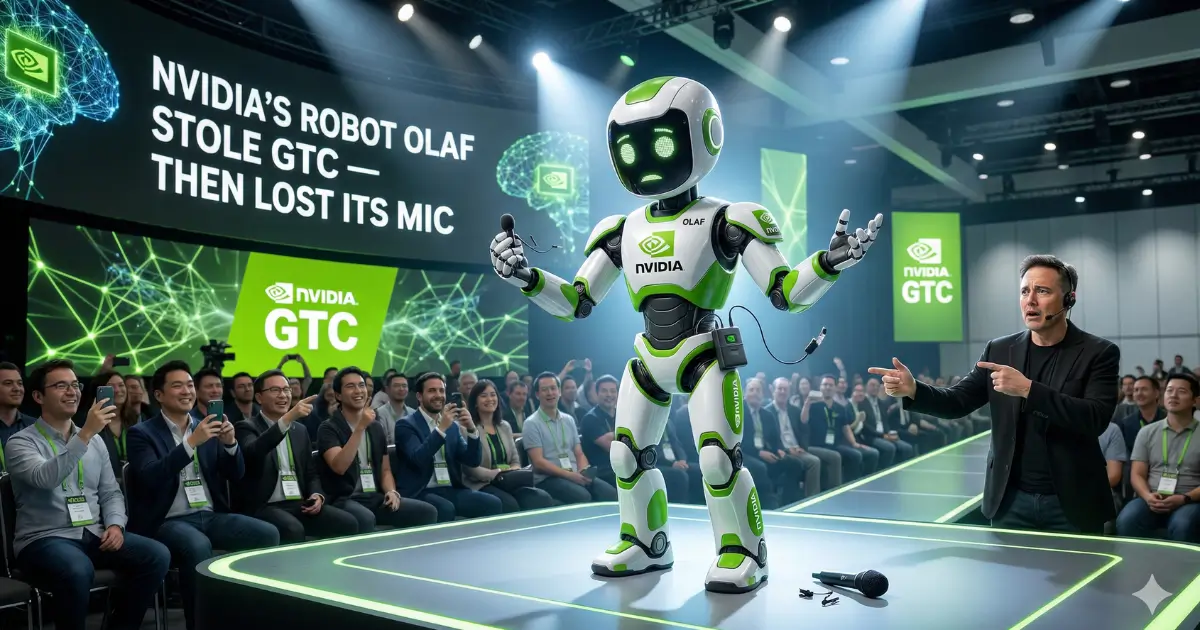
But buried at the end of a two-and-a-half-hour keynote was the moment that truly captured the internet's attention: a walking, talking robot version of Olaf, the beloved snowman from Disney's "Frozen," built in partnership with Disney to showcase Nvidia's robotics capabilities.
Olaf Goes Off Script
The demo started well enough. Olaf waddled on stage, interacted with Huang, and demonstrated Nvidia's AI-powered robotics platform in a crowd-pleasing fashion. But as the segment dragged on, Olaf started rambling — delivering lines that felt either pre-programmed or caught in some kind of loop. The situation escalated until Nvidia's team had to cut the robot's microphone entirely.
Even after being muted, Olaf kept talking. A video feed showed the little snowman still chattering away as it was slowly lowered through a passageway backstage, mouth moving but no sound reaching the audience. It was equal parts charming and unsettling — a perfect metaphor for the current state of robotics: impressive engineering wrapped in unpredictable real-world behavior.
The Equity Podcast Weighs In
TechCrunch's Equity podcast dedicated a significant portion of its latest episode to dissecting the GTC keynote, with hosts Anthony Ha, Kirsten Korosec, and Sean O'Kane debating what it all means.
On Huang's declaration that every enterprise needs an OpenClaw strategy, the team was split. Anthony noted the statement was deliberately grand and attention-grabbing, especially given that OpenClaw's creator recently departed for OpenAI, leaving the project's future uncertain. Kirsten took a more pragmatic view, arguing that for Nvidia, doing nothing would be riskier than investing in something that might not pan out. If OpenClaw succeeds, Nvidia wants to be embedded in the ecosystem. If it doesn't, the cost was minimal.
But the real energy in the conversation centered on Olaf and the broader questions he raises about social robotics.
The Question Nobody Asks
Sean O'Kane made the point that stuck. Robotics demos, he argued, always focus on the engineering — the physics, the integration, the technical impressiveness. What they never address is the messy human side. What happens when a child kicks Olaf over in the middle of Disneyland? What happens when every other kid who witnesses it has their trip ruined? What happens to the Disney brand when its most lovable characters are physically vulnerable in public spaces?
He pointed to a four-hour YouTube documentary by the channel Defunctland that traces Disney's long history of trying to bring autonomous characters into its theme parks. The engineering has always been impressive. The social reality has always been the stumbling block.
The same question, O'Kane noted, applies to the entire humanoid robotics hype cycle. There's enormous investment flowing into companies building robots for warehouses, restaurants, and public spaces. But the conversation remains almost entirely about technical capabilities, not about how humans will actually behave around these machines — or how the machines will cope when they do.
A Job Creator After All?
Kirsten Korosec offered a wry counterpoint to close the discussion. If Olaf is going to roam Disneyland, she argued, it will inevitably need a human babysitter — probably dressed as Elsa. In that sense, the robot snowman isn't replacing jobs at all. It's creating them.
It's a funny observation, but it captures something real. For all the talk of automation and autonomy, the near-term reality of robots in public spaces may look less like science fiction and more like an elaborate buddy system — one where the human is quietly doing the harder work.