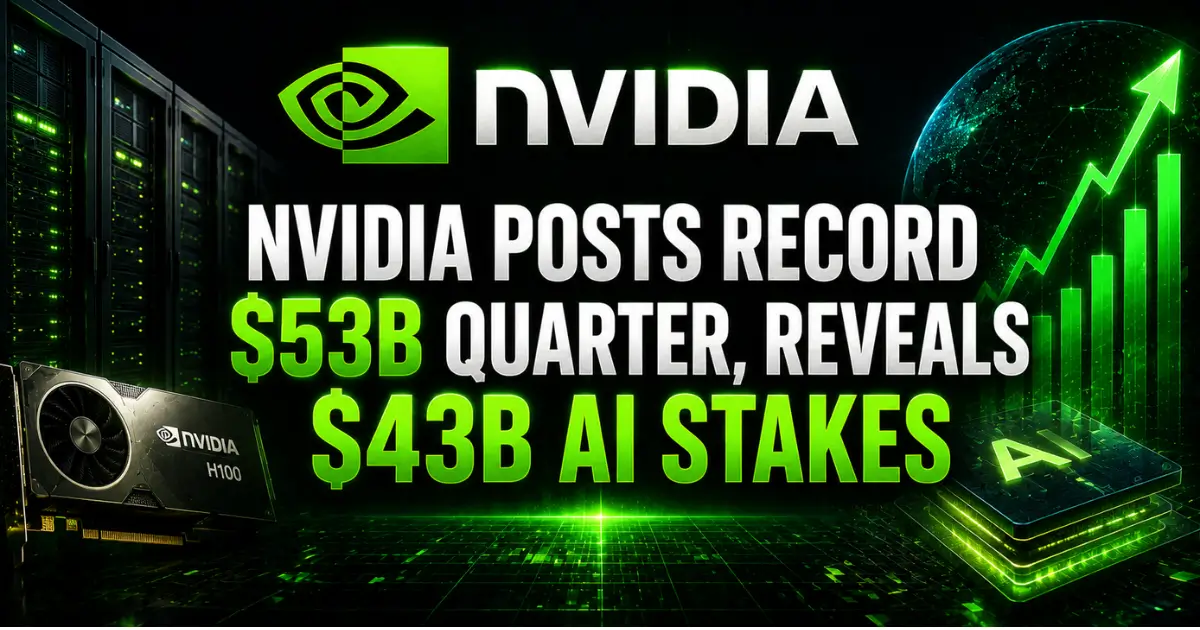

The CEO of the world's most valuable company earns a base salary of roughly $2 million — less than many mid-level executives at rival tech firms. But Jensen Huang's real compensation story has never been about the salary line. Nvidia has now adopted a new variable compensation plan for fiscal 2027 that sets Huang's target cash bonus at $4 million, tying payouts directly to revenue performance during a year when the company is forecasting $78 billion in first-quarter sales alone. In an era where AI spending is reshaping corporate balance sheets globally, how Nvidia pays its CEO tells us exactly how confident the chipmaker is in the demand cycle ahead.
Inside the Fiscal 2027 Bonus Framework
Bonus Tiers and Payout Mechanics
Nvidia's compensation committee approved the fiscal 2027 plan on March 2, 2026. The framework is performance-based and applies to the full fiscal year ending January 31, 2027. Here is how the bonus tiers break down for Huang:
Target bonus: $4 million — equal to 200% of his base salary
Threshold payout: 50% of target ($2 million) if minimum revenue benchmarks are met
Maximum payout: 200% of target ($8 million) if Nvidia exceeds its stretch revenue goals
Other named senior executives — including CFO Colette Kress and executive vice presidents Ajay Puri, Debora Shoquist, and Timothy Teter — each carry a target bonus of $1.5 million, representing 150% of their base salaries.
Where Cash Fits in the $49.9 Million Package
The $4 million cash bonus is a fraction of Huang's total compensation. In fiscal 2025, his total pay package reached $49.9 million, with stock awards worth $38.8 million making up the bulk. The cash bonus is the performance-linked variable layer on top of equity grants that rise or fall with Nvidia's long-term share price.
Notably, Nvidia raised Huang's base salary by 50% last year — from $1 million to $1.5 million — marking the first increase in a decade. The latest filing suggests another increase of roughly 33%, bringing the base to approximately $2 million.
The Strategic Read: What Nvidia's Board Is Really Saying
A $78 Billion Bet Baked Into the Bonus
Tying executive bonuses to revenue targets is standard practice. What makes this filing notable is the context. Nvidia just reported better-than-expected results for the January quarter and guided fiscal Q1 revenue to $78 billion, plus or minus 2%. Setting a revenue-linked bonus plan immediately after issuing that guidance signals that Nvidia's board expects the AI infrastructure spending wave to hold through at least early 2027.
The $2 Million Salary in a $4 Trillion Company
Huang's $2 million base salary is remarkably low for a company with a market capitalization exceeding $4 trillion. That structure is deliberate — it ties the vast majority of his compensation to Nvidia's stock performance and now, explicitly, to revenue execution. For investors, this alignment between CEO incentives and shareholder returns is a governance feature, not a quirk.
Bottom Line
Huang's $4 million target cash bonus is 200% of his base salary, with a maximum payout of $8 million if Nvidia exceeds stretch revenue goals.
The plan is strictly revenue-linked, reinforcing Nvidia's bet that AI chip demand will sustain through fiscal 2027.
Huang's total compensation reached $49.9 million in fiscal 2025, with stock awards representing nearly 78% of the package.
Senior executives carry $1.5 million bonus targets at 150% of base salary, applying the same performance framework across the C-suite.
The Fine Print: Risks and Blind Spots
$50 Million CEO Pay During Industry Layoffs
Nvidia's dominance in AI hardware has generated extraordinary shareholder value. But as the company's chips become critical infrastructure for everything from healthcare to defense, questions about executive compensation will intensify. A CEO earning nearly $50 million while the broader tech workforce faces layoffs and cost-cutting creates a tension that governance committees must navigate carefully.
When Revenue Is the Only Scorecard
Linking bonuses purely to revenue carries a known risk: it can incentivize top-line growth at the expense of margin quality, customer concentration discipline, or long-term R&D investment. Nvidia's current position — where demand far outstrips supply — makes this a theoretical concern for now. But if the AI spending cycle softens, revenue-only metrics could push decision-making in suboptimal directions.
What the Filing Doesn't Tell You
Nvidia deserves credit for disclosing the plan's mechanics in detail. However, the filing does not specify the exact revenue thresholds that trigger each payout tier. Without those numbers, outside observers cannot fully evaluate whether the targets represent genuine stretch goals or comfortable benchmarks the company already expects to clear.
Looking Ahead: Fiscal 2027 as the Proving Ground
Nvidia's fiscal 2027 will be the defining test of whether AI infrastructure spending is a sustained secular trend or a cyclical surge approaching its peak. The $78 billion Q1 revenue forecast sets a high baseline. If Nvidia meets or exceeds that pace across four quarters, Huang's maximum $8 million bonus becomes a certainty — and a footnote in a much larger story about sustained AI demand.
Watch for two developments. First, whether Nvidia introduces equity-linked performance metrics alongside revenue targets in future compensation cycles, which would signal a shift toward longer-term alignment. Second, how competitors like AMD and Intel structure their own executive incentive plans in response — compensation design is a competitive tool in the talent war for semiconductor leadership.
The $4 million headline number is modest by mega-cap CEO standards. The real story is what it reveals: Nvidia is so confident in its revenue trajectory that it is willing to put executive pay on the line to prove it.