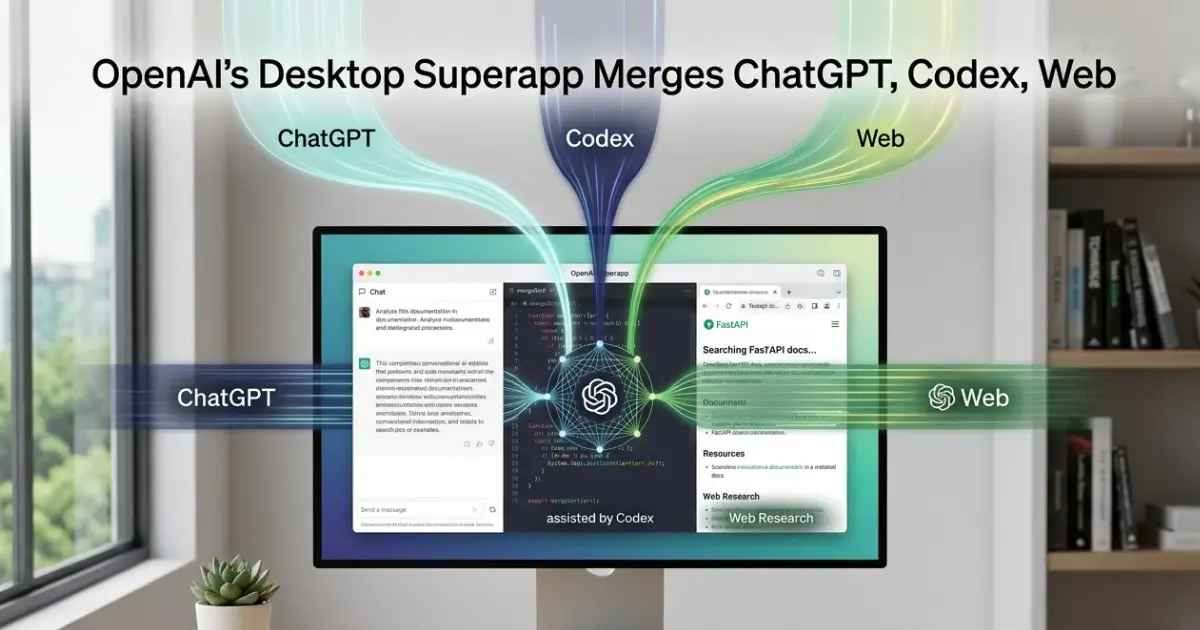
OpenAI is making its boldest product move yet. The company has confirmed plans to merge its ChatGPT application, Codex coding tool, and web browser into a single desktop "superapp," signaling a dramatic shift in how millions of people will interact with artificial intelligence. Rather than juggling multiple standalone tools, users will soon have one unified platform for conversation, code generation, and web navigation — all powered by AI.
Too Many Apps, Not Enough Focus
The decision stems from an internal recognition that OpenAI had stretched itself too thin. After launching ChatGPT in late 2022, the company entered a period of rapid product expansion, releasing a dedicated coding assistant, a standalone browser, and a growing list of features at a pace few startups could match. But that speed came at a cost. In an internal memo, Fidji Simo, OpenAI's CEO of Applications, acknowledged that maintaining separate products was creating fragmentation, slowing development, and making it harder to deliver the level of quality the company expected. The superapp is her answer: consolidate everything into one cohesive experience and refocus engineering resources where they matter most.
One Window to Rule Them All
The vision is compelling in its simplicity. Instead of switching between a chat interface, a coding environment, and a browser, users would operate entirely within a single application. A developer could research documentation through the built-in browser, ask ChatGPT to explain a tricky concept, and then have Codex generate the actual code — all without ever leaving the window. For knowledge workers, it could mean drafting a report while pulling in live web data and asking the AI to fact-check claims in real time. The goal is to eliminate the context-switching that fragments modern digital workflows and replace it with a seamless, AI-native workspace.
Agentic AI at the Core
What makes the superapp more than a simple bundling exercise is its underlying architecture. OpenAI is building the platform around agentic AI capabilities, meaning the system will be able to autonomously execute complex, multi-step tasks on behalf of users. Rather than simply responding to prompts, the AI could independently browse the web for information, write and test code, analyze datasets, and present finished results — all with minimal human intervention. This represents a meaningful leap from the conversational chatbot experience most users know today toward something closer to a digital colleague that can handle real work.
The Competitive Pressure
The timing is no accident. OpenAI faces mounting competition from Anthropic, whose Claude tools have gained significant traction among developers, and from Google, which continues to embed its Gemini models across a sprawling product ecosystem. By unifying its offerings, OpenAI is betting that a tightly integrated platform will be stickier than a collection of disconnected apps. The move also aligns with broader industry trends, as companies like Notion and others have found success by evolving from single-purpose tools into all-in-one workspaces that reduce friction.
The Microsoft Question
One of the most intriguing subplots is how this strategy will sit with Microsoft, which has invested over thirteen billion dollars in OpenAI and already embeds its models across Windows, Edge, and Office. A unified OpenAI desktop app that handles chat, coding, and browsing could step directly on the toes of Microsoft 365 and GitHub Copilot. Both companies continue to describe their relationship as a partnership, but a superapp that competes for the same workspace attention could test that dynamic in uncomfortable ways.
An IPO on the Horizon
The consolidation also carries a clear business logic. OpenAI is widely expected to pursue an initial public offering as soon as this year, and a single flagship product tells a cleaner story to investors than a scattered portfolio of experiments. Subscription tiers, enterprise licensing, and ecosystem lock-in are all easier to build around one platform than around half a dozen. Simo, who previously led Instacart, has been driving a culture of product discipline inside OpenAI in preparation for this next chapter.
What It Means for Users
For everyday users, the promise is straightforward: one app that replaces the tab chaos of modern knowledge work. If OpenAI can deliver a superapp that genuinely integrates conversation, coding, and browsing without sacrificing the power of each individual tool, it could redefine what people expect from their desktop. The AI era's first true productivity platform may be just months away.