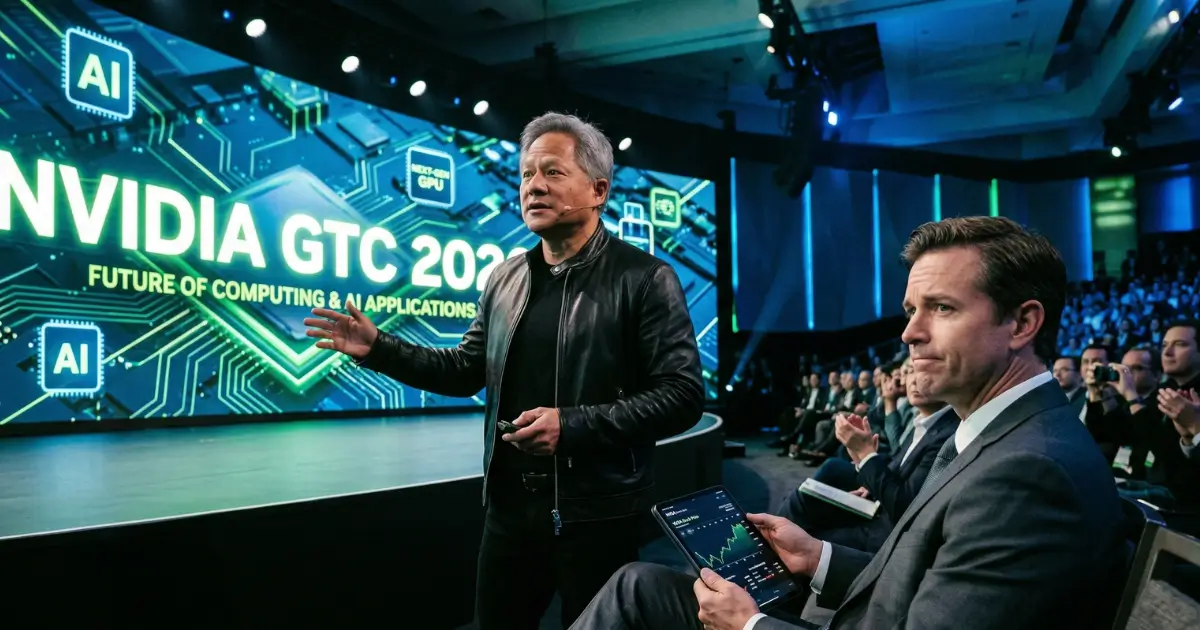
Jensen Huang delivered everything Nvidia investors could have asked for. A two-and-a-half-hour keynote packed with new products, record-breaking revenue figures, trillion-dollar market projections, and a confirmed one-million-GPU deal with Amazon. And yet, the moment the Nvidia CEO took the stage at the company's annual GTC conference on Monday, the stock started falling. Wall Street, it turns out, is not buying the hype — at least not right now. The disconnect between Silicon Valley's boundless optimism and the financial markets' growing anxiety tells a revealing story about where the AI industry stands in early 2026.
The Keynote Had Everything — Except a Rally
Huang's GTC presentation was, by any measure, a spectacle. He unveiled new video game graphics technology, updated networking infrastructure, autonomous vehicle partnerships, and a new chip designed in collaboration with Groq to accelerate AI inference within the upcoming Vera Rubin system. He described the AI agent ecosystem as a 35 trillion dollar market and the physical AI and robotics industry as a 50 trillion dollar opportunity. He projected one trillion dollars in purchase orders for the company's Blackwell and Vera Rubin chips alone by the end of 2027. In any other era, numbers like these would have sent a stock soaring. Instead, Nvidia's share price drifted downward as investors weighed the promises against a growing unease about the sustainability of the AI boom.
Markets Hate Uncertainty
The core issue, according to analysts, is not that Nvidia's business is weak — it clearly is not. The problem is that the pace of AI innovation has outrun Wall Street's ability to model it. Daniel Neuman, CEO of the research firm Futurum, explained that AI is moving so fast that investors cannot yet grasp what it will mean for the broader economy and the societal structures built around it. The technology is transformational, but that very speed has introduced a kind of uncertainty that financial markets find deeply uncomfortable. When the future is unclear, even extraordinary results in the present struggle to move the needle.
The ROI Question Lingers
Adding to the anxiety are persistent headlines about low enterprise adoption of AI and unclear returns on investment. While surveys continue to suggest that many businesses are struggling to demonstrate tangible financial gains from their AI spending, Neuman argues those reports are already outdated by the time they are published. He believes enterprise adoption is approaching an inflection point and that the lag in data collection is masking real momentum on the ground. Still, for investors scanning headlines, the narrative that companies are pouring money into AI without seeing results is a powerful deterrent — even if the underlying reality is more nuanced.
The Numbers Tell a Different Story
Nvidia's own financials paint a picture that is hard to argue with. The company's revenue surged 73 percent year-over-year last quarter, continuing a streak of not just meeting but dramatically exceeding Wall Street's estimates. And the pipeline shows no signs of slowing. This week alone, Nvidia confirmed that Amazon has committed to purchasing one million GPUs, along with additional AI infrastructure, by the end of 2027 for Amazon Web Services. Kevin Cook, a senior equity strategist at Zacks Investment Research, pointed out that regardless of investor sentiment, the entire stock market is effectively propped up by Nvidia because its technology underpins so much of the modern economy. The infrastructure Nvidia builds runs the rails for businesses across hardware, software, and an emerging category of physical AI that now includes companies as traditional as Caterpillar.
Bubble Talk Versus Business Reality
None of this means an AI bubble is impossible. Valuations remain stretched, expectations are sky-high, and the gap between spending on AI infrastructure and demonstrable returns continues to fuel scepticism. But the uncertainty Wall Street is pricing in does not appear to be a problem specific to Nvidia. The company's technology is clearly in demand, its revenue growth is extraordinary, and its customer base includes the largest technology companies on the planet. The broader market's nervousness seems less about Nvidia's fundamentals and more about a collective inability to forecast where AI is heading and how fast it will get there.
Nvidia Barrels Ahead Regardless
While Wall Street hesitates, Nvidia is not slowing down. Huang closed his keynote by positioning the company as a platform business sitting at the centre of a hundred-trillion-dollar global economy. The conference may not have delivered the stock bounce investors hoped for, but Nvidia's trajectory remains undeniable. The question is no longer whether the company can deliver — it is whether the rest of the world can keep up with what it is building. For now, the markets are choosing caution. Nvidia is choosing speed.