 Reviewed by Amit Kumar
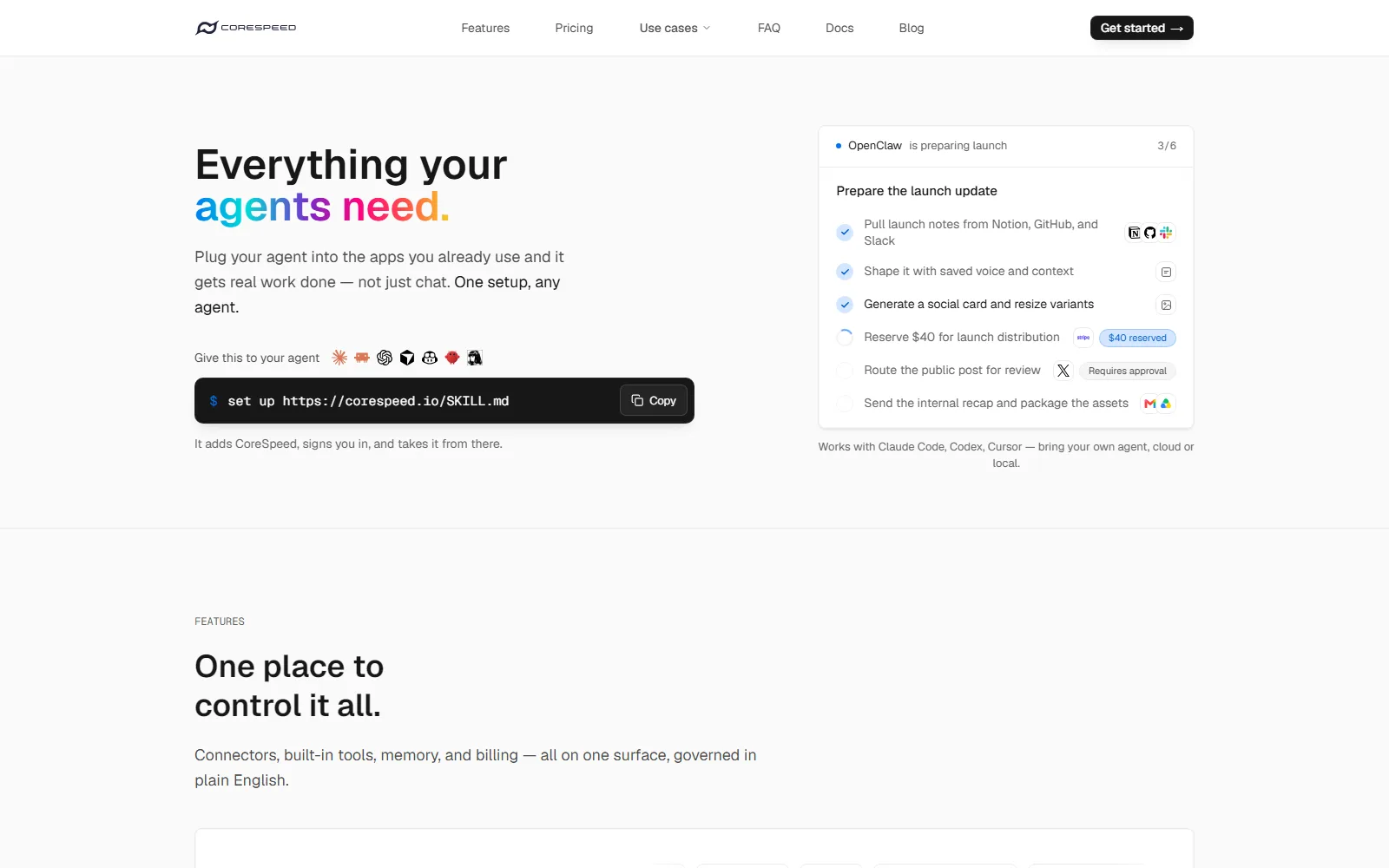
CoreSpeed is an MCP access layer for AI agents: one authenticated endpoint that carries your OAuth-connected apps, team memory, and built-in media, web and social tools, with spend caps and an activity log. Free costs $0 and gives 3,000 credits for 90 days; CoreSpeed Pro is $20 a month. We checked corespeed.io on 4 October 2026.
Fact-checked reviewAutomation

CoreSpeed Review: MCP Layer for Agents, Pricing
MCP access layer for AI agents
Quick verdict
The pricing is easy to follow, with a public rate card and a stated exchange rate of 1,000 credits to $1. The catch is the Free plan. Its credits expire after 90 days and it has no top-up, so anything beyond a short trial means Pro. Metered tools also vary a lot in cost, and some premium connector actions can burn credits fast. You need an MCP-capable agent client to use any of it.
Best forCloud and unattended agentsShared memory across agentsSpend caps for agent tools
How we reviewed CoreSpeed
Every CoreSpeed plan, price and limit in this review comes from CoreSpeed's own pages, checked on , and links to the page it came from. All 8 sources are listed at the end. A review cannot be bought. How these reviews are written
On this page
CoreSpeed at a glance
CoreSpeed is aimed at people whose agents have left a single laptop, running in the cloud, unattended or across several clients, and who do not want connector keys living in environment variables on one machine. The vendor describes it as what cloud agents run on: authorize apps once in the dashboard, connect any MCP-capable agent to https://api.corespeed.io/mcp, and keep memory, connectors and budgets on the CoreSpeed account so they travel when you switch agents. This review draws on the CoreSpeed homepage, pricing page, docs, billing guide, about page and legal pages.
What does CoreSpeed do?
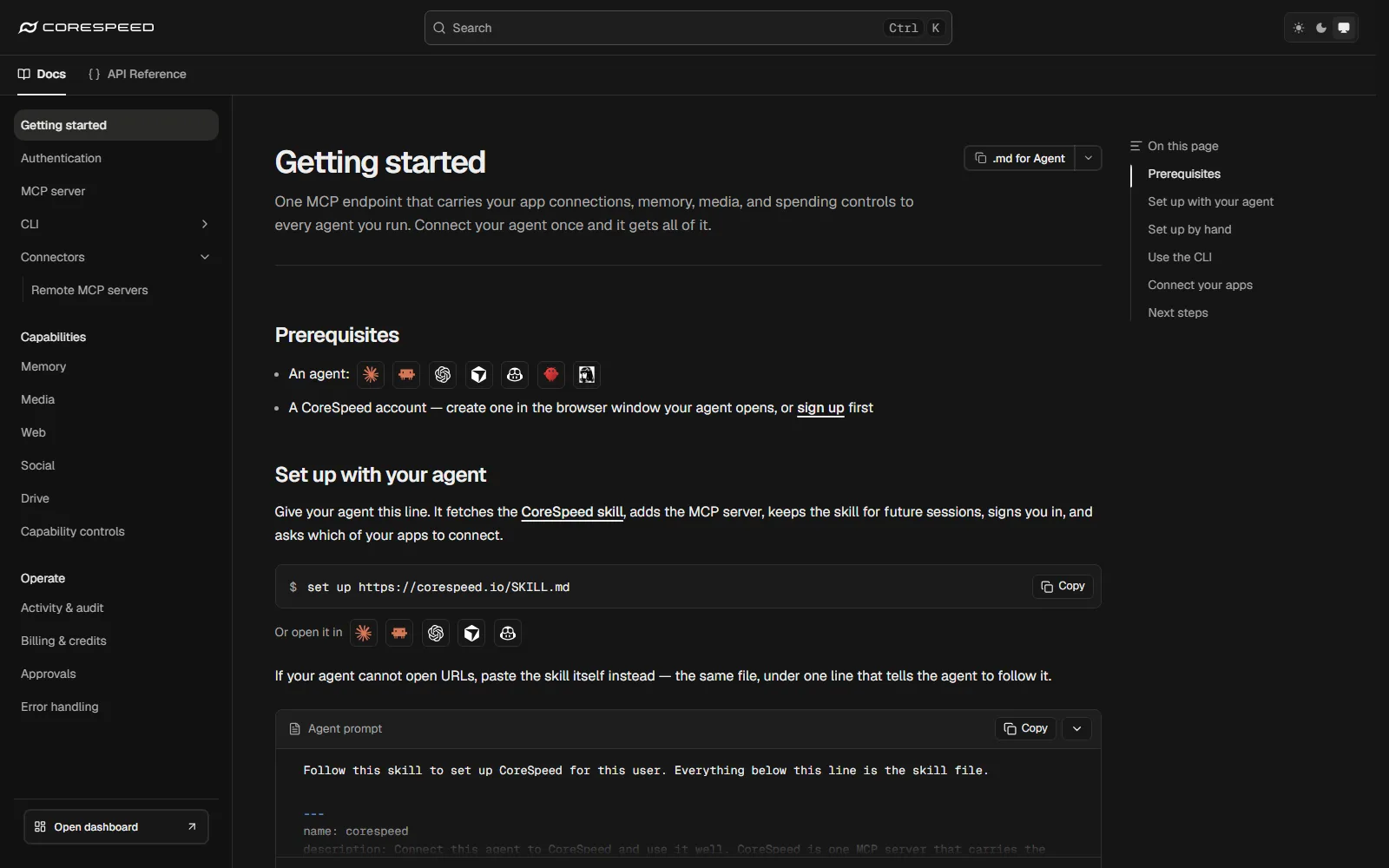
On the homepage and the getting started docs, the job is a single MCP server that exposes connected apps, persistent memory and built-in capabilities as namespaced tools (for example memory__search_memory, media__generate, web__search, social__x_search, and connector tools such as notion__search). Setup can be agent-driven: give the client the line that points at CoreSpeed's SKILL.md, or add the MCP URL by hand for Claude Code, Codex, Cursor, Copilot in VS Code, OpenClaw, Hermes or another MCP client. Headless or CI setups can use API keys created in the dashboard instead of browser OAuth.
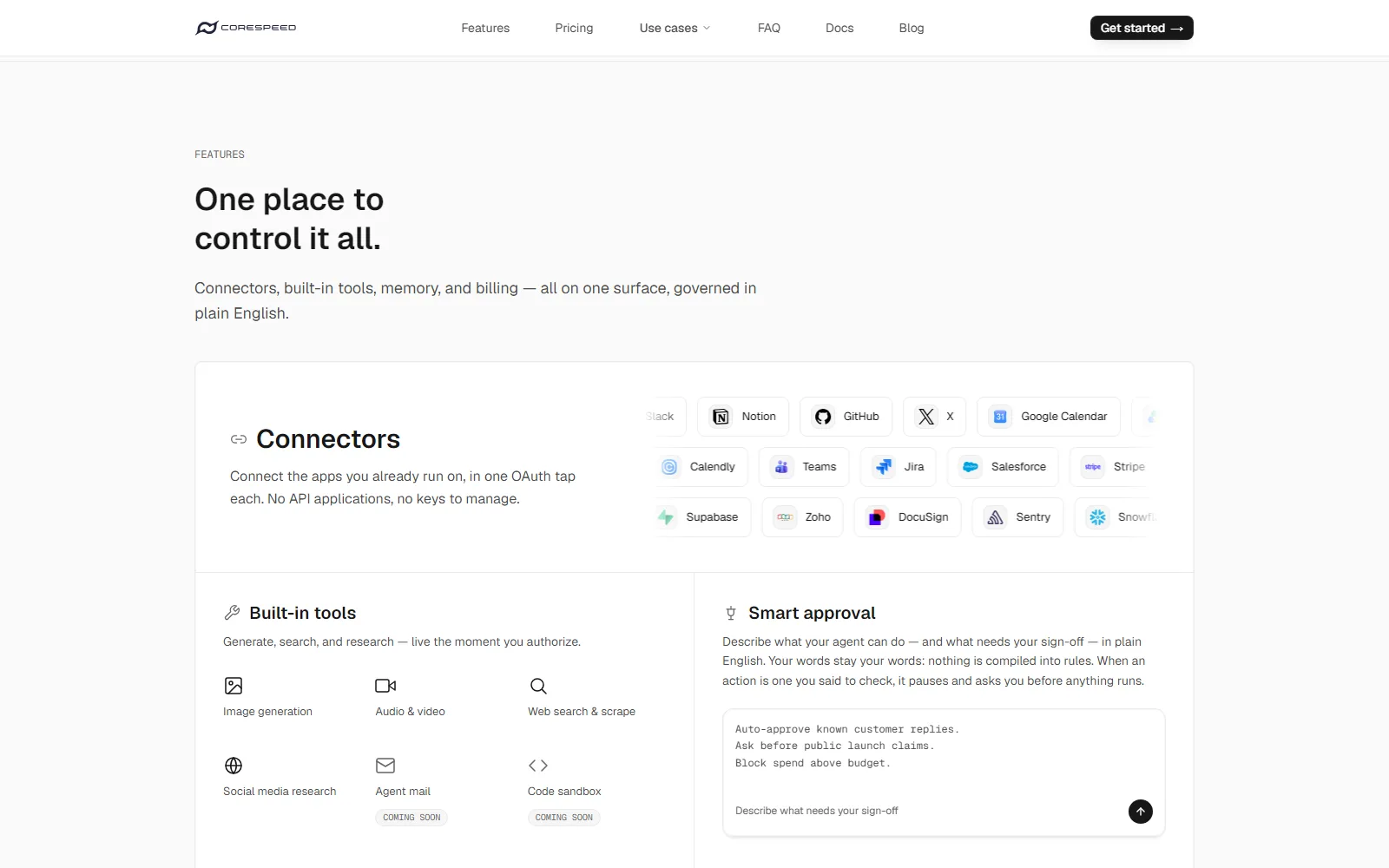
The product surfaces we found documented:
- Connectors. OAuth-backed; the agent gets tools, never the provider credential.
- Memory. Durable account memory across agents and sessions, and memory operations are free on the rate card.
- Media. Built-in generation and analysis.
- Web and collectors. Live web search and scraping, plus collectors for Google Search, Google Maps, Airbnb, TripAdvisor, Amazon and Zillow.
- Social data. Read-only tools for the platforms listed on pricing and docs: X, TikTok, Instagram, YouTube, Reddit, Facebook / Meta Ad Library, Threads and others.
- Controls. Org spend caps, per-API-key monthly limits, approval policies that can pause actions for sign-off, and one activity ledger for what ran, what it cost and whether it worked.
The CLI docs document npx @corespeed/cs for login, keys, connectors and usage (Node.js 20 or Bun).
The homepage FAQ, checked 4 October 2026, claims you do not apply for API access per service: you authorize once via OAuth. It also says CoreSpeed does not see passwords (scoped tokens only), switching agents does not drop app connections or memory, and access can be revoked, exported or deleted anytime. The About page states CoreSpeed Inc. was founded in January 2025 and positions the product as self-serve, with a free tier and a paid plan for teams on one public rate card.
Who CoreSpeed is for, and who should skip it
It fits you if you already run Claude Code, Codex, Cursor, Copilot or another MCP client and want one portable layer for apps, memory and metered research and media tools. It also suits cloud or unattended agents that should not have connector secrets welded to one machine, and anyone who wants org-level credits, spend caps and an audit trail. A free start of 3,000 credits for 90 days with no card is enough to evaluate before Pro at $20 a month.
Skip it in these cases:
- You want a Slack or Teams AI employee that lives in chat, not an MCP layer. Compare Viktor.
- You need an Agent Builder or FDE skill-packaging delivery platform. Compare ZooWork.
- You want an AEO platform for AI-search visibility. Compare Prefer.
- You only need embeddable in-product AI actions inside your own SaaS UI. Compare Yedric.ai.
- You need a forever-free unlimited credit pool. Free's signup credits expire after 90 days and Free has no top-up per the billing docs.
- You require published Enterprise list prices. Enterprise is custom and sold through talk-to-sales.
How much does CoreSpeed cost?
USD, checked 4 October 2026, from CoreSpeed pricing
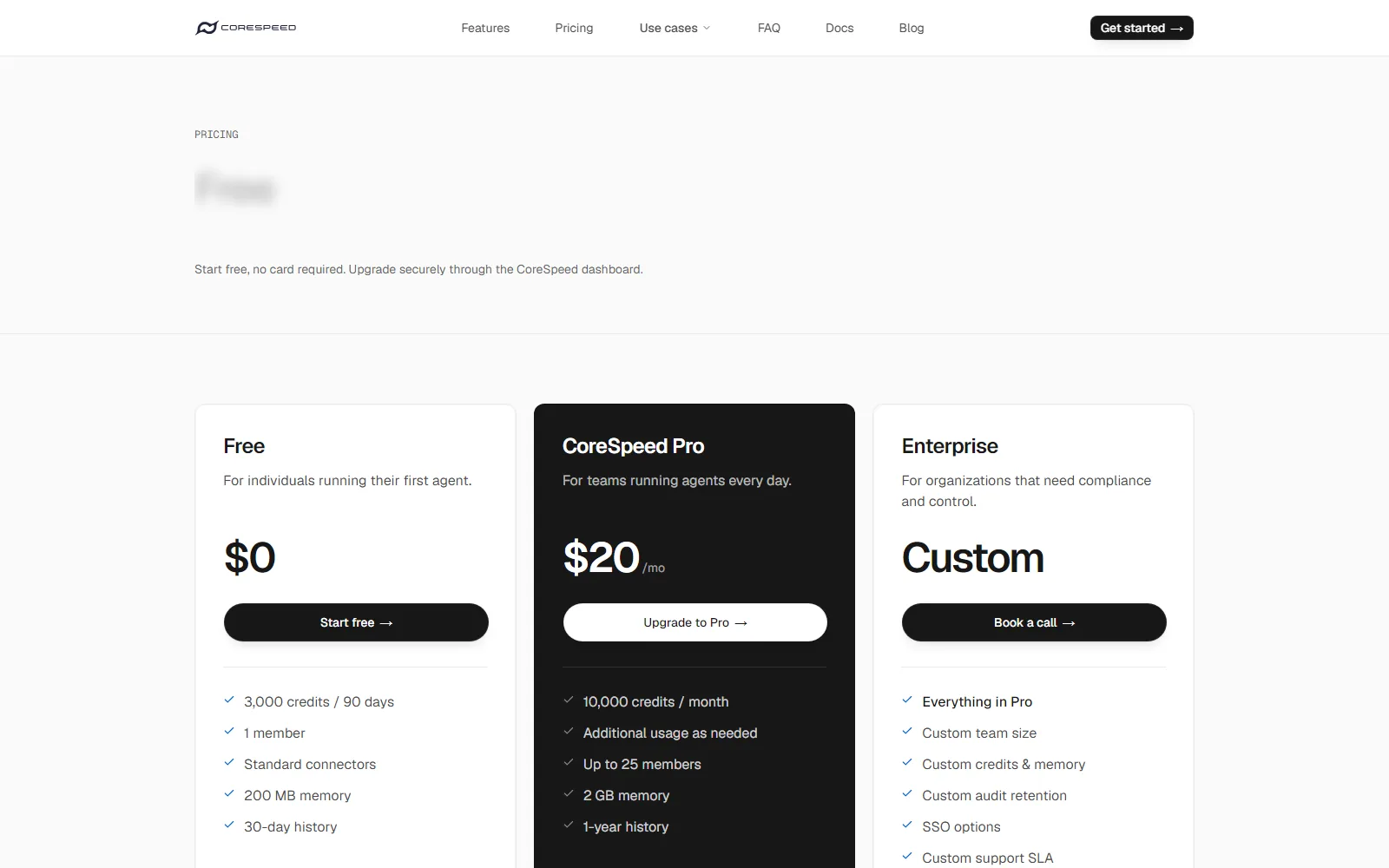
| Plan | Price (USD) | What you get | Where the tier stops |
|---|---|---|---|
| Free | $0 | 3,000 credits / 90 days; 1 member; standard connectors; 200 MB memory; 30-day activity history; unlimited connections (per plan table) | No additional usage or top-ups on Free; signup credits expire 90 days after grant; ongoing volume requires Pro |
| CoreSpeed Pro | $20 / month | 10,000 credits / month; additional usage available; up to 25 members; 2 GB memory; 1-year history; standard connectors; unlimited connections | Org-billed subscription; metered overages via credits and top-ups; not Enterprise SSO, SLA or custom deployment |
| Enterprise | Custom | Everything in Pro plus custom team size, credits and memory, audit retention, SSO options, custom support SLA, compliance and deployment planning | Sales-quoted via intro call; no fixed public dollar SKU on the pricing page checked |
Credit mechanics, from the billing and credits docs: 1,000 credits = $1 (public rate). The signup grant is 3,000 credits with a 90-day expiry, granted once per user to the signup org. Pro credits are 10,000 a month, reset monthly, and are spent before top-ups. Pro top-ups run $5 to $1,000 per checkout and never expire. Re-open those URLs before you subscribe, since rates and plan rows can change.
Credits, rate card and controls
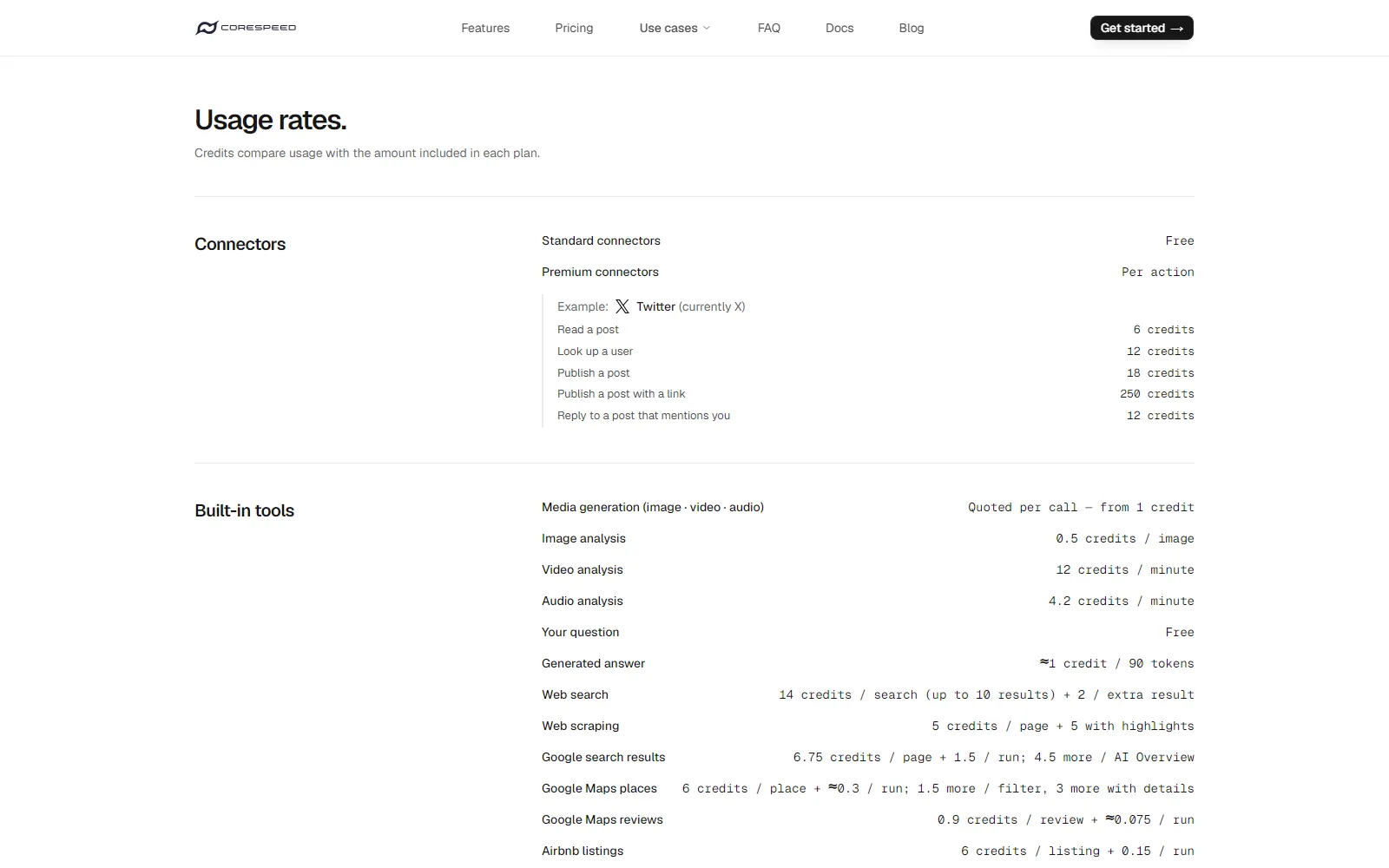
Plans are billed per organization, in USD. Included credits cover the public usage rates on the pricing page, and additional usage is available on Pro and Enterprise. Examples from that rate card, checked 4 October 2026:
- Standard connectors are free, and so are memory operations.
- Premium connector actions are charged per action. The X (Twitter) examples include reading a post at 6 credits and publishing a post with a link at 250 credits.
- Web search is 14 credits per search (up to 10 results), plus 2 per extra result.
- Web scraping is 5 credits per page, plus 5 with highlights.
- Media generation is quoted per call, from 1 credit.
The activity log is the itemized record of charges, and memory and discovery-style calls stay free where the rate card says so. Controls: plain-English approval policies that can pause actions for confirmation, monthly spend caps on API keys, and payment_required refusals when the org wallet crosses its billing threshold. Those refusals happen before the underlying tool runs. The Terms of Use (30 July 2026) state that paid usage runs on credits via Stripe, and that an agent under your key acts as you.
Is CoreSpeed free?
Yes to start. The pricing page, checked 4 October 2026, lists Free at $0 with 3,000 credits valid for 90 days, one member, standard connectors, 200 MB memory and 30-day history, with no card required. That is a time-limited credit grant, not an unlimited forever-free plan, and the billing docs state Free has no top-up path: more metered usage means subscribing to Pro.
Which agents work with CoreSpeed?
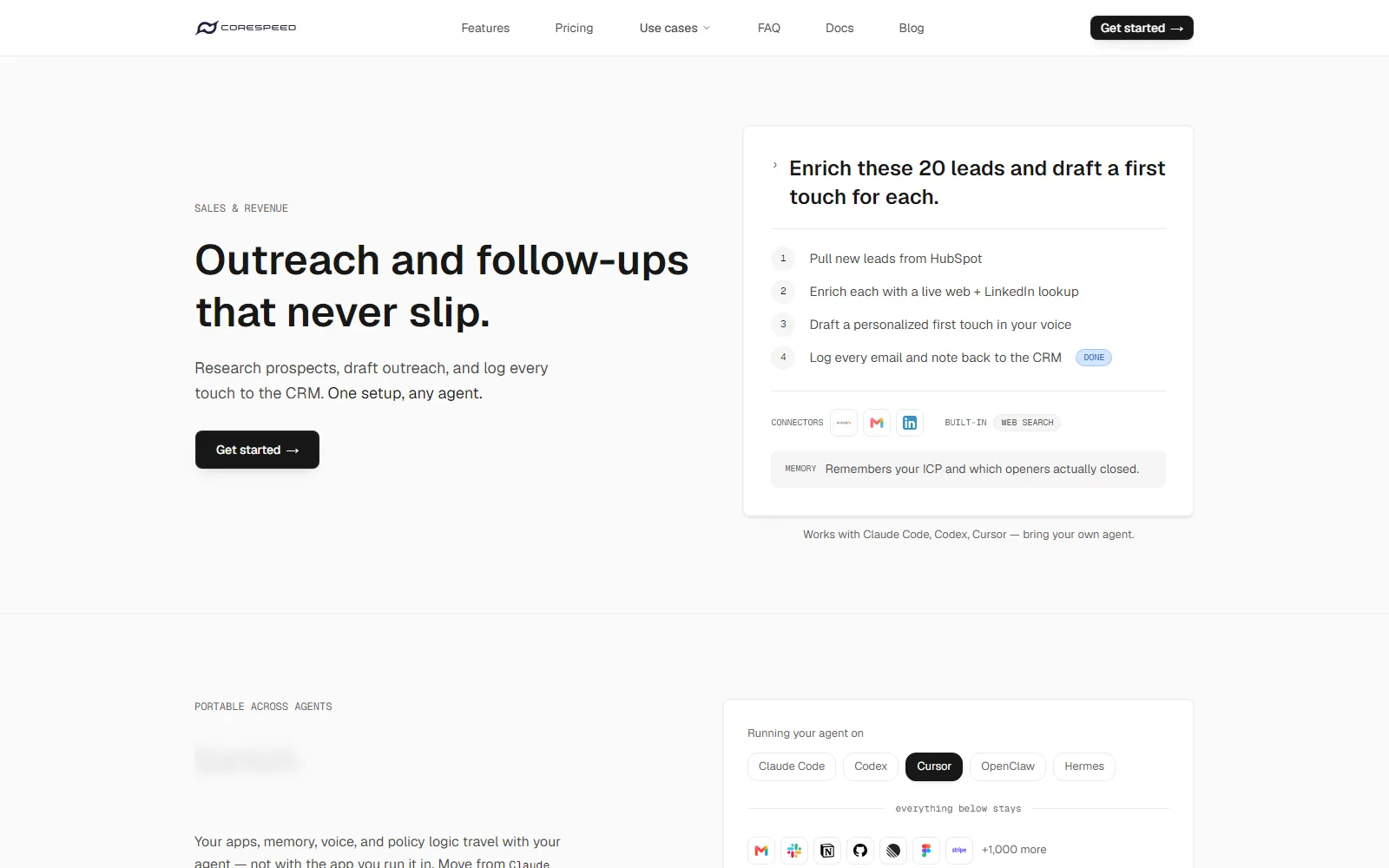
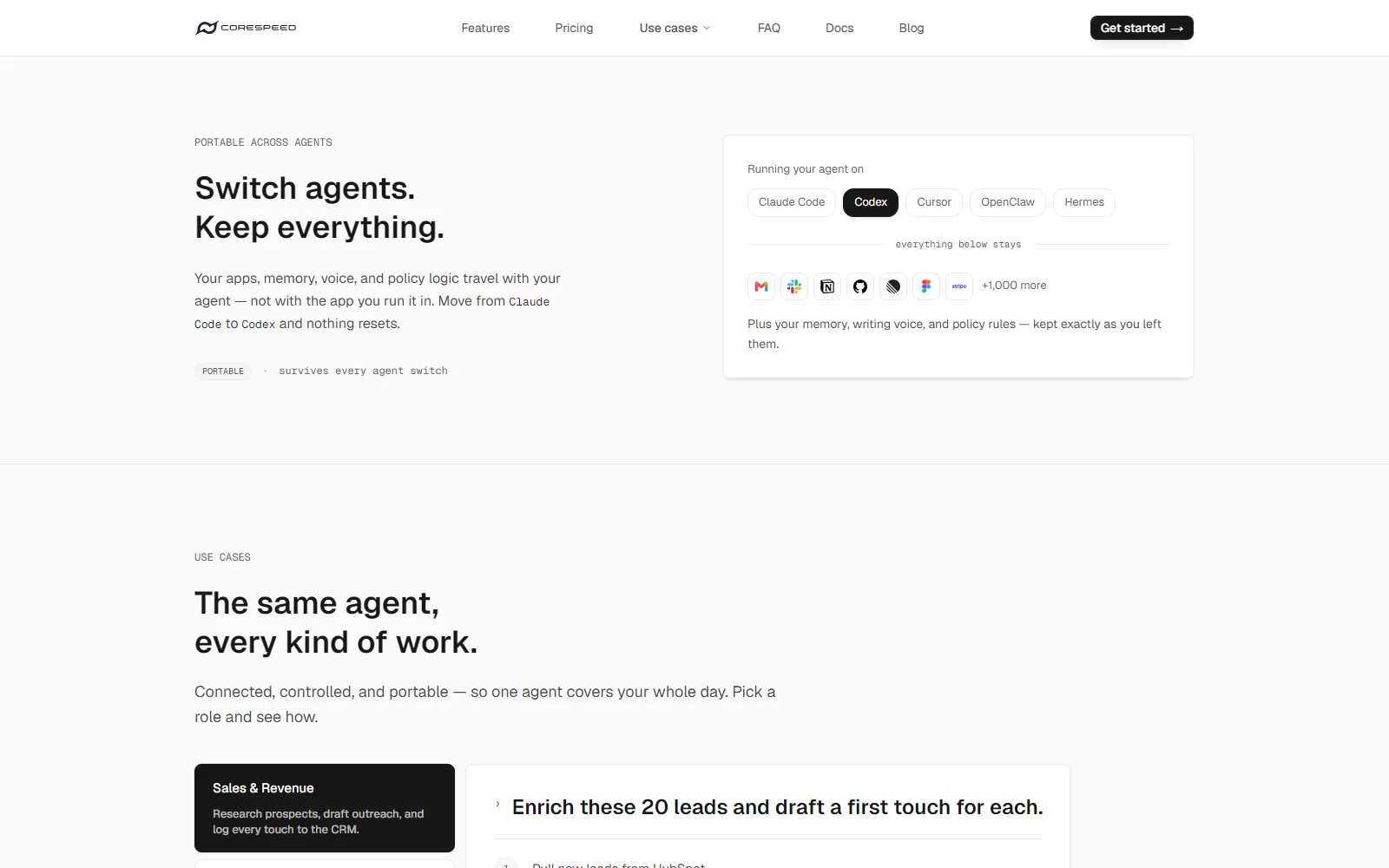
Vendor docs and homepage list Claude, Claude Code, Codex, Cursor, Copilot in VS Code, OpenClaw, Hermes and custom agents. Any MCP client that can reach https://api.corespeed.io/mcp (browser sign-in or API key) is in scope. CoreSpeed positions itself as the access layer underneath those agents, not as a replacement chat app.
Does CoreSpeed store my passwords?
No, according to the homepage FAQ checked 4 October 2026: connections use OAuth 2.0 only, you grant access on each provider's screen, and CoreSpeed receives scoped tokens, not passwords. The Privacy Policy (last updated 19 September 2026) covers the website, dashboard, API and connectors. Re-read it before connecting production accounts.
How CoreSpeed compares with other tools reviewed here
ZooWork. AI agent delivery and Agent Builder (our review, 4 October 2026). Its public USD card shows Pro at $30 a month (list $100, limited promo) with included and bonus credits for builder delivery. Choose ZooWork for FDE and domain-expert skill packaging and managed agent delivery, and CoreSpeed for a portable MCP surface for connectors, memory and metered web, media and social tools under one credit wallet.
Viktor. An AI employee for Slack and Microsoft Teams (our review, 4 October 2026), with $100 of free credits and Team plans from $50 a month in shared workspace credits. Pick Viktor for a chat-native coworker that executes inside Slack or Teams. Pick CoreSpeed for an agent-agnostic MCP layer you attach to Claude Code, Codex, Cursor and similar clients: Pro is $20 a month with 10,000 credits, and the free start is 3,000 credits for 90 days.
Prefer. An AEO platform for AI search visibility. Prefer is about being cited in AI answers; CoreSpeed is about giving your agents connected apps and research tools. Use Prefer for answer-engine visibility work, and CoreSpeed when the bottleneck is agent access, memory portability and spend control.
Browse more development tools, automation tools and productivity tools. Re-check pricing and docs before you buy: this review records what those URLs showed on 4 October 2026.
CoreSpeed screenshots
More of CoreSpeed's own website, captured . Each caption says which page it shows.
Sources
- CoreSpeed homepage: product framing, FAQ, setup line (checked 4 October 2026)
- CoreSpeed pricing: Free, Pro and Enterprise table and usage rates
- CoreSpeed docs, getting started: MCP setup, agents, CLI
- Billing and credits: 1,000 credits = $1, grants, top-ups, caps
- About CoreSpeed: company founding (January 2025), vendor framing
- Terms of Use: last updated 30 July 2026
- Privacy Policy: last updated 19 September 2026
- SKILL.md and llms.txt: agent setup index
CoreSpeed pros and cons
Pros
- Public Free and Pro pricing is clear: $0 with 3,000 credits for 90 days, Pro $20 a month (checked 4 October 2026)
- Agent-agnostic: setup docs cover Claude Code, Codex, Cursor, Copilot, OpenClaw and Hermes
- Credit math is explicit (1,000 credits = $1), with an itemized activity log and API-key spend caps
- Standard connectors and memory operations are free, and connections use OAuth only
- Apps, memory and budgets stay with the account when you switch agents
Cons
- Free credits expire after 90 days and Free has no top-up, so long evaluations need Pro
- Heavy web, social and media usage is metered; some premium connector actions (such as publishing on X) can burn credits fast
- Enterprise is custom-only, with no public list price for SSO, SLA or compliance
- Requires an MCP-capable agent client; not a Slack or Teams chat-native coworker by itself
The bottom line on CoreSpeed
Best for
- Cloud and unattended agents
- Shared memory across agents
- Spend caps for agent tools
Facts checked
Visit CoreSpeedCoreSpeed FAQ
Is CoreSpeed free?
Yes to start. Pricing (checked 4 October 2026) lists Free at $0 with 3,000 credits for 90 days, one member, standard connectors, 200 MB memory and 30-day history, no card required. Free has no top-up; ongoing metered usage needs CoreSpeed Pro.
How much does CoreSpeed cost?
Checked 4 October 2026 on corespeed.io/pricing: Free is $0 (3,000 credits for 90 days); Pro is $20 a month (10,000 credits a month, up to 25 members, 2 GB memory, 1-year history, additional usage available); Enterprise is custom. Per the billing docs, 1,000 credits = $1 and Pro top-ups of $5 to $1,000 never expire. Plans are billed per organization in USD.
What agents work with CoreSpeed?
Docs and homepage list Claude, Claude Code, Codex, Cursor, Copilot in VS Code, OpenClaw, Hermes and custom agents. Any MCP client that can use https://api.corespeed.io/mcp (browser sign-in or API key) is in scope.
How do CoreSpeed credits work?
Metered calls draw from the org wallet. The signup grant is 3,000 credits that expire in 90 days. Pro adds 10,000 credits a month, reset monthly and spent before top-ups. Memory operations are free per the rate card. API keys can have monthly spend caps, and wallets over the threshold refuse metered calls with payment_required.
Does CoreSpeed store my passwords?
No, per the homepage FAQ (checked 4 October 2026): it uses OAuth 2.0 only, with scoped tokens instead of passwords. Read the Privacy Policy (updated 19 September 2026) before connecting production accounts.
How does CoreSpeed compare to Viktor?
Viktor is a Slack or Teams AI employee with $100 of free credits and Team plans from $50 a month (our review, 4 October 2026). CoreSpeed is an MCP access layer (Free 3,000 credits for 90 days; Pro $20 a month) for connectors, memory and metered tools across your existing agent clients.
How does CoreSpeed compare to ZooWork?
ZooWork is an Agent Builder and delivery platform, with a Pro promo from $30 a month on our review (4 October 2026). CoreSpeed is a portable MCP layer with org credits and spend controls. Pick ZooWork for skill packaging and managed delivery, and CoreSpeed for agent-agnostic access to apps, memory and tools.
Who should not use CoreSpeed?
Skip it if you need chat-native Slack or Teams execution without MCP, published Enterprise list prices, a forever-free unlimited credit pool, or a tool for AEO visibility or in-SaaS embeds rather than an agent access layer.
Alternatives to CoreSpeed
 OctriFree plan + paid upgradesOpenAPI spec to docs, SDKs, MCP server and monitoring
 ViktorFree plan + paid upgradesAI coworker in Slack and Teams that does the work
 ZooWorkPaid onlyPackage expert know-how into managed AI agents
 AyvenFree plan + paid upgradesAI coordinator that chases team tasks in Slack and Teams
 EdgeeFree plan + paid upgradesGateway that routes, compresses and meters agent tokens

Reviewed by
Amit Kumar
Full Stack AI Strategist
Amit Kumar runs MPAT, where he reviews AI tools and writes its guides. When he covers a tool he checks its pricing, credits and plan limits against the vendor's own pages, so readers know what a plan includes before they pay. He also leads the site's SEO and AI-focused content strategy.