
 Compiled by Amit Kumar
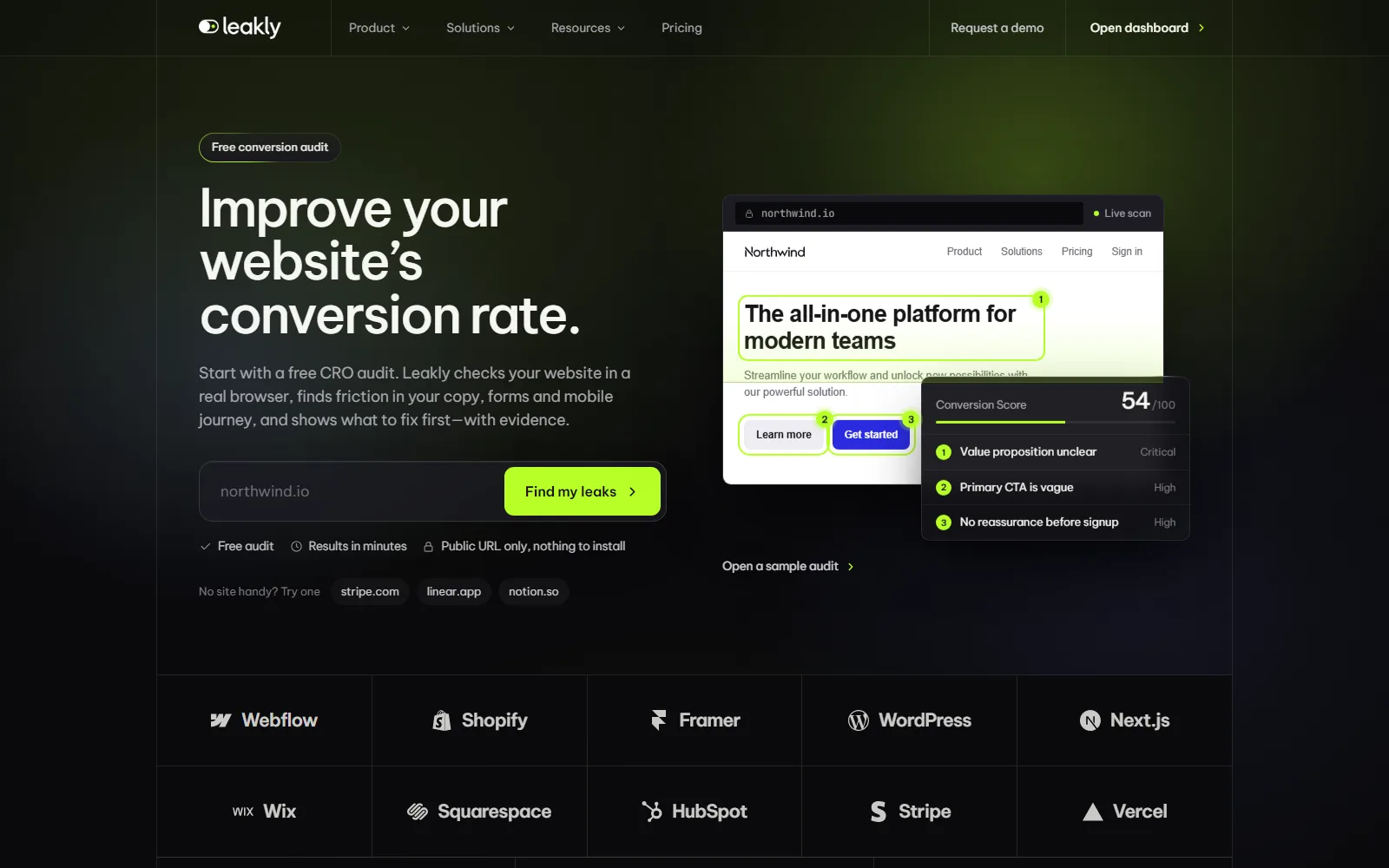
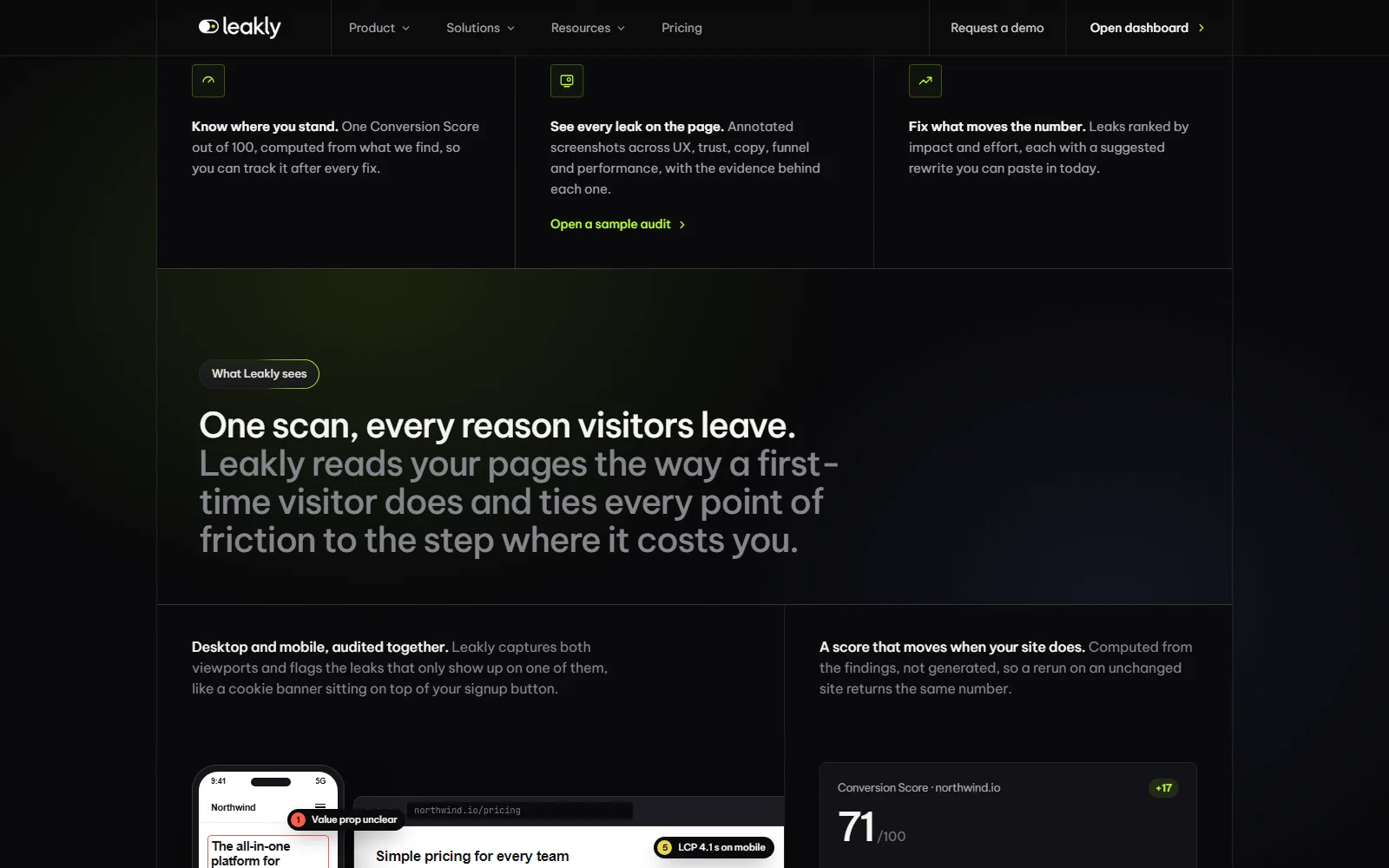
Leakly is a conversion audit tool for founders, growth teams and agencies. It opens your public web pages in a real browser, on desktop and mobile, checks them against 32 published rules and returns a ranked list of fixes with evidence. The first audit is free with no signup; paid plans run from $39 to $99 a month.
Our read: what sets it apart on paper is the discipline of the method: every finding has to cite a screenshot element, a quote or a measurement, the rules are public, and the score is computed rather than guessed. Two things dent that. Pro's headline extra, revenue per leak, depends on analytics connections that the privacy policy says are not available yet, and the homepage mentions an Agency plan the pricing page does not list. Both are covered below.
We read the Leakly homepage, the Leakly pricing page, the methodology, the sample report, the Terms of Service and the Privacy Policy on 12 October 2026. The sources section at the end links the rest.
What does Leakly do?
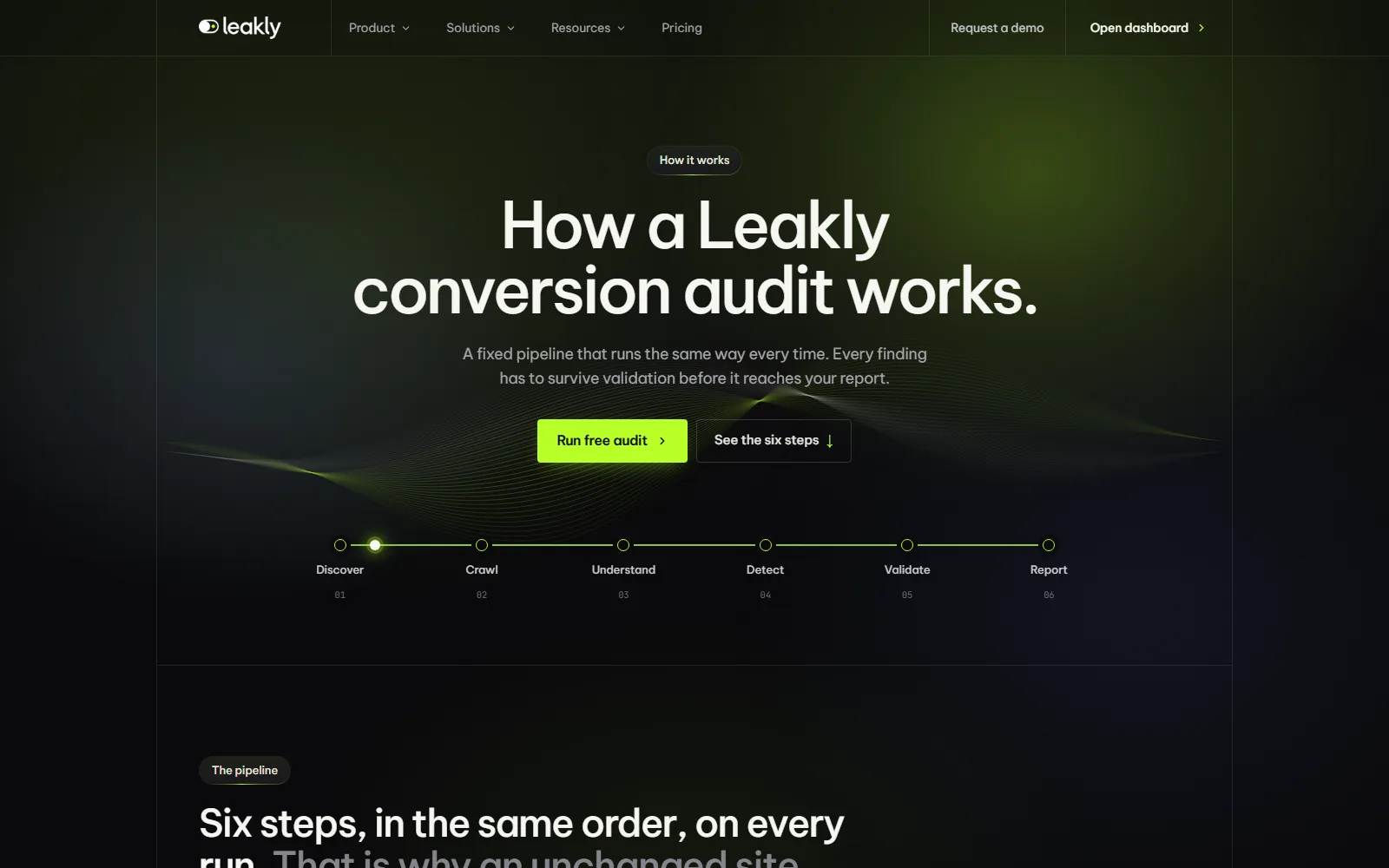
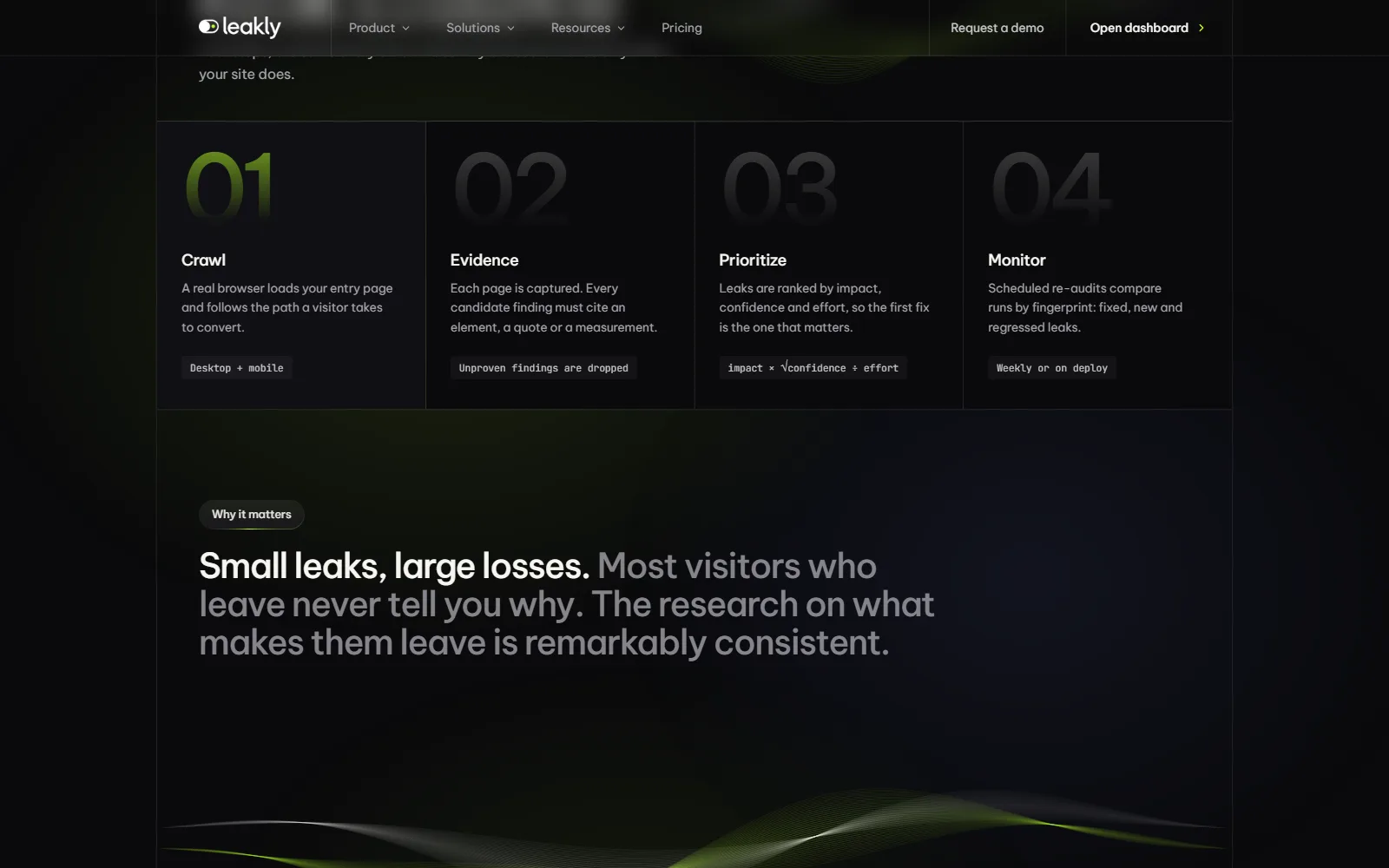
You paste a public URL and pick a conversion goal. Leakly finds the pages on the path to that goal, such as pricing, signup or checkout, and loads each one in a headless Chromium at 1440 px and at 390 px, the width of a mid-range phone. The how-it-works page lists six fixed steps: discover, crawl, understand, detect, validate and report.
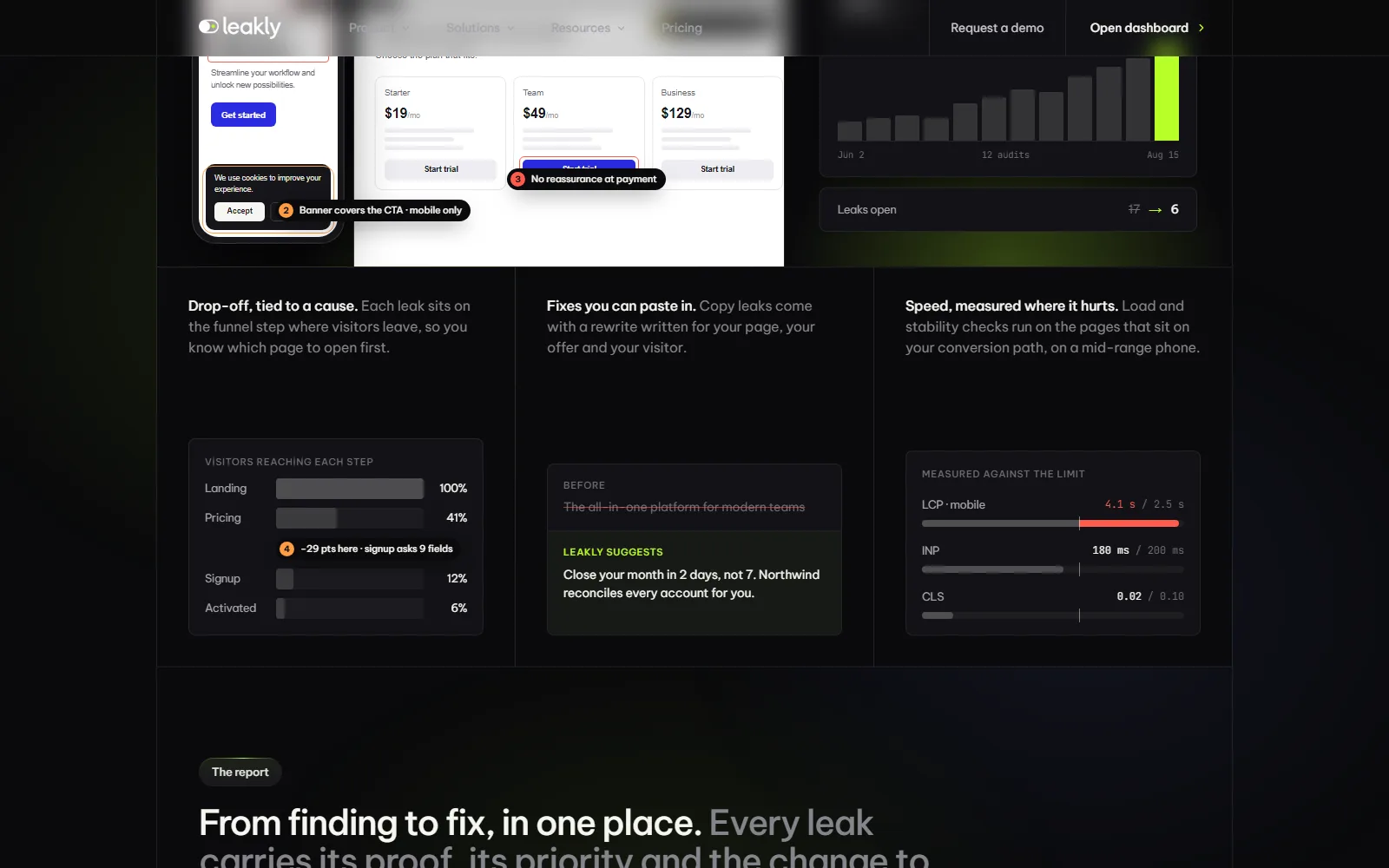
- 32 rules in six categories. Content, UX, UI, funnel, trust and performance. Examples include a headline that names no outcome, a signup form that asks for too much, a cookie banner covering the main button on mobile, and pages slower than 2.5 seconds to show their main content. Each rule has a public ID and a fix in the Leakly leak library.
- Evidence on every finding. A leak must cite an element, a word-for-word quote or a measurement. Leakly says findings without proof are dropped before the report.
- A computed score. The Conversion Score out of 100 comes from the findings with fixed weights. The vendor says no language model sets the number, so an unchanged site gets the same score twice. Categories it could not check are left out and listed, not counted as perfect.
- Ranked fixes. Leaks are sorted by impact, confidence and effort. Copy leaks come with a suggested rewrite.
- Monitoring on paid plans. The conversion intelligence page describes re-audits that track each leak by a stable fingerprint, mark a fix as verified when the next crawl no longer finds it, and alert you by email or Slack when a page regresses.
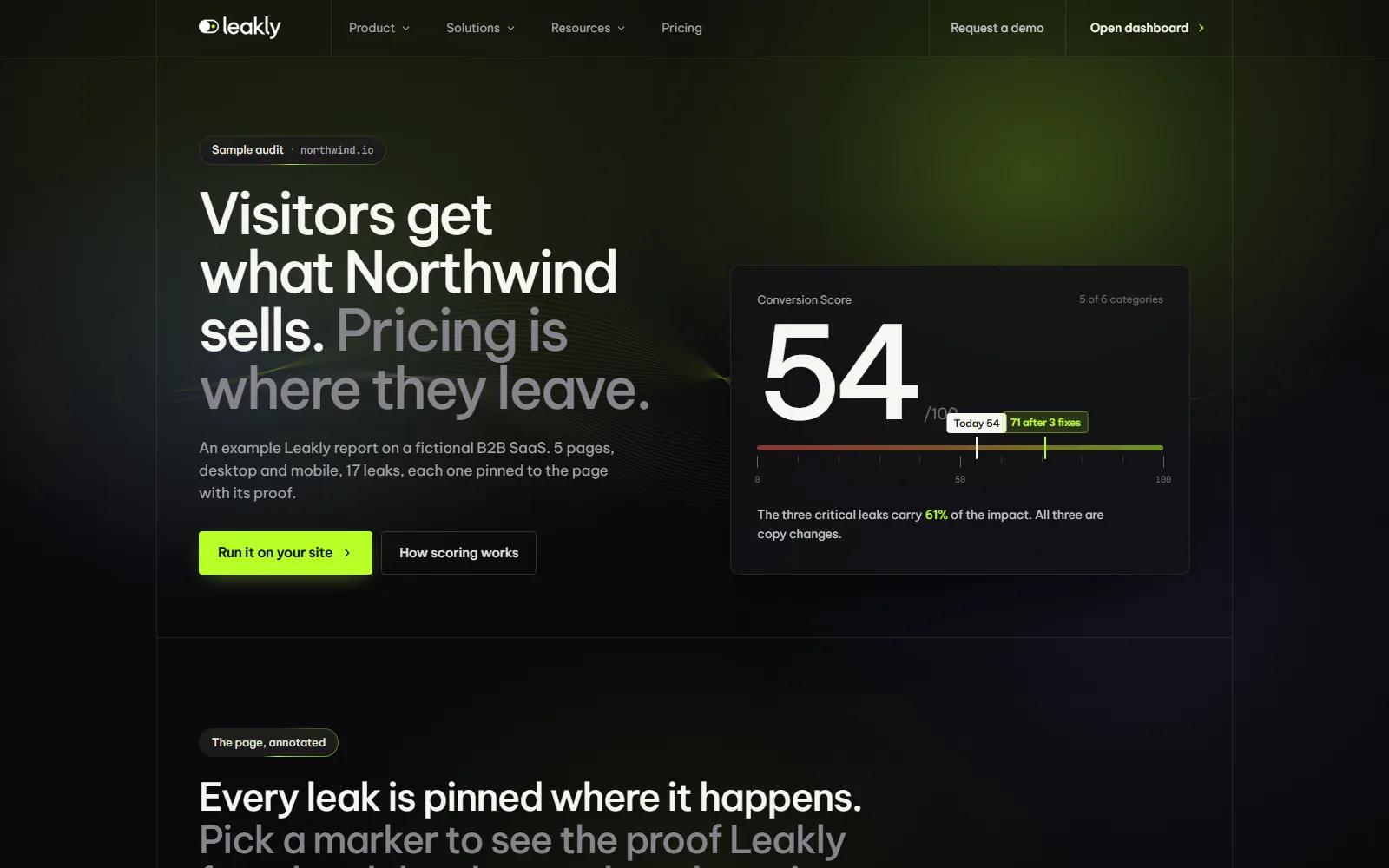
The sample audit shows the report format on a fictional SaaS site: five pages, 17 leaks pinned to screenshots, and a score of 54 out of 100 with trust marked "not assessed".
Who is Leakly for, and who should skip it?
Leakly fits a founder or growth lead who has traffic but not enough signups and wants a short, ranked list of page changes. It also suits small e-commerce teams checking product and cart pages, and agencies that audit prospects before a sales call. Because it reads public pages, the vendor's comparison table says it works before a site has traffic, unlike analytics or heatmaps.
Skip it if your conversion path sits behind a login. The LeaklyBot page says the crawler never submits forms or logs in, and the e-commerce page says session-dependent carts and protected checkout steps need separate checks. Skip it, too, if you want proof from real users. An automated audit reads what a page says and how fast it loads; it does not watch visitors, and the vendor itself says a better score alone does not prove revenue lift.
How much does Leakly cost?
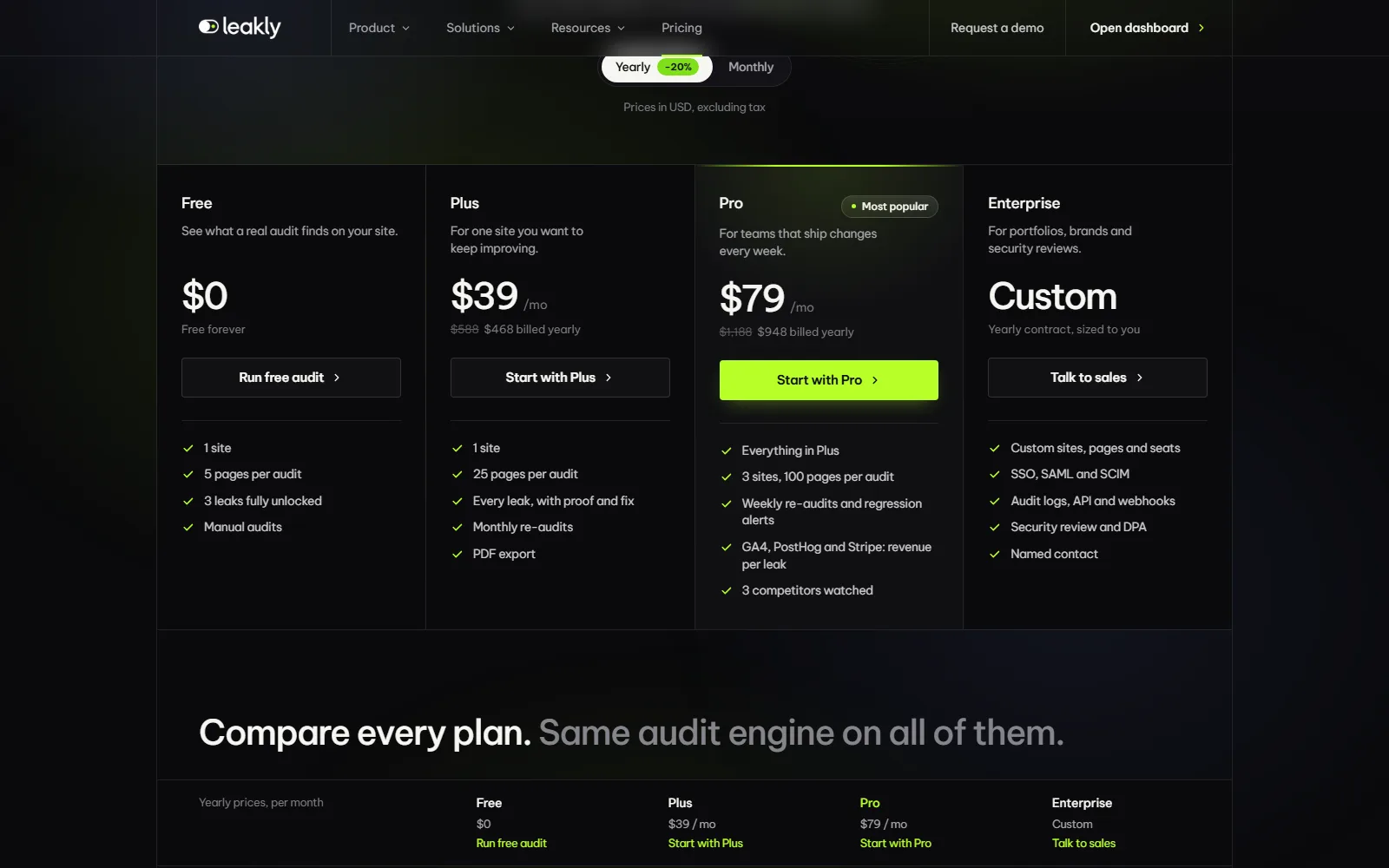
USD, checked 12 October 2026, from Leakly pricing
| Plan | Price | What you get | Where it stops |
|---|---|---|---|
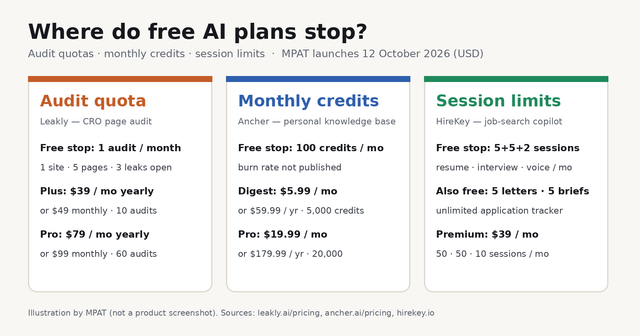
| Free | $0, no card, no signup for the first audit | 1 site, 5 pages per audit, 1 audit a month, Conversion Score, 3 leaks shown in full with evidence and fix | Other leaks stay locked; manual audits only; no history, PDF export or alerts |
| Plus | $39 a month billed yearly ($468), or $49 monthly | 1 site, 25 pages per audit, 10 audits a month, every leak with proof and fix, monthly re-audits, history and audit diff, PDF export | One site and one seat; no regression alerts, analytics or competitor watch |
| Pro | $79 a month billed yearly ($948), or $99 monthly | 3 sites, 100 pages per audit, 60 audits a month, 3 seats, weekly re-audits, regression alerts by email and Slack, analytics and revenue per leak, 3 competitors watched | Reports carry the Leakly mark; no SSO, API or white-label |
| Enterprise | Custom, yearly contract | Custom sites, pages and seats; SSO, SAML and SCIM; audit logs, API and webhooks; security review and DPA; named contact | Price not published |
Billing is per plan, not per seat or per credit. The meter that matters is audits per month, and the pricing table notes that competitor audits and rechecks count toward it. Yearly billing saves 20%. Upgrades apply at once; downgrades and cancellations take effect at the end of the period. Prices exclude tax. The terms add that plans renew automatically, partial periods are not pro-rated except where the law requires it, and price changes come with 30 days' notice.
Two points need checking before you pay. First, Pro's headline extra is "GA4, PostHog and Stripe: revenue per leak", yet the privacy policy dated 5 October 2026 says analytics, tag manager and CRM connections "are on our roadmap and are not available yet". Ask the vendor which connections work today. Second, the homepage mentions an "Agency plan" with 20 sites, white-label reports and an API, but the pricing page lists no such plan and the agencies page says white-label is on Enterprise only.
Is Leakly worth paying for?
That depends on how often your pages change. A one-off check of a landing page may be covered by the free audit. Plus at $39 to $49 a month makes sense if you ship page changes monthly and want every finding plus a history to compare against. Pro at $79 to $99 a month is aimed at teams shipping weekly or watching competitors, but confirm the analytics point above first. Treat the score as a checklist, not a forecast: the legal notice says findings are for information only and carry no commercial guarantee.
What does Leakly do with my site's data?
It reads only public pages. LeaklyBot identifies itself in the user agent, reads and follows robots.txt, accepts cookie banners after its first screenshot, and runs only when someone requests an audit. Site owners can block it in robots.txt or ask to be put on a server-side blocklist. The bot page says captures are deleted after three days and are not sold or used to train models. The privacy policy, though, keeps audits and reports for 24 months, and the enterprise page says screenshots are kept 72 hours while text evidence is kept for history.
The privacy policy names OpenAI as the processor that generates findings and recommendations, and says submitted content is not used to train third-party models. Hosting is with Hetzner in Finland; PostHog, Google Analytics, Google Ads and Resend are the other named processors, all in the US. The terms forbid auditing a site you are not authorised to audit where that would break its terms or the law.
How does Leakly compare with other tools reviewed here?
Several marketing tools touch the same funnel, each at a different step.
- Okara, the AI CMO reads your website and runs agents for SEO, AI-search visibility and social drafts. Our review lists a free strategy tier and paid plans at $129 and $249 a month, checked 29 September 2026. Okara brings visitors and writes content; Leakly checks what happens once they land.
- CrawlRaven's SEO action plan joins Google Search Console and GA4 data into a ranked to-do list. Our review lists a free tier for one site and lifetime licences from $39 one-time, checked 30 September 2026. CrawlRaven ranks what to write for search; Leakly ranks what to change on the page.
- ConvoScore's AI contact chat replaces a contact form with a chatbot that captures and scores leads. Our review lists a free plan and Starter at $49 a month, checked 8 October 2026. ConvoScore swaps one conversion step for a new one; Leakly audits the steps you already have, including forms.
Who makes Leakly?
The legal notice names Sky Labs LLC, a limited liability company incorporated in Wyoming (filing ID 2025001813009) with a registered office in Sheridan, and lists Michael Thorne, co-owner, as publication manager. The terms are governed by Delaware law, with disputes going to binding arbitration under American Arbitration Association rules; EU consumers keep their home-country protections. Leakly was featured on BetaList on 11 October 2026. A different product called Leakly, a subscription finder for bank statements, is listed on Product Hunt; it is not this tool.
Sources
Plans, prices, limits and the pricing FAQ come from the Leakly pricing page. The audit pipeline and score method come from the how-it-works page, the rules from the leak library, the report format from the sample audit, and monitoring from the conversion intelligence page. Crawler behaviour comes from the LeaklyBot page, agency and enterprise terms from the agencies page and enterprise page, data handling from the Leakly Privacy Policy, billing rules from the Leakly Terms of Service, and the company details from the Leakly legal notice. The 11 October 2026 feature date comes from Leakly's BetaList page. Vendor pages were read on 12 October 2026.