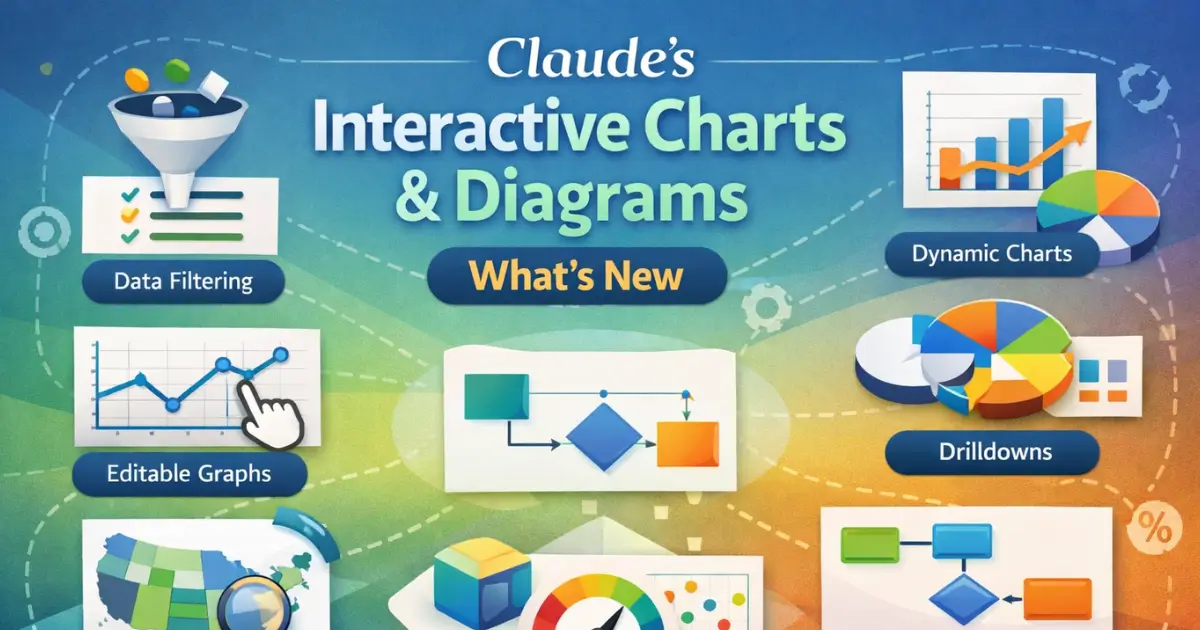
Anthropic launches inline interactive visualizations for all Claude users, turning the AI chatbot into a real-time whiteboard that draws while it talks.
Text-Only Claude Is Officially Dead
Anthropic has flipped the switch on one of the most visually significant upgrades to its AI assistant Claude: the ability to create custom charts, diagrams, and other visualizations inline in its responses and then tweak and modify them as the conversation develops. The update, now rolling out in beta to all Claude users including those on the free plan, represents Anthropic's clearest move yet into multimodal territory a space long dominated by Google and OpenAI.
How It Works: A Whiteboard Inside Your Chat
Anthropic likens the capability to giving Claude access to its own whiteboard, allowing it to sketch out concepts, data, and instructions in visual form within the conversation window. Unlike Claude's existing Artifacts feature, which creates permanent documents in a separate side panel for downloading and sharing, these new visualizations serve a different purpose: Claude builds them to aid users' understanding as it's discussing the topic at hand. They appear inline rather than in a side panel, and they're temporary they change or disappear as the conversation evolves.
No Code Required — Claude Decides When to Draw
The feature is on by default. Claude will decide when to build a visual for something, or users can ask it directly with queries like "draw this as a diagram" or "visualize how this might change over time." For example, asking Claude to explain compound interest might automatically trigger an interactive calculator chart complete with adjustable sliders instead of a dry paragraph of numbers. Students can generate interactive learning tools such as a periodic table or step-by-step diagrams explaining how to fold a paper airplane, while businesses could use it to present daily revenue data or compare job applicants' resumes visually.
Built on HTML and SVG, Not Images
Under the hood, this is not image generation. The visuals rely on HTML and SVG, which means they load faster than generated images, scale cleanly across screen sizes, and remain interactive. Users can hover over chart elements or click through options rather than simply viewing a static picture. By embedding lightweight code instead of rendering pixel-based graphics, Anthropic avoids the latency and resolution trade-offs that traditional image generation introduces. This approach also means the visuals can include interactive multiple-choice inputs and clickable navigation elements.
From "Imagine with Claude" to Public Beta
The feature was first announced in autumn 2025 as "Imagine with Claude" and has now entered the public beta phase. That original prototype allowed Claude subscribers to create custom interfaces on a virtual desktop in real time. Instead of manually writing code, the system relied on built-in tools that enabled Claude to assemble software elements dynamically. The new visualization capability functions similarly but is now embedded directly into everyday conversations.
Recipes, Weather, and Purpose-Built Formats
The inline visuals are part of a broader push to make Claude's responses more than just text. Earlier this year, Claude began using purpose-designed formats for some topics: recipes now appear with ingredients and steps, and Claude provides a visual when users ask about the weather. The generated visualizations and widgets can also interact with external platforms such as Figma, Canva, and Slack, further extending their utility beyond standalone chat.
The Competition Is Heating Up
The launch comes just three days after OpenAI added similar interactive visual tools to ChatGPT. OpenAI launched what it calls "dynamic visual explanations" in ChatGPT, though that feature is mostly focused on explaining math and science topics to students. Google, meanwhile, debuted interactive charts and simulations for Gemini Ultra subscribers at $200 per month last December. The key differentiator for Anthropic is accessibility Claude's visualizations are available to all users, including those on the free tier.
Known Limitations: Beta Means Beta
The feature is not without rough edges. Creating these visuals can take a while often half a minute and the model occasionally makes mistakes in labeling or layout. Anthropic warns it is releasing beta software, so users should expect some quirks along the way. Additionally, the feature is not yet available on mobile. Weather and recipe visuals are currently available only on desktop, as those formats do not yet render in the iOS app.
What This Means for the Future of AI Chat
Anthropic's move signals a fundamental shift in how AI chatbots communicate. Rather than dumping information as text and expecting users to parse it, Claude now meets users where understanding happens best visually. Where Google and OpenAI invested heavily in audio, image, and video models, Anthropic mostly ignored this space until now. With interactive visualizations available to every user at no cost, Anthropic is betting that the best way to compete is not just to generate better text but to make that text come alive on screen. The era of boring data walls in AI chat may finally be over.