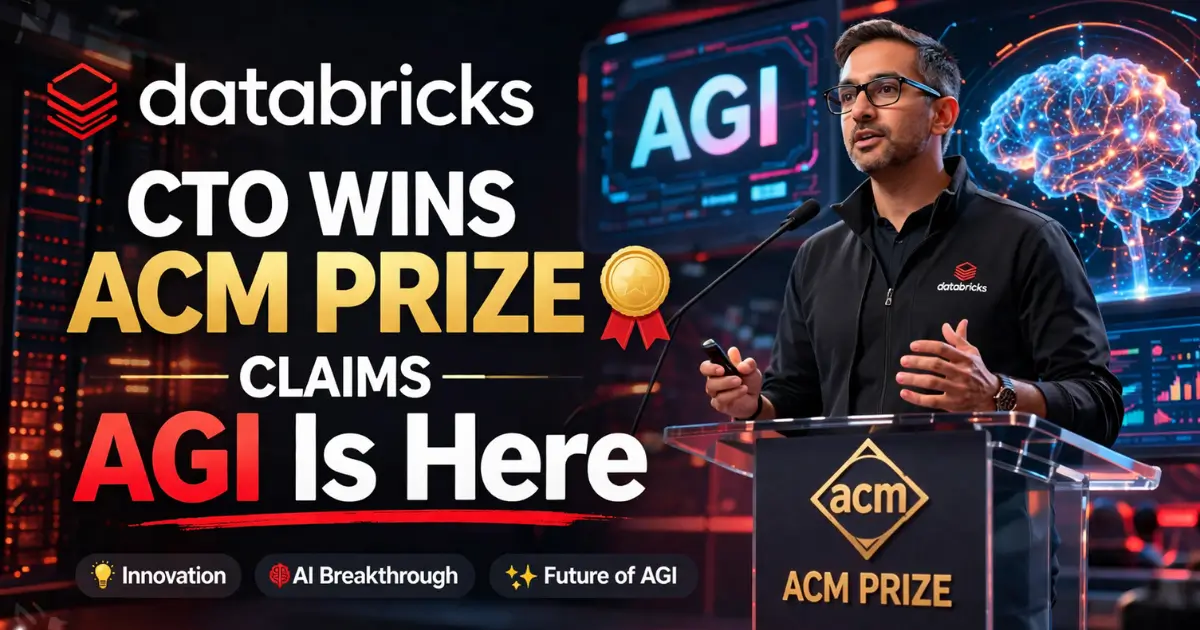
Databricks co-founder and CTO Matei Zaharia has been named the 2026 recipient of the ACM Prize in Computing, one of the most prestigious awards in computer science. The honour comes with a $250,000 cash prize, which Zaharia plans to donate to charity.
The announcement was made on Wednesday, April 8, 2026 by the Association for Computing Machinery, recognising Zaharia's collective contributions to the field most notably Apache Spark, the open-source data processing framework he created during his PhD at UC Berkeley that fundamentally changed how the tech industry handles big data.
But Zaharia is not looking backward. In a conversation with TechCrunch, he made a bold claim that is sure to spark debate across the AI community: AGI is already here we are just not recognising it for what it is.
The Man Behind Apache Spark
Zaharia's story reads like a textbook Silicon Valley success. In 2009, while studying under renowned UC Berkeley professor Ion Stoica, he developed a way to dramatically speed up the slow, clunky big data processing jobs that enterprises were struggling with at the time. He released this work as an open-source project called Apache Spark.
The impact was immediate and massive. Big data was the dominant tech trend of that era much like AI is today and Spark quickly became the industry standard. At just 28 years old, Zaharia became a tech celebrity, and the project eventually grew into Databricks, the company he co-founded.
Since then, Databricks has become one of the most valuable private tech companies in the world. The company has raised over $20 billion in funding, reached a valuation of $134 billion, and hit $5.4 billion in annual revenue. Under Zaharia's technical leadership as CTO, Databricks has evolved from a cloud data processing company into a full-stack data and AI platform that now competes directly with the likes of Snowflake.
Why He Thinks AGI Is Already Here
Zaharia's AGI claim is not the typical Silicon Valley hype. His argument is more nuanced he believes AGI already exists, but in a form that people do not recognise because they keep measuring AI against human standards.
A human, he explained, can only pass the bar exam after integrating vast amounts of knowledge over years of study. An AI model, by contrast, can ingest enormous volumes of information almost instantly. If it answers knowledge questions correctly, that does not necessarily equate to general intelligence in the way humans understand it. The capabilities are real, but they manifest differently.
His core message is that the industry needs to stop applying human benchmarks to AI systems and instead evaluate them on their own terms understanding both their extraordinary strengths and their very real limitations.
The Security Problem With AI Agents
Zaharia is particularly concerned about the security implications of the current wave of AI agents. He singled out popular AI agent tools as a growing risk, pointing out that many are designed to mimic trusted human assistants handling passwords, accessing bank accounts, and making decisions on behalf of users.
The problem is obvious: an AI agent is not a human you can trust with your credentials. If that agent gets compromised, attackers gain access to everything the agent could reach. And if the agent is authorised to spend money or make transactions, the potential for damage is significant.
This is not a theoretical risk. As AI agents become more capable and more deeply integrated into daily workflows, the attack surface expands dramatically. Zaharia warned that the industry is moving too fast on agent capabilities without adequately addressing the security architecture underneath.
AI for Research Is the Real Opportunity
While much of the AI industry is focused on coding assistants and chatbots, Zaharia sees the biggest opportunity in what he calls "AI for research." Just as vibe coding has made software prototyping accessible to non-programmers, he believes accurate, hallucination-free AI research tools will eventually become universal.
His reasoning is practical: not that many people need to build applications, but almost everyone needs to understand information. The real value of AI lies in helping people make sense of complex data whether that means diagnosing every rattle in a car, simulating molecular-level changes to predict drug effectiveness, or scanning beyond text and images to include radio waves and microwaves.
As both a professor at UC Berkeley and a product leader at one of the world's most valuable AI companies, Zaharia sees his students already pushing these boundaries using AI to simulate and predict outcomes at a molecular level that would have been impossible just a few years ago.
What This Means for the AI Industry
Zaharia's ACM Prize is a recognition of past achievements, but his comments point squarely at the future. The message to the industry is twofold: stop anthropomorphising AI systems, and start building infrastructure that plays to AI's actual strengths rather than forcing it into a human-shaped box.
For Databricks, which now sits at the intersection of enterprise data and AI, these ideas are not just philosophical they are the product roadmap. And for the broader tech world, Zaharia's perspective offers a useful corrective at a time when the hype around AI agents and AGI often outpaces the reality of what these systems can safely and reliably do.