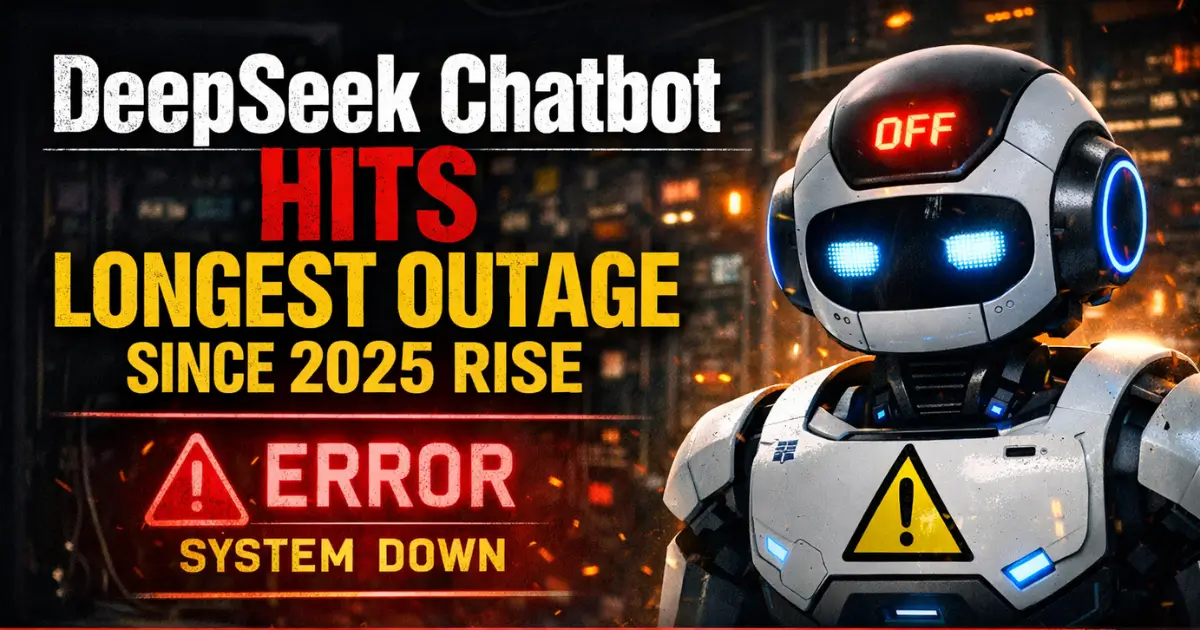
China's most popular AI chatbot went dark for more than seven hours on March 30, 2026 the longest service disruption DeepSeek has experienced since its flagship R1 and V3 models catapulted the platform to global fame in early 2025. The outage disrupted access for hundreds of millions of users worldwide and raised fresh questions about the reliability of AI platforms that have become embedded in everyday workflows.
What Happened
According to DeepSeek's official status page, the chatbot suffered a "major outage" lasting seven hours and 13 minutes. The trouble began on Sunday evening, with users first reporting issues on outage-tracking platform Downdetector. DeepSeek acknowledged the initial fault at 9:35 p.m. local time in Beijing and appeared to resolve it within two hours.
But the fix did not hold. A second wave of performance issues hit shortly after midnight, at 12:20 a.m. on Monday, and the platform did not return to full operation until 10:33 a.m. local time. DeepSeek deployed multiple updates overnight in an attempt to restore service, but the disruption persisted through the morning.
The company did not disclose the root cause of the outage, following what it described as standard company protocol. Industry experts noted that outages of this nature are typically caused by server overloads, infrastructure failures, or software bugs introduced during system updates.
Why It Matters
What makes this incident significant is not just its duration but its target. DeepSeek's API service used primarily by developers to integrate the chatbot into third-party applications had experienced day-long outages in late January 2025 during the peak of its viral surge. However, the consumer-facing chatbot interface, which is the primary portal for everyday users, had maintained near-perfect uptime since launch. Prior to March 30, DeepSeek's main webpage had never recorded a major outage exceeding two hours.
That record is now broken. For a platform serving an estimated 355 million users globally, seven hours of downtime represents a major reliability event one that ripples across industries, workflows, and the growing number of businesses that have built processes around DeepSeek's capabilities.
User Reactions
The outage triggered a wave of reactions on social media, with many users expressing just how dependent they have become on the chatbot. One user's comment captured the sentiment: "Only after DeepSeek went down did I realise I no longer knew how to work without it." Another described the chatbot as their "best employee" who simply didn't show up to work that day.
The frustration highlighted a broader reality in the AI industry: as chatbots become integral to daily productivity from coding assistance and content generation to research and customer service any downtime carries real professional consequences.
Timing Adds Pressure
The outage could not have come at a worse moment for DeepSeek. The global AI community is intensely focused on the company's upcoming V4 model, which is expected to be a trillion-parameter, native multimodal system optimized for Huawei's Ascend chips. Reports indicate V4 could launch within weeks, with Chinese tech giants Alibaba, ByteDance, and Tencent already placing massive chip orders in preparation.
A high-profile service failure just weeks before a landmark product release puts additional pressure on the Hangzhou-based startup to demonstrate that its infrastructure can keep pace with its ambitions. Competitors including Alibaba's Qwen, ByteDance's Seed, Zhipu AI, and MiniMax have all rolled out competing models in recent months, and any erosion of user trust could benefit rival platforms eager to capture market share.
A Larger Industry Problem
DeepSeek's outage is not an isolated case. It reflects a challenge facing every major AI platform: the gap between innovation speed and infrastructure maturity. As models grow more powerful and user bases expand into the hundreds of millions, the operational demands on servers, networks, and backend systems are scaling faster than most companies can build.
For DeepSeek, the path forward likely involves not just building better models but building the reliability infrastructure to match. In the AI race, uptime may prove just as important as benchmarks.