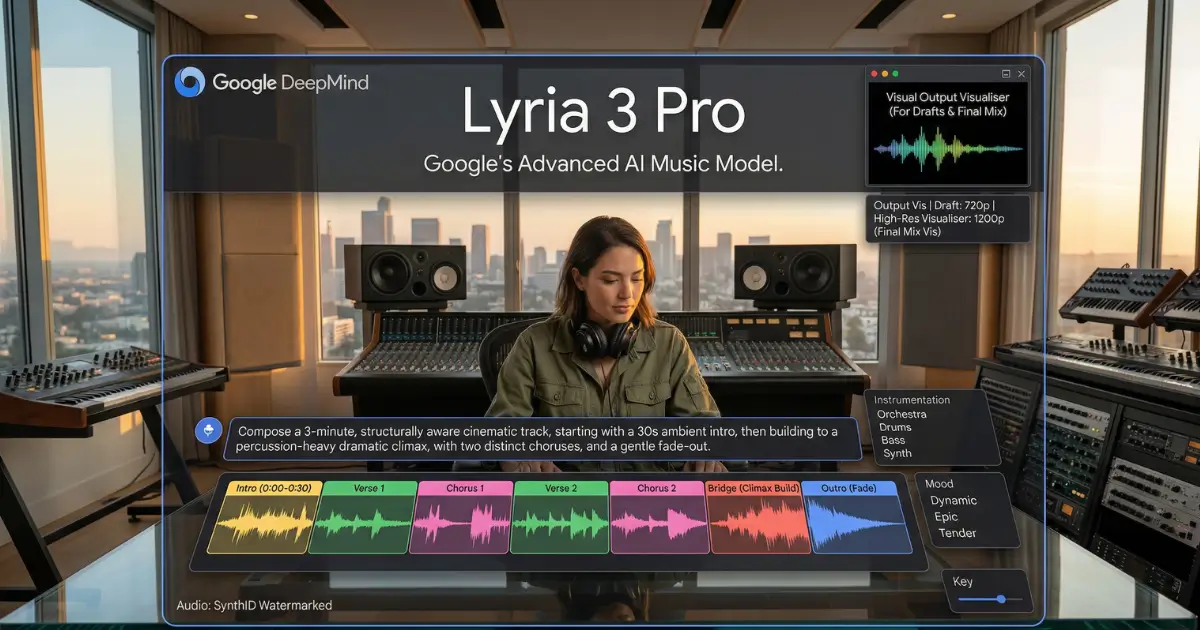
Google on Wednesday announced the release of Lyria 3 Pro, its latest AI-powered music generation model. The launch comes just one month after the release of Lyria 3, and the new Pro model allows users to create tracks up to three minutes long — a significant upgrade from the 30-second limit of the previous version.
Better Creative Control
Beyond just longer tracks, Lyria 3 Pro offers improved creative control and customization options. Users can now specify different structural elements of a musical piece in their prompts, including intros, verses, choruses, and bridges, as the model has a much stronger understanding of track structure compared to its predecessor. This means the output should feel more like a professionally composed song rather than a short generated loop.
Where You Can Use It
Google had previously introduced music generation capabilities to the Gemini app with the Lyria 3 release. The Pro model is now also rolling out in Gemini, though only paid subscribers will have access to it.
Beyond Gemini, Google is also bringing Lyria 3 Pro to its Google Vids video editing app and ProducerAI, a generative AI music production tool that Google acquired last month. This suggests Google is building an ecosystem where AI-generated music can be seamlessly integrated into video and content creation workflows.
Enterprise Access
Google is also making the model available to enterprise customers through Vertex AI (in public preview), the Gemini API, and AI Studio. This opens the door for developers and businesses to embed AI-generated music directly into their own applications and products.
Training Data and Artist Protection
Google emphasized that it used data from its partners along with permissible data from YouTube and Google to train the model. The company also stated that the model does not mimic any particular artist. However, if users specify an artist in their prompts, the model takes "broad inspiration" from that artist to generate a track.
To maintain transparency, all tracks created using Lyria 3 and Lyria 3 Pro are marked with SynthID to clearly indicate that AI was used in their creation.
Industry Context
This launch comes at a time when the music industry is grappling with the implications of AI-generated content. Earlier this week, Spotify released new tools allowing artists to review songs released under their name, aimed at preventing AI-generated content from being falsely attributed to real musicians. Meanwhile, Deezer has launched tools that allow any streaming service to identify AI-generated music.
The Bigger Picture
Lyria 3 Pro represents a significant step forward in AI music generation. The combination of longer tracks, better structural understanding, and broad platform integration makes it a powerful tool for both professional creators and casual users. However, as AI-generated music becomes more sophisticated and accessible, questions around artists' rights, originality, and the future of human creativity in music will only grow louder. Google's use of SynthID and its careful messaging around artist imitation suggest the company is aware of these concerns — but whether these measures will satisfy the music industry remains to be seen.