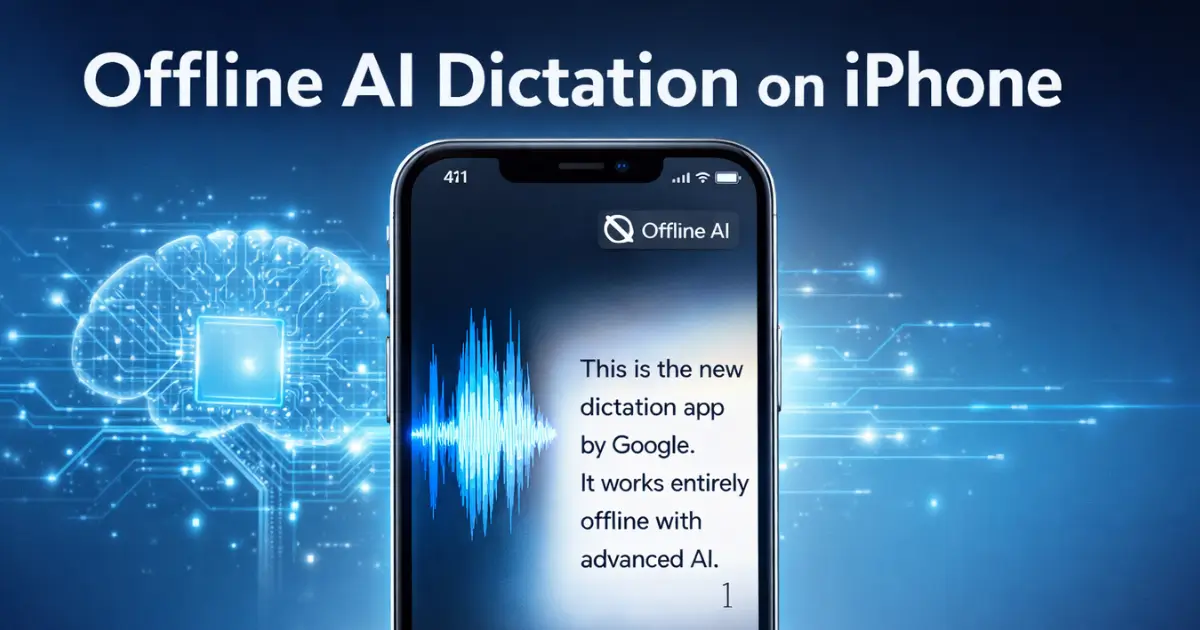
Google has released a new offline-first dictation app called "Google AI Edge Eloquent" on the iOS App Store, entering a competitive space dominated by tools like Wispr Flow, SuperWhisper, and Willow. The app is free, runs locally on your device, and uses Google's own Gemma-based speech recognition models to turn messy spoken words into clean, polished text.
The release happened with almost no fanfare no blog post, no keynote announcement. Google simply pushed the app live on Monday, April 7, 2026, and let the internet do the rest.
How Google AI Edge Eloquent Works
Once you download the app and install its on-device AI models, you can start dictating immediately no internet connection required. The app transcribes your speech in real time, and when you pause, it automatically strips out filler words like "um," "uh," and mid-sentence corrections. What you get back is clean, readable prose that reflects what you actually meant to say, not the stumbling way you said it.
Below the transcript, the app offers quick transformation options including "Key Points," "Formal," "Short," and "Long" letting you reshape your dictation for different use cases without typing a single word.
There is also a cloud mode that connects to Google's Gemini models for more advanced text cleanup, but you can switch it off entirely and keep everything processed locally on your phone. For users who care about privacy, this is a significant selling point.
Smart Features Beyond Basic Transcription
Google AI Edge Eloquent goes further than most dictation apps in a few notable ways. It can import keywords, names, and specialised jargon directly from your Gmail account, helping the speech recognition model understand your vocabulary better. You can also manually add custom words to improve accuracy for industry-specific terms.
The app keeps a full history of your dictation sessions and lets you search through them. It also tracks useful metrics like words dictated per session, words-per-minute speed, and total word count features that will appeal to writers, professionals, and productivity enthusiasts who want to measure their output.
Android Version Referenced but Not Yet Available
While the app is currently iOS-only, the original App Store listing included references to an Android version with features like system-wide keyboard integration and a floating transcription button similar to how Wispr Flow works on Android. However, Google has since updated the listing and removed those Android references, replacing them with a note that an iOS keyboard extension is coming soon.
This suggests Google is taking a cautious, staged approach testing the waters on iOS first before rolling out a broader cross-platform release.
Why This Matters for the AI Dictation Market
AI-powered dictation apps have seen a sharp rise in popularity over the past year as on-device speech recognition models have dramatically improved. Tools like Wispr Flow raised $30 million in funding in 2025, and Willow's voice keyboard gained traction among iOS power users. The category has clearly moved beyond niche territory.
Google entering this space changes the dynamics considerably. Unlike smaller startups, Google has the resources to develop and distribute its own on-device AI models at scale and it has a built-in ecosystem of services like Gmail that can feed contextual data into the dictation experience.
The fact that Eloquent runs on Google's Gemma models the same family of lightweight, open-source AI models the company has been pushing for edge computing signals that Google sees on-device AI as a serious product strategy, not just a research project.
What This Means for Users
For anyone who regularly converts speech to text writers, journalists, professionals who draft emails on the go, or people with accessibility needs Google AI Edge Eloquent is worth watching. It is free, it works offline, and it is backed by one of the largest AI companies in the world.
The app is still in its early stages and has some rough edges. In testing by TechCrunch, the transcription was not always perfect, particularly with certain words. But given Google's track record of rapidly improving its AI products, the app is likely to get significantly better in the coming months.
If this experiment proves successful, expect to see improved dictation features across Android and possibly baked into Google's core mobile products. For now, Google AI Edge Eloquent is a quiet but meaningful signal that the race for AI-powered voice input is heating up and Google does not intend to sit on the sidelines.