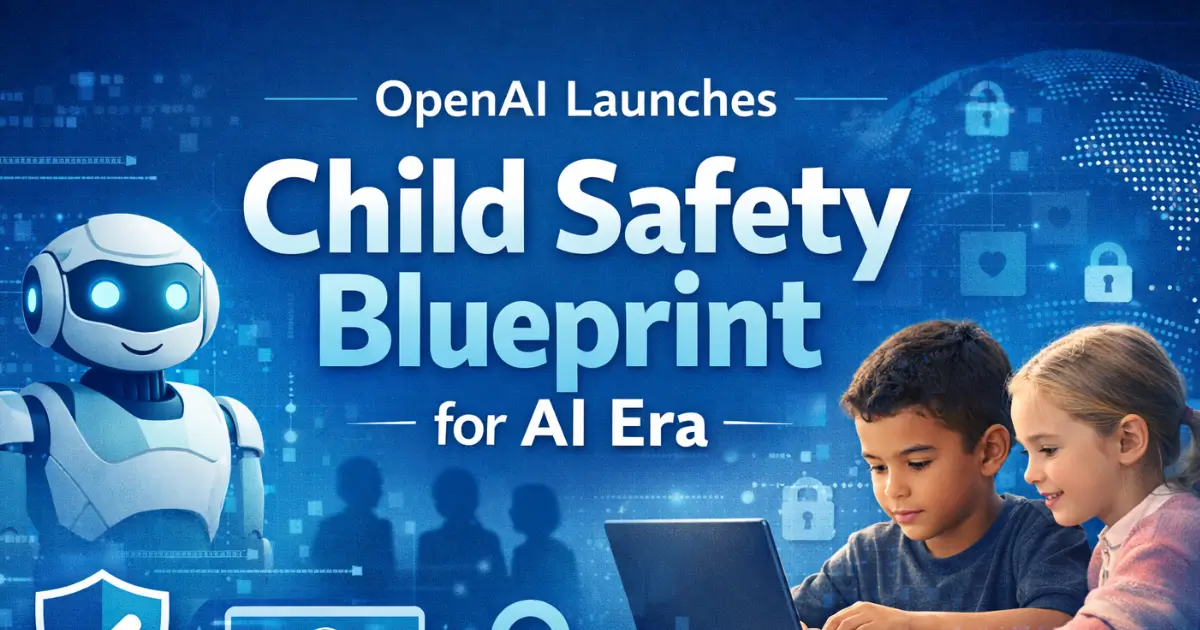
OpenAI has published a new Child Safety Blueprint aimed at strengthening child protection across the United States as AI-generated exploitation content continues to surge. The blueprint, released on Tuesday, April 8, 2026, lays out a framework for faster detection, improved reporting to law enforcement, and preventative safeguards built directly into AI systems.
The move comes at a critical moment. AI-powered child sexual exploitation is growing at an alarming rate, and OpenAI itself has faced multiple lawsuits alleging that its products contributed to real-world harm involving minors.
The Scale of the Problem
The numbers behind this initiative are deeply concerning. According to the Internet Watch Foundation, more than 8,000 reports of AI-generated child sexual abuse content were detected in just the first half of 2025 alone — a 14 percent increase compared to the same period the year before.
Criminals are using AI tools in multiple ways: generating fake explicit images of children for financial sextortion schemes, creating convincing messages to groom victims, and producing realistic abuse material that is increasingly difficult to distinguish from real photographs. The accessibility and improving quality of generative AI models have made these attacks easier and cheaper to execute at scale.
This is no longer a fringe problem. It has become one of the most urgent safety challenges facing the AI industry, and one that lawmakers, educators, and child safety advocates have been pressing technology companies to address with far greater urgency.
What the Blueprint Proposes
OpenAI's Child Safety Blueprint focuses on three core areas. First, it calls for updating existing legislation to explicitly cover AI-generated abuse material, which currently falls into legal grey areas in many jurisdictions. Traditional child exploitation laws were written before generative AI existed, and prosecutors have struggled to apply them to synthetic content.
Second, the blueprint proposes refining the mechanisms through which abuse is reported to law enforcement. The goal is to ensure that actionable information reaches investigators faster and in a format they can work with — closing the gap between detection and response that has slowed enforcement efforts.
Third, OpenAI wants to see preventative safeguards integrated directly into AI systems at the model level. Rather than relying solely on after-the-fact moderation, the idea is to build protections into the technology itself so that abuse content is harder to generate in the first place.
The blueprint was developed in collaboration with the National Center for Missing and Exploited Children (NCMEC) and the Attorney General Alliance. North Carolina Attorney General Jeff Jackson and Utah Attorney General Derek Brown also provided input during the development process.
OpenAI's Own Legal Troubles
The timing of this blueprint is significant given OpenAI's own legal exposure on child safety issues. Last November, the Social Media Victims Law Center and the Tech Justice Law Project filed seven lawsuits against OpenAI in California state courts. The suits allege that OpenAI released GPT-4o before it was ready, and that the product's psychologically manipulative nature contributed to the deaths of four young individuals who died by suicide after extended interactions with ChatGPT. Three additional individuals cited in the lawsuits reportedly experienced severe, life-threatening delusions.
These cases have drawn intense scrutiny from both the legal community and child safety organisations, raising fundamental questions about the responsibility AI companies bear when their products are used by minors.
OpenAI has also faced broader criticism from policymakers who argue that the entire AI industry has moved too slowly on child safety protections. The rapid rollout of increasingly capable generative models — without equally robust safety infrastructure — has created a gap that bad actors have been quick to exploit.
Building on Previous Efforts
The Child Safety Blueprint is not OpenAI's first move in this space. In December 2025, the company updated its guidelines for interactions with users under 18, adding rules that prohibit generating inappropriate content for minors, discourage self-harm related outputs, and prevent advice that could help young people hide unsafe behaviour from caregivers.
More recently, OpenAI released a separate safety blueprint focused on teen users in India, tailored to the specific risks and regulatory landscape in that market.
However, critics have argued that these measures remain reactive rather than proactive. The broader challenge for the AI industry is not just building safer products after problems emerge, but designing systems that anticipate and prevent harm before it happens — particularly when the most vulnerable users are children.
Why This Matters for the AI Industry
OpenAI's blueprint is a signal that the company recognises child safety as a foundational issue for the future of AI, not a peripheral concern. But whether this framework translates into meaningful change will depend on execution — and on whether the rest of the industry follows suit.
The AI sector is at an inflection point on child safety. Governments are moving toward stricter regulation, lawsuits are mounting, and public trust is on the line. OpenAI's blueprint offers a starting framework, but the real test will be whether it leads to concrete, enforceable protections that keep pace with the speed at which AI technology is evolving.