
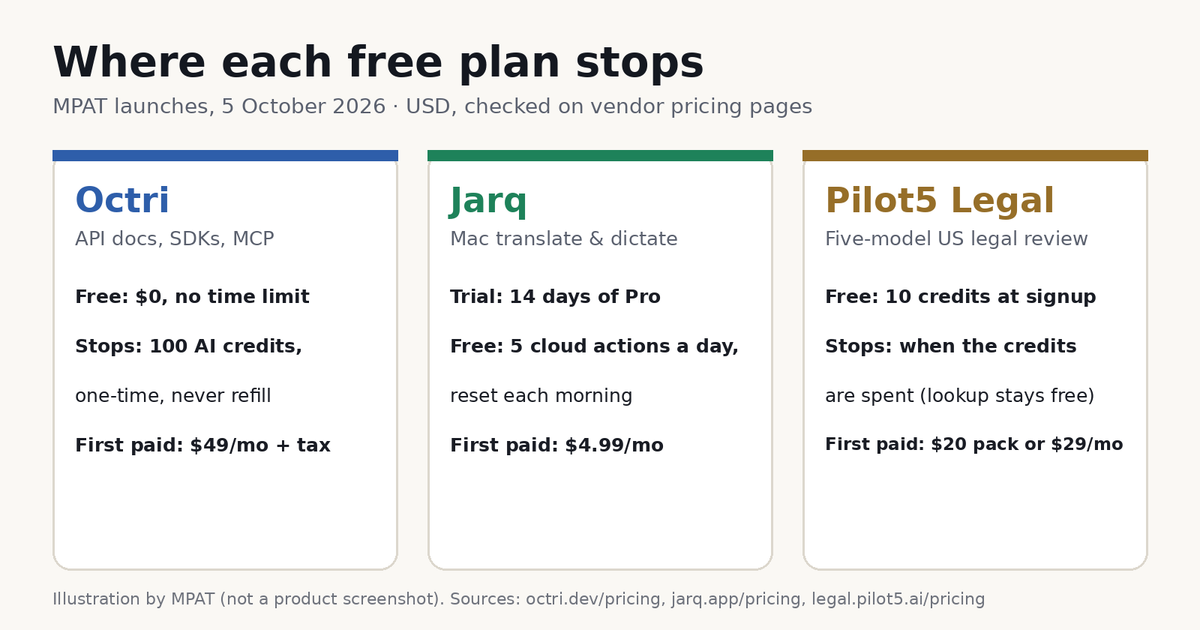
Short answer: all three of MPAT's 5 October 2026 launches let you start without paying, but each free plan stops in a different place. Octri has a permanent $0 plan whose 100 AI credits never refill. Jarq gives 14 days of Pro, then 5 cloud actions a day. Pilot5 Legal gives 10 one-time credits. The first paid steps are $49, $4.99 and $29 a month.
This MPAT guide sets out where the free plan stops for each product, what the first invoice buys, and which billing unit you are actually paying for. Every price below was read on the vendors' own pricing pages and on the three live MPAT listings on 5 October 2026. It is compiled from those pages, not a hands-on test, and there are no scores or star ratings. Pricing pages change, so open the vendor link again on the day you buy.
What launched on MPAT on 5 October 2026?
Three products went live on the board on the same UTC day. They do three unrelated jobs, which is why this guide is about cost and limits rather than a feature shoot-out:
Octri (morning) turns one OpenAPI spec into a hosted documentation site, client SDKs in ten languages, an MCP server for AI agents, and error monitoring inside those SDKs. It is for teams that ship a public or partner API.
Jarq (afternoon) is a Mac menu-bar app that translates, shortens, fixes or rewrites selected text in place in any app and types dictated speech at the cursor. It needs an Apple Silicon Mac.
Pilot5 Legal (evening) runs five AI models over a US legal question or document, has them critique each other, and returns a sourced recommendation that keeps the strongest dissent. It is for lawyers, in-house counsel and compliance teams.
A developer, a bilingual writer and a lawyer would each buy one of these, not all three. What they share is a pricing pattern that catches people out: a free start that looks generous on the pricing card but ends at a specific, countable limit.
Where does each free plan stop?
USD, checked October 5, 2026, from the Octri pricing page, the Jarq pricing page and the Pilot5 pricing page.
Free plan, $0 with no stated time limit | 100 AI credits, one-time, never refill; 1 project, 1 SDK language, 50 endpoints | Starter $49/month plus tax | Plan tier, with monthly AI credits for drafting and chat | |
14-day Pro trial, then Free with no expiry | 5 cloud dictations or translations a day; on-device dictation stays unlimited | Pro $4.99/month, tax included | A licence for up to 2 Macs, fair use 2,000 actions a month | |
10 credits at signup, no card | Paid workflows stop when the 10 credits run out; authority lookup and firm playbook stay free | Starter $29/month for 30 credits, or a $20 pack | Credits per run, 1 credit = $1 list value |
The table hides one important difference. Octri's free plan keeps working after the credits are gone: your docs stay online, SDKs keep building and monitoring keeps ingesting, but AI drafting and the Ask-the-docs chat stop answering. Jarq's free plan resets every morning. Pilot5's grant is used once and is not replaced.
Is Octri free, and where does the Octri free plan stop?
Yes, Octri has a permanent Free plan at $0. According to the Octri listing on MPAT (checked 5 October 2026), it includes one project, one SDK language, 50 API endpoints, 100 MB of monitoring a month, a custom domain, GitHub sync and the Ask-the-docs chat.
The stop is the AI credit grant. Free gets 100 AI credits once. Generating documentation for one endpoint costs 1 credit and each Ask-the-docs answer costs 1 credit, so a 50-endpoint API can use most of the grant on its first full draft. SDK builds, hosting, hand edits and monitoring do not use credits, per the Octri fair-use policy. A cached regeneration of an unchanged page is free, and so is a failed generation.
The paid ladder on the Octri pricing page is Starter $49, Growth $99 and Business $249 a month, all plus tax, with Enterprise on request. Monthly AI credits rise from 1,000 on Starter to 2,500 on Growth and 5,000 on Business. Each extra SDK language beyond your plan's bundle costs $50 a month, and annual billing takes 15% off the base price. Credit packs on the MPAT listing run from 1,000 credits for $10 to 20,000 for $160, and purchased credits never expire.
Who hits the limit first: a team with a large API that wants the AI to draft every endpoint page. A team that writes most docs by hand and mainly wants SDKs can stay on Free longer, because SDK builds cost nothing.
Is Jarq free, and where does the Jarq free plan stop?
Partly. Every new Jarq install gets 14 days of Pro with no card and no account. On day 15 it moves to the Free plan, which is $0 with no expiry and allows 5 cloud dictations or translations a day, reset each morning, per the Jarq pricing page.
What counts against those five is anything that reaches Jarq's servers: translations, the text actions such as Improve or Short, and dictation that types a different language from the one you spoke. Dictation through the optional 632 MB on-device model never counts, on any plan, and works offline. The Jarq listing on MPAT quotes the vendor's own admission that five a day is not enough for a working day.
Paid plans are Pro $4.99 a month, Pro Yearly $39 a year (about $3.25 a month) and Lifetime $179 once at a launch price shown against $200. Prices include VAT and sales tax. One licence covers two Macs, and the "unlimited" paid plans sit under a fair-use ceiling of 2,000 actions a month per licence.
Who hits the limit first: anyone who translates or rewrites more than a handful of messages a day. Someone who mainly dictates in the language they speak can stay on Free indefinitely once the on-device model is installed.
For a wider Mac command bar with paid AI, compare Raycast's free launcher and $10-a-month Pro. Its MPAT listing (checked 24 September 2026) says the free tier excludes Raycast AI, dictation and the translator.
Is Pilot5 Legal free, and where do its free credits stop?
Partly. Every new Pilot5 account gets 10 free credits with no card, according to the Pilot5 FAQ. Framing a question with the chat companion is always free. On the legal homepage, the statutory authority lookup (up to 25 citations, returned as the publisher's own text) and the firm playbook are also listed as free.
The three paid legal workflows spend credits: a statutory review costs 0.5 credits, a contract-understanding run 0.2 credits and a settlement-range session about 4 credits. At those rates, 10 credits covers about 20 statutory reviews, 50 contract maps or two settlement sessions. Pilot5 describes itself as pay-as-you-go rather than freemium, so once the grant is spent there is no daily refill.
The Pilot5 pricing page lists Starter $29 a month for 30 credits, Pro $79 for 90, Expert $149 for 200, Master $299 for 450 and Business $999 for 1,750. Credit packs without a subscription cost $20, $45, $100 or $240 for 20, 50, 120 or 300 credits, valid for 12 months. Monthly subscription credits are also valid for 12 months from each grant. One thing to check at checkout: the Annual toggle shows "Save up to 10%", but the yearly figures printed on the page are exactly twelve times the monthly price.
Who hits the limit first: anyone running settlement-range sessions, at about 4 credits each. A lawyer who mostly needs statute text by citation can use the free lookup without spending anything. The vendor is clear that it gives no legal advice, works only on US law and is not a citator. For another professional tool that shows the source behind each answer, see Veltrix, the AI finance copilot (Starter $49 a month after a 14-day trial, per its MPAT listing checked 2 October 2026).
What does the first paid month cost?
If you outgrow the free start in your first month, the cheapest self-serve step for each product, as listed on 5 October 2026, is:
Jarq: $4.99 for Pro Monthly, tax included. That is the lowest entry price of the three by a wide margin, and $39 a year brings it to about $3.25 a month.
Pilot5 Legal: $20 for a one-time 20-credit pack, or $29 a month for Starter's 30 credits. If your use is occasional, the pack avoids a renewal, because pack credits last 12 months.
Octri: $49 a month plus tax for Starter, with 2 SDK languages, 100 endpoints and 1,000 AI credits a month. Teams that need more languages pay $50 a month per extra language or move to Growth at $99.
Those three numbers are not comparable as value. They buy a different unit of work each: a seat-like Mac licence, a pool of reasoning credits, or a platform tier for an API team. Compare each against the alternative you would otherwise pay for, not against each other.
How do the billing units differ?
Octri bills by plan tier. The tier sets how many SDK languages, endpoints and projects you get. AI credits are a secondary meter that only touches documentation drafting and chat. If you run out, the platform keeps working without AI.
Jarq bills a flat licence. After the free plan, there is no per-action charge until the fair-use ceiling of 2,000 actions a month. The only meter that matters day to day is the free plan's 5-a-day cap.
Pilot5 bills per run in credits. Each workflow shows its credit estimate before it starts. The Pilot5 terms say credits are reserved at launch, settled on completion, and any excess is refunded, while purchased credits and fees are otherwise non-refundable except where the law requires.
The practical lesson is the same for all three. Before you pay, find the single number that will run out first for your usage: AI credits for Octri, daily cloud actions for Jarq, and credits per workflow for Pilot5.
Which one should you try first?
Pick by job, not by price:
You publish a REST API and your docs and SDKs drift apart: start with Octri's Free plan and watch the 100-credit grant.
You write in two languages every day on a Mac: install Jarq, use the 14-day trial on real work, and count your daily cloud actions before day 15.
You need an argued second opinion on a US legal position: spend the 10 free credits on Pilot5 Legal statutory reviews or one settlement session, then decide between a $20 pack and a subscription.
To see the rest of today's board and earlier launches, open the MPAT launch board.
FAQ
Which of today's MPAT launches is cheapest?
Jarq, at $4.99 a month or $39 a year with tax included (checked 5 October 2026). Pilot5 Legal's smallest purchase is a $20 credit pack, and Octri's first paid tier is $49 a month plus tax.
Do Octri, Jarq and Pilot5 Legal have permanent free plans?
Octri and Jarq do. Octri's Free plan is $0 with no time limit stated, though its 100 AI credits are one-time. Jarq's Free plan has no expiry and allows 5 cloud actions a day. Pilot5 has no permanent free credit allowance; its 10 credits are a one-time signup grant, but the authority lookup and firm playbook are free.
Do unused credits roll over?
On Pilot5, yes: each monthly grant and each pack is valid for 12 months. On Octri, paid allowances reset each billing cycle, while purchased credit packs never expire, according to its MPAT listing. Jarq does not use credits.
Are taxes included in these prices?
Jarq's prices include VAT and sales tax. Octri's prices are shown plus tax. Pilot5's pricing page lists USD prices without a tax note, so check the total at checkout.
Is Pilot5 Legal a replacement for a lawyer?
No. Pilot5 says it is a legal research and decision-support tool, does not provide legal advice and does not create an attorney-client relationship. It checks that a cited case exists but not whether it is still good law.
Does Jarq work on Windows?
No. Jarq runs only on Apple Silicon Macs with macOS 13 or later, per its MPAT listing.
Sources
Compiled for MPAT by Amit Kumar on 5 October 2026 from the vendor pricing pages above and today's three MPAT tool listings. Not a hands-on review. Prices and free allowances can change, so check them again before you pay.