
 Compiled by Amit Kumar
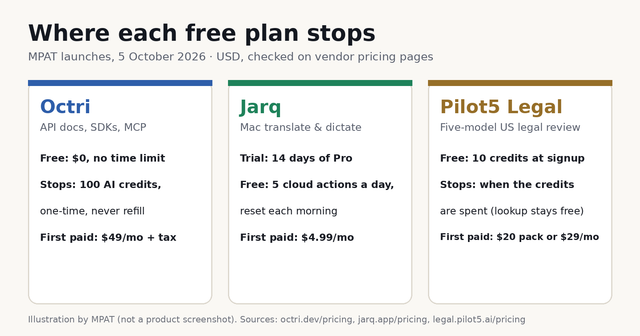
Octri is an API publishing platform that turns one OpenAPI spec into a hosted documentation site, client SDKs in ten languages, an MCP server for AI agents, and error monitoring that runs inside those SDKs. It is built for teams that ship a public or partner API. Free costs $0; paid plans run $49 to $249 a month plus tax.
MPAT checked the Octri homepage, the Octri pricing page, the Fair Use Policy, the product docs and the legal pages on 5 October 2026. This MPAT listing is put together from those vendor pages. It is not a hands-on review, and MPAT did not run a production Octri project for it. The Octri press kit gives the public launch date as Thursday, 1 October 2026, says the company was founded in September 2026, and describes Octri, LLC as a bootstrapped Delaware company with a team of two to ten people. Octri also launched on the MPAT launch board, and this page lives at /tools/octri.
Octri in one paragraph
Octri takes an OpenAPI, Swagger, Postman or AsyncAPI file and turns it into four things that stay in step with each other. The first is an AI-drafted documentation site on your own domain. The second is client libraries in TypeScript, Python, Go, Java, Dart, Ruby, PHP, Rust, Swift and Kotlin, which Octri can publish to each language's registry. The third is an MCP server that lets Claude, Cursor or VS Code read your docs and call your endpoints. The fourth is monitoring that reports errors from inside those generated SDKs. One plan covers all four, and plans are priced per organisation rather than per seat. As of 5 October 2026, Free is $0 with 1 SDK language, 50 endpoints, 100 one-time AI credits and 100 MB of monitoring. Starter is $49 a month, Growth $99, Business $249, and Enterprise is custom. Extra SDK languages cost a flat $50 a month each. Octri fits API teams that would otherwise maintain docs, SDKs and an agent integration by hand.
What Octri does
The product homepage describes one pipeline. You upload a spec or link a GitHub repository. Octri normalises it to OpenAPI 3.1, AI drafts a page for every endpoint, and you edit those pages like a document before publishing. The support page lists OpenAPI 3.0 and 3.1, Swagger 2.0, Postman collections and AsyncAPI as accepted inputs, in JSON or YAML. When a merged change updates the spec, Octri builds a new draft and shows a diff. Nothing republishes until you approve it.
Documentation site. Three-column endpoint pages, a live "try it" playground, MDX guides next to the generated reference, and a custom domain on every tier. Edits are stored per page, so regenerating only touches endpoints that actually changed.
SDK Studio. Per-language settings for naming, pagination, idempotency and code style, plus custom hooks compiled into the client. Builds can auto-publish to npm, PyPI, Maven Central, crates.io, RubyGems, Packagist and pub.dev. Go and Swift ship through git tags.
MCP server. According to the MCP server page,
npx @octri/mcpwith a project id gives an agent seven read-only documentation tools, plus one callable tool for each endpoint you include in the SDK. The agent's credential stays in your local client config, and an endpoint you exclude from the SDK has no tool. Octri does not run a hosted remote MCP endpoint. You run it over stdio, or host it yourself over SSE.Monitoring. Telemetry can be compiled into the generated SDKs or added to your backend as a standalone package. You get logs, grouped issues, traces, a service map, N+1 query detection, uptime checks and alerts. Monitoring is off by default, and credentials and direct identifiers are redacted on the client before an event is sent.
CLI and spec audit. The CLI guide documents
@octri/cli(Node 20+) for pushing specs, building SDKs, publishing docs and triaging production errors. A free audit on the homepage scores a spec out of 10 against fourteen code-generation rules.
Who it is for, and who should skip it
A good fit if your company publishes a REST API, already keeps an OpenAPI file, and is tired of docs and SDKs drifting apart. The pitch is strongest for small API teams that would rather not hire someone just to maintain client libraries. It also suits teams that want AI coding assistants to call their real endpoints instead of guessing from memory. Indie developers can ship a docs site and one SDK on the Free tier, on their own domain.
Skip it if you have no API spec, or your API is GraphQL-only. The supported inputs listed are OpenAPI, Swagger, Postman and AsyncAPI. Also skip it if you need SOC 2 or ISO 27001 today: the security page says plainly that Octri holds neither certification. Teams that want a vendor-hosted MCP URL, or that need SAML SSO below Enterprise, should look elsewhere for now. If your goal is a customer help centre and not developer docs, a support tool will serve you better.
Plans and prices
USD, checked 5 October 2026, from Octri's pricing page. Prices exclude tax. | |||
Plan | Price | What you get | Where the tier stops |
|---|---|---|---|
Free | $0/mo | 1 SDK language, 50 API endpoints, 100 AI credits (one-time), 100 MB monitoring a month, custom domain, GitHub sync, AI docs and Ask-the-docs chat, community support | 1 project; no extra languages; no versioning; credits never refill; 7-day monitoring retention |
Starter | $49/mo + tax | 2 SDK languages, 100 endpoints, 1,000 AI credits a month, 1 GB monitoring, email support | 1 project; extra languages $50/mo each; no versioning or custom code |
Growth | $99/mo + tax | 4 SDK languages, 300 endpoints, 2,500 AI credits a month, 5 GB monitoring, versioning, custom code and components, priority support | 5 projects; extra languages $50/mo each; no white-label |
Business | $249/mo + tax | All 10 SDK languages, 600 endpoints, 5,000 AI credits a month, 20 GB monitoring, white-label, SDK CDN hosting, priority support | 20 projects; no SSO/SAML |
Enterprise | Custom | Unlimited languages and endpoints, SSO/SAML, dedicated support, optional self-hosting of the generator and docs renderer | Agreed in an order form |
Project counts and retention periods come from the Fair Use Policy. The same page says Enterprise includes 25,000 AI credits a month. The pricing page says annual billing takes 15% off the base price. The Terms of Service (updated 25 September 2026) add that language add-ons bill at twelve times the monthly rate with no annual discount. Paddle is the merchant of record, and the terms say there are no refunds for unused time.
How Octri credits work
Only AI features use credits. Generating documentation for one endpoint costs 1 credit, and one Ask-the-docs answer costs 1 credit. Building SDKs, hosting the site, editing docs by hand and ingesting monitoring data do not use credits. A cached regeneration of an unchanged page is free, and so is a failed generation. When credits run out, AI drafting and chat stop, but your docs, SDK builds and monitoring keep running. The Fair Use Policy lists credit packs of 1,000 for $10, 5,000 for $45 and 20,000 for $160. Purchased credits never expire and are used only after the plan allowance runs out. Monitoring does not stop at the allowance: Octri keeps accepting data up to 10 times the allowance, and as of 5 October 2026 the excess is recorded but not charged.
How it compares to tools already on MPAT
CoreSpeed, the MCP access layer for agents, gives your own agents one endpoint for apps, memory and web tools (Free with 3,000 credits for 90 days; Pro $20/month on its MPAT listing checked 4 October 2026). Octri works in the other direction. It turns your API into an MCP server that other people's agents can call. Choose CoreSpeed to equip your agents, and Octri to publish your API to theirs.
Chat.sh, the AI help centre with citations, answers customer questions from a knowledge base (free tier of 50 pages and 100 AI answers a month; $399 one-time lifetime plan on its MPAT listing checked 2 October 2026). Octri's Ask-the-docs chat answers developers from API reference pages. Chat.sh is for support content, and Octri is for API reference.
VibeDefend, agent-time security for coding tools, checks code while Claude Code or Cursor writes it (Free plan; Developer from $21/month on its MPAT listing checked 29 September 2026). It protects the code you write. Octri ships the SDKs and docs your users integrate with. The two can sit side by side in one engineering stack.
For more options, browse development tools on MPAT.
Is Octri free?
Yes, there is a permanent Free plan at $0 with no time limit stated on the pricing page. It includes one project, one SDK language, 50 endpoints, 100 MB of monitoring a month, GitHub sync, a custom domain and Ask-the-docs. The catch is AI credits. Free gets 100 as a one-time grant. At 1 credit per endpoint page, that covers the plan's 50 endpoints with some left for chat answers, but the credits never refill.
How much does Octri cost?
Checked 5 October 2026: Starter is $49 a month, Growth $99, Business $249, all plus tax, and Enterprise is custom. Each SDK language beyond your plan's bundle costs $50 a month, and Business already includes all ten. Annual billing takes 15% off the base price.
What is Octri used for?
Teams use it to publish an API: hosted reference docs, idiomatic SDKs pushed to package registries, an MCP server so AI assistants can call the API correctly, and alerts when a generated client breaks inside a customer's app. That last part is what Octri leads with on its homepage.
Does Octri train AI models on my spec or telemetry?
No, according to the homepage FAQ and the privacy policy (updated 1 August 2026). Spec excerpts and doc passages go to the model providers listed on Octri's subprocessors page (Anthropic for writing and answers, OpenAI for embeddings). Octri says those providers work under API terms that ban training on that data. Account, billing and monitoring data are not sent to model providers. Ask-the-docs chats are deleted after 7 days.
Who should not use Octri?
Teams without an OpenAPI-style spec, buyers who need SOC 2 paperwork now, and anyone who wants a vendor-hosted MCP URL should wait. Look again at the pricing and security pages before you sign up, since Octri launched publicly on 1 October 2026 and its plans may change.