
 Compiled by Amit Kumar
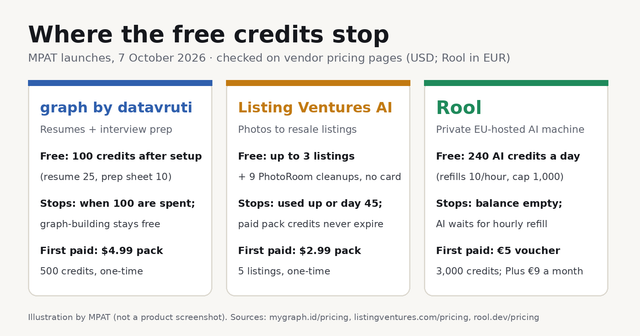
Rool is a private AI workspace that gives each user a cloud computer, called a Rool Machine, where chats, files and long-term memory are stored in Finland. It is built for people who want AI help on real projects without ads or training on their data. The Standard plan is free; Plus costs €9 a month.
MPAT read the Rool homepage, the Rool pricing page, the FAQ, legal pages, developer docs and iOS App Store listing on 7 October 2026. This page is compiled from those pages, not a hands-on review: MPAT did not create an account or run any prompts. Rool was featured on Product Hunt on 7 October 2026, and it also launched on the MPAT launch board, where this listing lives at /tools/rool.
Rool in one paragraph
Rool is an AI assistant that lives inside its own private Linux computer in the cloud. Each Rool Machine holds your chats, uploaded files, notes and a structured memory, and the AI agent runs inside the same virtual machine, so it can read your documents, create new files, run software and pick up a project where you left it. You start with a chat on the web, iPhone or Android, and can invite others into the same machine. Rool is made by Lightpost One Ltd in Dublin and stores machines and account data in Finland. As of 7 October 2026, the free Standard plan gives 2 machines with 1 GB each and 240 AI credits a day, which the vendor puts at about 20 to 25 typical reasoning prompts. Plus costs €9 a month and Pro €25 a month. It suits privacy-minded individuals and small groups, not teams that need admin controls yet.
What Rool does
The features below come from the Rool features page, the Rool FAQ and the release notes on the App Store listing, read on 7 October 2026.
- A private cloud machine per workspace. Each Rool Machine is a Linux virtual machine with its own encrypted storage. The agent runs inside that VM, so your work is isolated at the machine level.
- Chat that works on files. You can bring in documents, PDFs, images, spreadsheets, code, audio and video, then ask Rool to summarise, edit, calculate or create new files. Voice input is supported.
- Object Memory. Chats, files and ideas become Objects stored in the machine, which the AI can link and build on later. A recent update added core memories, notes Rool sees in every conversation.
- Several machines. You can keep separate machines for work and personal projects, each with its own files and memory. Standard and Plus include 2 machines; Pro includes 5.
- Shared machines. Invited collaborators work in the same machine with the same files, memory and AI, with real-time sync and undo history.
- Connectors and MCP. Plus and Pro can connect outside services through built-in connectors and custom MCP servers.
- Export and API. You can download files at any time, ask the AI to package them, or reach the machine through an API. The Rool TypeScript SDK documentation shows how developers create machines, upload files, define agents and run Linux commands from their own apps.
Rool picks the AI model for each task, and you cannot choose one yourself. The FAQ says most requests run on models Rool hosts on GPU servers in the EU, but the vendor does not name those models.
Who it is for, and who should skip it
A good fit if you want one AI assistant that remembers a long-running project, such as a renovation, a research topic or a side business, and keeps the related files next to the chat. It also suits people who want their AI workspace hosted in the EU, and developers who want a persistent machine they can drive from code.
Skip it if you want to pick a specific model for each chat, or you need team billing and admin controls today; the vendor says a team plan is still in the making. Skip it too if you need a security certification, since MPAT found no SOC 2 or ISO 27001 claim on the site, or if anyone using it is under 16, because the terms do not allow it. Heavy daily users should expect to pay.
Plans and prices
| Plan | Price | What you get | Where the tier stops |
|---|---|---|---|
| Standard | €0, free forever, no card | 2 Rool Machines, 1 GB storage each, 240 AI credits a day (10 an hour, balance capped at 1,000), Object Memory, AI models included | No connectors or MCP and no custom subdomain; AI pauses when credits run out until they refill |
| Plus | €9 a month | 2 machines, 2 GB each, 1,200 credits a day (50 an hour, cap 2,000), custom subdomain, connectors and MCP | No priority support |
| Pro | €25 a month | 5 machines, 10 GB each, 4,800 credits a day (200 an hour, cap 5,000), custom subdomain, connectors and MCP, priority support | Highest published tier; storage cannot be bought separately |
| Credit voucher | €5, one-time | 3,000 AI credits, redeemable on any plan including Standard, and transferable until redeemed | No subscription |
The US Rool App Store listing shows in-app purchases of Plus at $12.99 and Pro at $29.99, so prices bought through Apple differ from the web prices; the listing does not state the billing period. Neither the pricing page nor the FAQ says whether the euro prices include VAT. The Rool terms of service say fees are non-refundable unless the law requires otherwise, and that prices can change with reasonable notice.
How Rool credits work, and where the free plan stops
Credits meter AI use and track the compute a request actually consumes. The FAQ says a typical reasoning prompt averages about 10 credits, a simple factual question can cost 1, and heavy repetitive work or media generation costs more. On that basis the free plan's 240 daily credits cover about 20 to 25 typical reasoning prompts.
When credits run out, nothing is deleted: you can still read and edit the machine, and AI resumes as credits refill, after a voucher or after an upgrade. A full machine pauses new uploads until you free space.
By MPAT's arithmetic from those figures, a €5 voucher of 3,000 credits is roughly 300 typical reasoning prompts.
Privacy, data and terms
The Rool privacy policy, effective 29 September 2026, says Rool does not sell personal data, shows no ads and does not use your content to train AI models on any plan. Machines, files, conversations and account data are stored in Finland. Records of each AI request and response are kept for 30 days, and staff may access machine data for support, faults or security incidents.
The Rool subprocessor register names Hetzner and Verda in Finland for hosting and GPUs, Google Cloud in its Finland region, Stripe, Apple, Resend for email, which stores message content in the United States, and Speechmatics for voice. Optional services you can switch off in settings include TensorX as a backup model provider, Google's Vertex AI for images, and Brave Search, SerpApi and Jina Reader for search and page reading.
The terms set a minimum age of 16, Irish law and Irish courts, and a liability cap of the fees paid in the previous 12 months, or €100 for free users. Per the Rool account deletion page, you can delete your account from settings; backups are purged within 30 days, and invoices are kept for up to 5 years for tax reasons. The Rool contact page lists a Dublin office address and Irish company number for Lightpost One Ltd. Rool also runs a paid creator referral programme, so some recommendations online are paid.
How it compares to tools already on MPAT
MPAT does not yet list another private cloud-machine assistant; these are the closest tools on the site.
- Raycast, the keyboard launcher with paid AI, has a free launcher but no AI on the free plan; AI starts with Pro at $10 a month for 500 credits, per its MPAT listing checked 24 September 2026. Raycast runs on your computer; Rool runs in a cloud machine.
- Viktor, the AI employee for Slack and Teams, starts teams with $100 in free credits and sells Team plans from $50 a month for 20,000 shared credits, per its MPAT listing checked 4 October 2026. Viktor works inside company chat; Rool is a personal or small-group machine.
- Squint, the on-screen AI answer tool, has a Free plan of 3 captures a day and Plus at $10 a month or $99 a year, per its MPAT listing checked 30 September 2026. Squint answers about what is on your screen; Rool keeps a project's files and history in one place.
For more assistants and workspace tools, browse productivity tools on MPAT.
Is Rool free?
Yes. The Standard plan is free with no card and no time limit. It includes 2 machines with 1 GB each and 240 AI credits a day, about 20 to 25 typical reasoning prompts by the vendor's estimate. Connectors and MCP need a paid plan. Checked on 7 October 2026.
How much does Rool cost?
On the web, Plus is €9 a month and Pro is €25 a month, and a one-time voucher of 3,000 credits costs €5. The US App Store lists Plus at $12.99 and Pro at $29.99.
What is Rool used for?
Long-running projects where an AI should keep the files, notes and decisions in one private machine: drafting reports from notes, planning from saved tasks, organising documents and running code. Developers can also drive machines through the SDK.
Does Rool train AI on my data?
No, according to the privacy policy and terms. Rool says it does not train on your content on any plan, and its AI providers are contractually barred from doing so. Request logs are kept for 30 days.
Sources
Plan names, prices, credit allowances and storage limits come from the pricing page and the FAQ, and App Store prices from the iOS App Store listing. Features come from the features page, the FAQ and the SDK documentation. Data handling comes from the privacy policy and the subprocessor register, both dated 29 September 2026, and age, refund and liability rules from the terms of service, effective 17 September 2026. The launch date comes from the Product Hunt listing. All pages were read on 7 October 2026.