
 Compiled by Amit Kumar
graph by datavruti is a web app that turns notes about your real work into tailored resumes, interview prep sheets and a shareable profile. It is built only for data, AI and analytics professionals. Building your graph is free and comes with 100 credits; paid credit packs start at $4.99, paid once.
MPAT read the graph homepage and FAQ, the graph pricing page, the terms of service, the privacy policy, the about page and the vendor's own comparison pages on 7 October 2026. This page is compiled from those vendor pages. It is not a hands-on review: MPAT did not create an account, upload a resume or generate any output. The product appeared on BetaList on 6 October 2026 after a closed beta, and it also launched on the MPAT launch board, where this listing lives at /tools/graph-by-datavruti. The site writes the name in lower case as "graph".
graph by datavruti in one paragraph
graph by datavruti is a career tool for data engineers, data scientists, ML and AI engineers and analysts. You start by giving it your resume as a PDF or pasted text. After that you log short notes when you ship, fix or decide something, and the app asks follow-up questions about scale, latency, trade-offs and rollbacks so the details are written down while you still remember them. From those notes it writes a resume tailored to a pasted job description, exported as an editable Word file, plus an interview prep sheet with likely questions and gaps to prepare. Building the graph, logging notes and daily standup summaries are free. As of 7 October 2026, new accounts get 100 credits; a tailored resume costs 25 credits and a prep sheet 10. More credits cost $4.99 for 500, or $19.99 for three months of unlimited use, both paid once with nothing renewing.
What graph by datavruti does
Features below come from the homepage, FAQ and comparison pages, read on 7 October 2026. The product screens on the homepage use a made-up sample profile.
- Resume import. You upload a resume as a PDF or paste the text. The app shows what it understood and walks you through a few steps to correct it and add missing evidence.
- Work capture with guided prompts. Six starters (I built, I fixed, I scaled, I decided, I kept it running, I learned) turn a one-line note into a dated entry. The homepage says you can type or dictate the note from a phone or laptop.
- Follow-up questions. A "Clarify" step asks about the engineering detail a vague bullet hides, such as throughput, latency targets, edge cases and rollback plans. Your answers are stored with the entry.
- Tailored resume. Paste a job description and the app picks relevant entries, rewrites the bullets for that role, shows a match score with highlighted keywords, and exports an editable Word (.docx) file in one of three layouts: Classic, Visual or Banner.
- Interview prep sheet. Built from your own entries against a job description: talking points, likely questions, gap guidance for things you have not mentioned yet, and "vocabulary bridges" that restate your experience in the language of the role.
- Standup summaries. Recent entries become a Yesterday / Today / Blockers update you can paste into Slack. This output does not use credits.
- Profile and evidence links. You can claim an address such as mygraph.id/your-name, choose what is public, and connect sources such as GitHub or Kaggle as supporting evidence.
- Free bullet checker. A separate Test your bullet tool takes one resume line and a role and points out missing context, with no sign-up.
The FAQ lists ten supported roles, from Data Analyst and Analytics Engineer to MLOps, NLP and Computer Vision Engineer.
Who it is for, and who should skip it
A good fit if you work in data, AI or analytics and your resume says "built data pipelines" when the real story had numbers, decisions and trade-offs. The capture-as-you-go habit suits people who expect to change jobs or ask for a promotion within a year, and the free standup summary gives a reason to log work every week. The FAQ also names freshers, who can log projects instead of production systems.
Skip it if you work outside data and AI; the vendor's own comparison pages say a general resume builder fits better. Skip it too if you want cover letters, a job board, an application tracker or many templates; the vendor says graph has none of those. If you need a resume today and have logged nothing, a template builder will be faster; this tool's value grows with the notes you add.
Plans and prices
| Plan | Price | What you get | Where the tier stops |
|---|---|---|---|
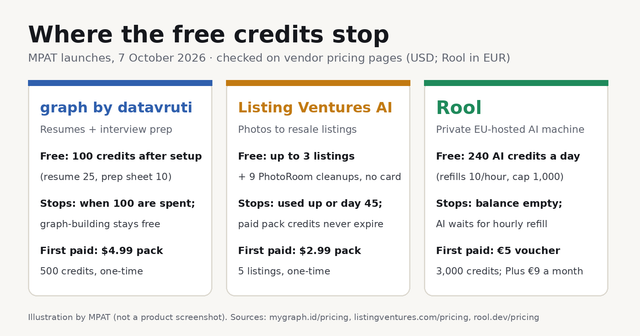
| Free | $0, no card | Build your graph from your resume, capture work, add context and evidence, daily standup summaries, private graph with optional public profile, plus 100 credits once setup is finished | Free features have no stated limit; credit outputs stop when the 100 credits (and any referral credits) are used |
| Starter credit pack | $4.99 once | 500 credits that never expire, about one cent a credit: 20 resume generations or 50 interview prep sheets | Ends when the 500 credits are spent; buy another pack or go unlimited |
| Unlimited | $19.99 once | Unlimited credits for 3 months (the vendor shows about $6.66 a month) | Ends after 3 months; nothing renews automatically |
Credits are spent on three outputs: generating an updated resume from your graph (25 credits), tailoring a resume to a job description (25 credits) and generating an interview prep sheet (10 credits). The app shows the cost before you generate. Payments go through Razorpay by card, UPI or net banking. The pricing FAQ says prices can change, and the terms of service say fees are non-refundable unless the law requires otherwise or the vendor states otherwise.
What credits buy, and where the free tier stops
The 100 starting credits arrive when you finish setting up your graph. That covers four resume generations, or ten prep sheets, or a mix such as two tailored resumes and five prep sheets. Referral credits exist, but the pricing page does not give the amount.
If a resume, tailoring or prep generation fails, the credits go back to your balance, according to the pricing page. A job seeker applying to a handful of roles, with one tailored resume and one prep sheet each (35 credits per role), would get about 14 applications out of a $4.99 pack. Heavy applicants are the case the three-month Unlimited option is priced for. That arithmetic is MPAT's, from the published credit costs.
Privacy, data and terms
The graph privacy policy (effective 31 August 2026) says your graph is private by default, with visibility set per item to only you, anyone with the link, or public. Public pages can be indexed by search engines, and deleting them later may not remove copies held elsewhere. The vendor says it does not sell personal data and does not use your content to train general-purpose AI models without explicit opt-in consent.
AI features are processed by graph or by "trusted AI service providers", which the policy does not name. Data may be stored in India or other countries. The service is operated by Reflion Tech Private Limited in Ahmedabad, Gujarat, which runs the data and AI recruitment agency datavruti. Users must be 16 or older, Indian law governs the terms, and the terms say connected GitHub or Kaggle links are evidence you supply, not independent verification by graph, even though the homepage uses the word "verified".
How it compares to tools already on MPAT
MPAT does not yet list another resume builder; these are the closest tools on the site.
- Jarq, the Mac app that rewrites and translates text at your cursor, allows 5 cloud actions a day on its Free plan after a 14-day trial, with Pro at $4.99 a month, per its MPAT listing checked 5 October 2026. Jarq polishes any sentence you select; graph writes resume bullets from facts you logged and asked it to keep.
- Sayble, the live-call assistant that suggests what to say next, offers one free 5-minute session and Pro at $24.99 a month for the first year at its founder rate, per its MPAT listing checked 30 September 2026. Sayble works during a live call; graph prepares answers from your own work before the conversation starts.
- Voicenotes, the AI note-taker for spoken thoughts, lists a Basic plan at $0 and Pro at $9 per user a month on its MPAT listing updated 21 September 2026. Voicenotes is a general voice notebook; graph's capture prompts are narrower and aimed at career evidence.
For more writing and work tools, browse productivity tools on MPAT.
Is graph by datavruti free?
Mostly, yes. Creating your graph, logging work, adding context and generating standup summaries are always free, with no card. New accounts also get 100 credits for the paid outputs. Tailored resumes and interview prep sheets need credits after those are used. Prices checked on 7 October 2026.
How much does graph by datavruti cost?
A Starter credit pack is $4.99 once for 500 credits that never expire. Unlimited is $19.99 once for three months of unlimited credits. In India the same options are ₹500 and ₹1,699. A resume costs 25 credits and a prep sheet 10. There is no subscription.
What is graph by datavruti used for?
It is used to keep a running record of what you built, fixed and decided at work, then turn that record into a resume tailored to a specific job, an interview prep sheet, standup updates and an optional public profile. It is aimed at data, AI and analytics roles only.
Does graph use my resume to train AI models?
Not without your opt-in, according to the privacy policy. Your content is processed by graph or unnamed AI service providers to produce the outputs you ask for.
Does graph write cover letters?
No. The vendor's graph vs Jobscan comparison says graph has no cover letter builder, job board or application tracker, and offers three resume layouts rather than dozens of templates.
Sources
Plan names, credit costs and payment rules come from the pricing page. Features come from the homepage and FAQ and the vendor's comparison pages. Data handling comes from the privacy policy, and refund, age and liability rules from the terms of service, both effective 31 August 2026. The launch date comes from the BetaList listing. All pages were read on 7 October 2026.