
 Compiled by Amit Kumar
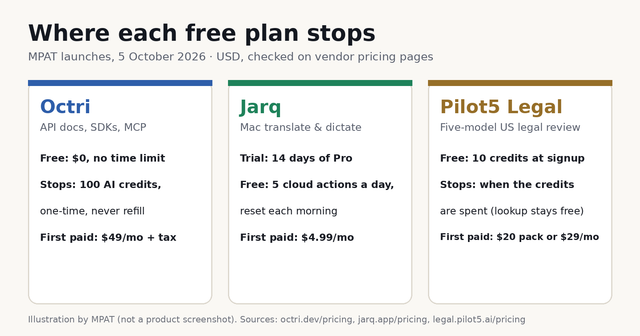
Pilot5 Legal is a legal research and decision-support console in which five AI models analyse a US legal question or document, argue with each other and return a sourced recommendation that keeps the losing view on the record. It is built for lawyers, in-house counsel and compliance teams. New accounts get 10 free credits; plans start at $29 a month.
MPAT read the Pilot5 Legal homepage, the Pilot5 pricing page, the FAQ, the profession page for legal teams, the MCP and API docs, and the privacy policy and terms on 5 October 2026. This listing is compiled from those vendor pages. It is not a hands-on review, and MPAT did not run a paid deliberation for it. Pilot5 is a brand of ECOEMIT SOLUTIONS SARL, a company registered in Paris, according to the legal notice. Pilot5 Legal was featured on Product Hunt's daily board on 5 October 2026 and also launched on the MPAT launch board, where this page lives at /tools/pilot5-legal.
Pilot5 Legal in one paragraph
Pilot5 Legal gives a lawyer a structured second opinion instead of one fluent chatbot answer. You describe a matter or attach an agreement, a chat companion helps you frame the brief, and then five AI models work on it separately before they critique each other's reasoning anonymously. The output is a recommendation of GO, PIVOT, NO GO or INSUFFICIENT BASIS, with a confidence score, the sources behind each claim and a Minority Report that keeps the strongest dissent. Five focused workflows sit on top: statutory review, contract understanding, settlement range, statutory authority lookup and a firm playbook. Work is paid in credits, where 1 credit has a list value of $1. As of 5 October 2026, new accounts get 10 free credits with no card. Subscriptions run from $29 a month for 30 credits to $999 a month for 1,750 credits. Reviews are scoped to US law, and the vendor says plainly that it does not give legal advice.
What Pilot5 Legal does
The homepage lists five legal workflows, each priced in credits (read on 5 October 2026).
- Statutory review (0.5 credits, about 90 seconds). Checks a separation agreement or similar US employment document against selected federal requirements and shows the provision behind each finding. The console capture names OWBPA/ADEA, FCRA, DTSA and the Speak Out Act. Findings are tagged Missing, Needs review or No defect found, and you can export an annotated agreement in Word.
- Contract understanding (0.2 credits). Maps what each numbered clause of an unfamiliar contract does, quotes the source wording verbatim and flags material it skipped.
- Settlement range (about 4 credits, about 10 minutes). You enter what is in dispute, your position and the other side's stated position. Five independent positions are tested and the result shows what each side would have to give up. The form itself warns that the panel is not a neutral mediator and that the session is not privileged.
- Statutory authority lookup (free). Paste up to 25 citations and get the publisher's own text back, with the official source and retrieval date. No generative model is used, and anything unresolved stays marked unresolved.
- Firm playbook (free). Save approved firm positions on top of the statutory baseline so later reviews reuse them. Human approval is required for each position.
The Pilot5 page for legal teams lists the primary sources the panel retrieves from: CourtListener opinions and dockets, govinfo for the US Code, eCFR, the Federal Register, Congress.gov, Regulations.gov, official statute text for 17 states and the District of Columbia, OpenStates, SEC EDGAR and the OFAC SDN list. Every claim is tagged as sourced or inferred. Case citations are checked against CourtListener for a matching reporter cite, court, year and parties. Pilot5 is careful to call that a fabrication check, not a citator: it confirms a case exists, not that it is still good law.
Outside the browser, the Pilot5 MCP guide connects the same engine to Claude, Cursor, ChatGPT, Perplexity, Le Chat and Zed through OAuth, with 31 tools registered on the server. A REST API with scoped keys and signed webhooks is documented as well. Listed document connectors include Clio, SharePoint, NetDocuments and Google Drive.
Who it is for, and who should skip it
A good fit if you are a US-qualified lawyer, in-house counsel or compliance officer who wants an argued second opinion before a position goes to a client, a board or a court. The settlement-range and statutory-review workflows suit employment matters in particular, because the statutory checks shown are federal employment rules. Each run shows its credit estimate before it starts, which suits matter budgets.
Skip it if your matters sit under non-US law. The homepage says every review is scoped to United States law and no other jurisdiction is consulted. Skip it too if you want a drafting tool, a full research database or a citator; the legal-teams page says Pilot5 is none of those. People without a lawyer should also look elsewhere. The site says it does not practise law, does not create an attorney-client relationship and that outputs must be reviewed by a qualified professional. MPAT found no SOC 2 or ISO 27001 certification claimed on the trust, security or privacy pages, which some firm procurement checklists require.
Plans and prices
| Plan | Price | What you get | Where the tier stops |
|---|---|---|---|
| Free start | $0 | 10 credits at signup, no card; question framing, statutory authority lookup and firm playbook use no credits | One-time grant; paid workflows stop when the 10 credits are spent |
| Starter | $29/month | 30 credits a month ($0.97 per credit) | Credit balance; every workflow included |
| Pro | $79/month | 90 credits a month ($0.88 per credit) | Credit balance |
| Expert | $149/month | 200 credits a month ($0.75 per credit) | Credit balance |
| Master | $299/month | 450 credits a month ($0.66 per credit) | Credit balance |
| Business | $999/month | 1,750 credits a month ($0.57 per credit); the legal homepage routes this plan to sales | Credit balance |
| Credit packs | $20, $45, $100 or $240 once | 20, 50, 120 or 300 credits, no subscription | Pack credits valid 12 months |
The pricing page also lists indicative Enterprise API bundles from $640 for 1,000 credits to $10,000 for 20,000 credits, scoped per engagement. Monthly subscription credits are valid for 12 months from each grant and are spent oldest-first, per the Pilot5 FAQ. One point to confirm at checkout: the Annual toggle carries a "Save up to 10%" badge, yet the yearly figures shown on the page ($348, $948, $1,788, $3,588 and $11,988) are exactly twelve times the monthly prices. MPAT has not listed a discounted annual price because none is readable on the page.
What the free credits cover
At the listed rates, 10 free credits pay for about 20 statutory reviews, 50 contract-understanding runs or two settlement-range sessions. The FAQ says the same grant is enough for one full five-model deliberation in the general A-Team mode, which costs 3.0 to 5.5 credits. Pilot5 describes itself as pay-as-you-go rather than freemium: once the grant is gone, the smallest top-up is the $20 pack. Credits are reserved when a run starts, settled on completion and any excess is refunded, according to the terms of service (effective March 2026). The same terms say purchased credits and subscription fees are non-refundable except where the law requires, and EU buyers can ask for a refund of unused credits within 14 days.
How it compares to tools already on MPAT
MPAT lists no other legal tool yet, so these are the closest sourced or credit-billed professional tools.
- Veltrix, the AI finance copilot for books and cash, answers plain-English questions from connected accounting data and shows the report behind each number (Starter $49 a month after a 14-day trial, per its MPAT listing checked 2 October 2026). Veltrix grounds answers in your own books. Pilot5 Legal grounds them in public legal authority and adds a built-in opposing argument.
- Viktor, the AI employee for Slack and Teams, also bills in credits ($100 of free credits, then Team from $50 a month for 20,000 credits, per its MPAT listing checked 4 October 2026). Viktor executes tasks across connected tools. Pilot5 does not execute anything; it produces a reasoned recommendation and leaves the decision with you.
- Chat.sh, the AI help centre that answers with citations, cites the pages it used for customer questions (free tier of 50 pages and 100 AI answers a month; $399 one-time lifetime, per its MPAT listing checked 2 October 2026). Citations there point to your support content, while Pilot5 cites statutes, regulations and court opinions.
For other assistants that support professional work, browse productivity tools on MPAT.
Is Pilot5 Legal free?
Partly. Every new account gets 10 free credits with no card, and the statutory authority lookup, firm playbook and question framing are free to use. Statutory review, contract understanding and settlement range spend credits, so ongoing paid work needs a plan or a credit pack. Prices checked on 5 October 2026.
How much does Pilot5 Legal cost?
Subscriptions are Starter $29, Pro $79, Expert $149, Master $299 and Business $999 a month, for 30 to 1,750 credits. Credit packs cost $20, $45, $100 or $240 without a subscription. Inside the legal console, a statutory review uses 0.5 credits, a contract map 0.2 credits and a settlement range about 4 credits.
What is Pilot5 Legal used for?
Checking a separation agreement against federal statutory requirements, getting oriented in an unfamiliar contract, pressure-testing a settlement position before a negotiation, pulling the enacted text of a statute or regulation by citation, and recording a firm's approved positions so later reviews apply them.
Does Pilot5 Legal store or train on my matters?
The Pilot5 privacy policy (version 1.3, effective June 2026) says deliberation content is never used to train AI models. Questions and context are sent through OpenRouter to the selected model providers, which the policy names, including OpenAI, Anthropic, Google, Mistral, xAI, DeepSeek and others. A pseudonymisation layer swaps names and identifiers for tokens before inference, though the legal-teams page notes that automated detection cannot guarantee every identifier is caught. Deliberation history is kept for 2 years and conversations for 1 year. A Zero Data Retention mode keeps a run's content out of the database and discards it within 24 hours. The database is hosted with Supabase in the EU, and a GDPR Article 28 DPA is available on request.
Sources
- Pilot5 pricing: subscriptions, credit packs and Enterprise API bundles
- Pilot5 Legal homepage: the five legal workflows and their credit costs
- Pilot5 for legal teams: primary sources, citation checks and limits
- Pilot5 FAQ: free credits, credit expiry and modes
- Pilot5 privacy policy: model providers, retention and Zero Data Retention (version 1.3, June 2026)