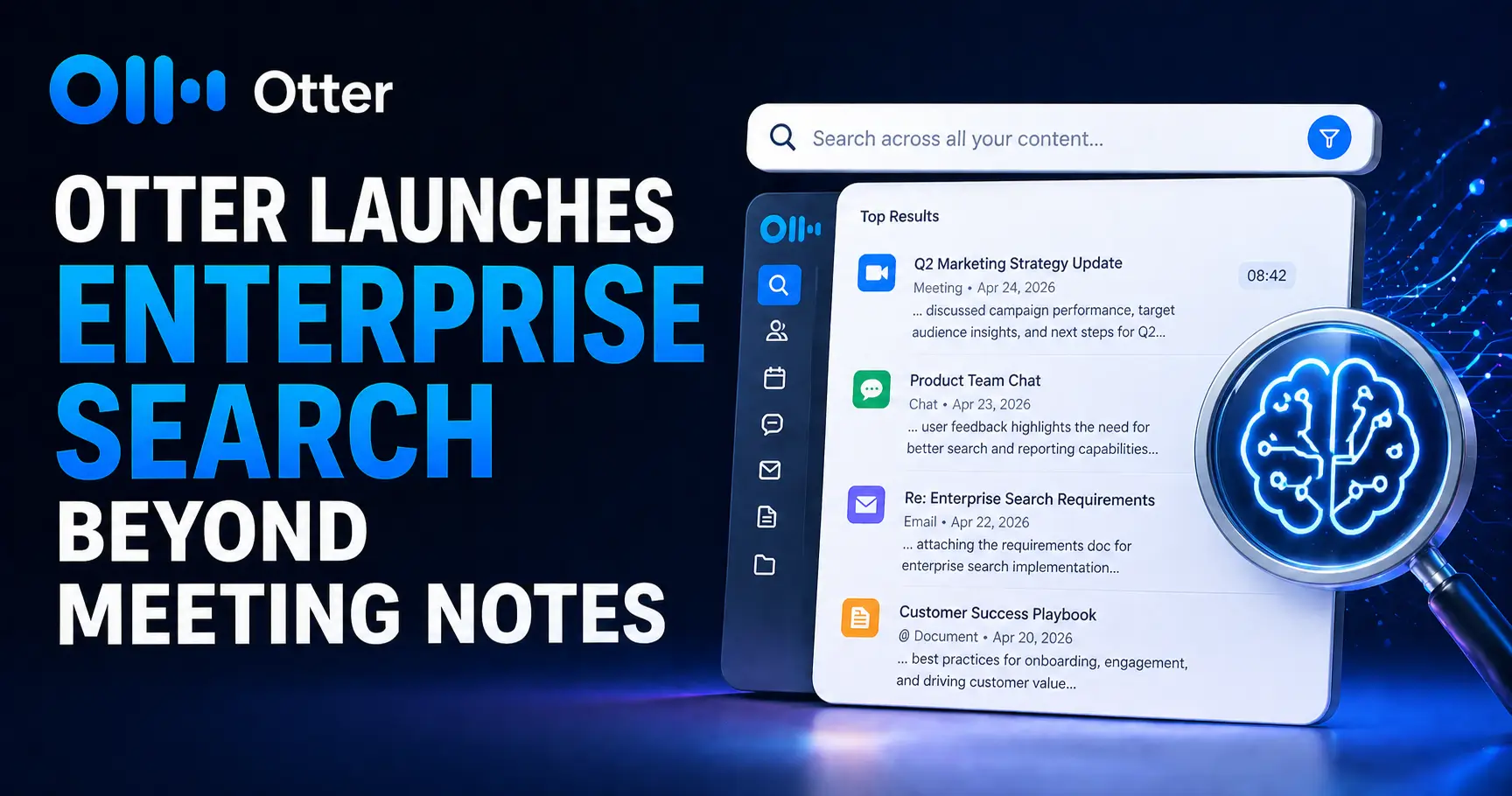
AI meeting notetaker Otter is making its biggest pivot yet. The company launched an enterprise search feature that connects to Gmail, Google Drive, Notion, Jira, and Salesforce — letting users query all their work data from a single interface. The move transforms Otter from a meeting transcription tool into an AI-powered workspace that pulls data from across an organization's entire tool stack.
What Changed
Otter now acts as a Model Context Protocol client. MCP is a common standard that AI tools are rapidly adopting for connecting to external apps and services. By integrating MCP, Otter can pull data from outside platforms and combine it with its existing meeting transcription database.
Users can search across all connected tools simultaneously. They can also push meeting summaries to Notion or draft Gmail messages directly from the Otter interface. Microsoft Outlook, Teams, SharePoint, and Slack integrations are coming soon.
The company also redesigned its AI assistant. It is now visible across the entire interface. The assistant understands the context of what the user is looking at — whether a specific meeting, a channel, or a search result — and answers questions accordingly.
The Notetaker Wars
Otter is not the only meeting AI trying to expand beyond transcription. The entire category is racing to justify its valuations by becoming broader enterprise productivity tools. Granola raised $125 million at a $1.5 billion valuation and expanded from meeting notes to enterprise AI. Read AI, Fireflies.ai, and Fathom are all making similar moves.
The shift reflects a hard truth: meeting transcription alone is not a big enough business. Users want AI that does not just record what happened in a meeting but connects that information to the rest of their work. A sales call summary is more useful when it links to the relevant Salesforce deal. A product discussion is more actionable when it connects to Jira tickets.
Bot or No Bot
A parallel battle is playing out over how meetings get recorded. Most notetakers are following Granola's lead and offering botless capture. This records meetings through a device's system audio instead of sending a visible bot into the call. The approach is less intrusive and avoids the awkward moment when a bot joins and participants feel surveilled.
Otter CEO Sam Liang says enterprise customers actually prefer bots. The bot provides transparency. It signals to all participants that the meeting is being recorded. And the resulting notes are shared with everyone, not just the person who initiated the recording. Otter brought botless capture to Mac late last year and is now launching a Windows app with the same feature — giving customers the choice.
The company also built a deduplication feature. It prevents multiple bots from joining the same call simultaneously. Without it, some meetings had more bots than humans — an absurd situation that undermined trust in the technology.
The Numbers
Otter now has 35 million users, up from 25 million last year. The company previously reported $100 million in annual recurring revenue. It did not share updated financials, but the user growth suggests continued momentum.
At $100 million ARR, Otter is one of the larger AI startups in the productivity space. But the competition is fierce. Google is embedding Gemini across Workspace. Microsoft has Copilot in every Office app. And a growing number of startups are building AI-native alternatives from the ground up.
Why It Matters
Otter's enterprise search launch represents a broader pattern in AI. The first generation of AI tools did one thing well — transcription, image generation, code completion. The second generation is about integration. The winners will be the tools that connect to everything, understand context across platforms, and help users make decisions rather than just capture information.
For Otter, the bet is that meetings are the richest source of unstructured business data. If the company can combine that data with information from every other tool a company uses, it becomes indispensable. If it cannot, it risks becoming just another AI feature embedded in someone else's platform.