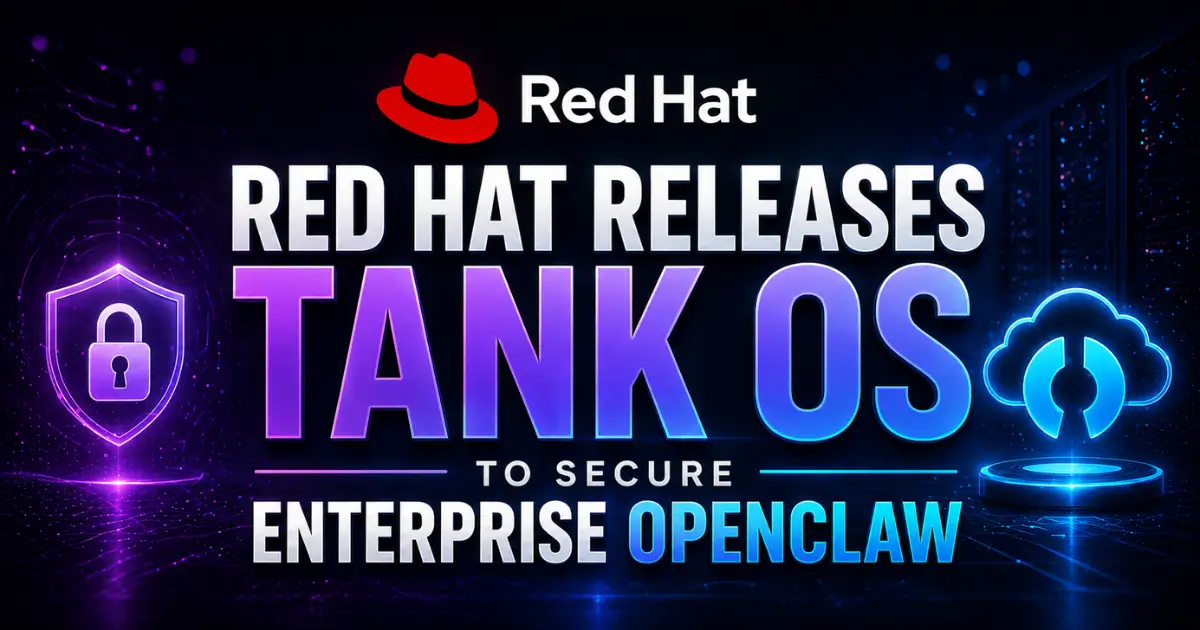
Red Hat principal engineer Sally O'Malley has released Tank OS, an open-source tool that makes deploying and managing OpenClaw AI agents dramatically safer for enterprise use. The tool packages OpenClaw inside secure, rootless containers on Red Hat's Fedora Linux — solving one of the biggest headaches facing IT teams as autonomous AI agents spread across corporate networks.
What Tank OS Does
Tank OS loads OpenClaw onto Fedora Linux inside a Podman container. Podman is a container platform built by Red Hat that runs without root privileges. That means the AI agent inside the container cannot access anything on the underlying computer it is not explicitly given permission to touch.
The container is made bootable. When the computer starts, OpenClaw launches automatically. Tank OS includes everything needed for unsupervised operation: state management so the agent can remember tasks, secure API key storage for accessing subscriptions and services, and isolation between instances.
Users can run multiple Tank OS instances on a single machine. Each handles different tasks. None share passwords or credentials. And no instance can access anything else running on the computer. For IT teams managing hundreds or thousands of AI agents across a corporate fleet, this level of isolation is essential.
Why Enterprise Safety Matters
OpenClaw is powerful. It is also dangerous when misconfigured. Horror stories have piled up. A Meta AI security researcher's Claw agent started deleting all her work emails. Another agent downloaded a user's entire WhatsApp message history in plain text. A growing crop of malware now specifically targets OpenClaw users.
O'Malley built Tank OS because she saw these problems coming at enterprise scale. One rogue agent on a single laptop is a headache. Thousands of rogue agents across a corporate network is a cybersecurity catastrophe.
Her position gives the project credibility. As an OpenClaw maintainer, O'Malley is among the select engineers who work with creator Peter Steinberger to decide which features and bugs get prioritized. She focuses specifically on making OpenClaw work better for enterprise deployments and Red Hat's Linux ecosystem.
The OpenClaw Ecosystem Is Growing Fast
Tank OS enters a rapidly expanding ecosystem of tools built around OpenClaw. The open-source project installs an AI agent on a local computer. It has spawned countless modifications, integrations, and competing alternatives.
NanoClaw, for instance, is doing similar containerized deployments through Docker. Startups like Gitar are tackling the code quality problems that arise when AI agents write software autonomously. And the broader AI agent market is attracting billions in investment, from NeoCognition's $40M for self-learning agents to OpenAI's revamped Codex with its own sandbox safety tools.
Steinberger, who created OpenClaw, was hired by OpenAI in February but still leads the independent open-source project. Anthropic temporarily banned him from accessing Claude earlier this month. The incident highlighted the complex dynamics between AI companies and the open-source tools that run on their models.
Not for Beginners
O'Malley is clear that Tank OS is not for casual users. It requires comfort with installing and maintaining software. The target audience is IT professionals — Red Hat's core customer base — who will eventually need to manage fleets of autonomous agents the same way they already manage other containerized applications.
The update model is familiar. IT teams can push updates to Tank OS instances using the same tools and workflows they use for other containers. As OpenClaw evolves, enterprise deployments can be updated centrally rather than requiring manual intervention on every machine.
The Bigger Picture
O'Malley's vision extends beyond individual deployments. She is thinking about what happens when millions of autonomous agents communicate with each other across enterprise networks. The security implications of that scenario are enormous. Without proper isolation and management, a single compromised agent could cascade across an entire organization.
Tank OS is a weekend project that addresses a multi-billion dollar problem. As AI agents move from developer toys to enterprise tools, the infrastructure for deploying them safely is becoming as important as the agents themselves. Red Hat's engineer just made that infrastructure a little more real.