
 Compiled by Amit Kumar
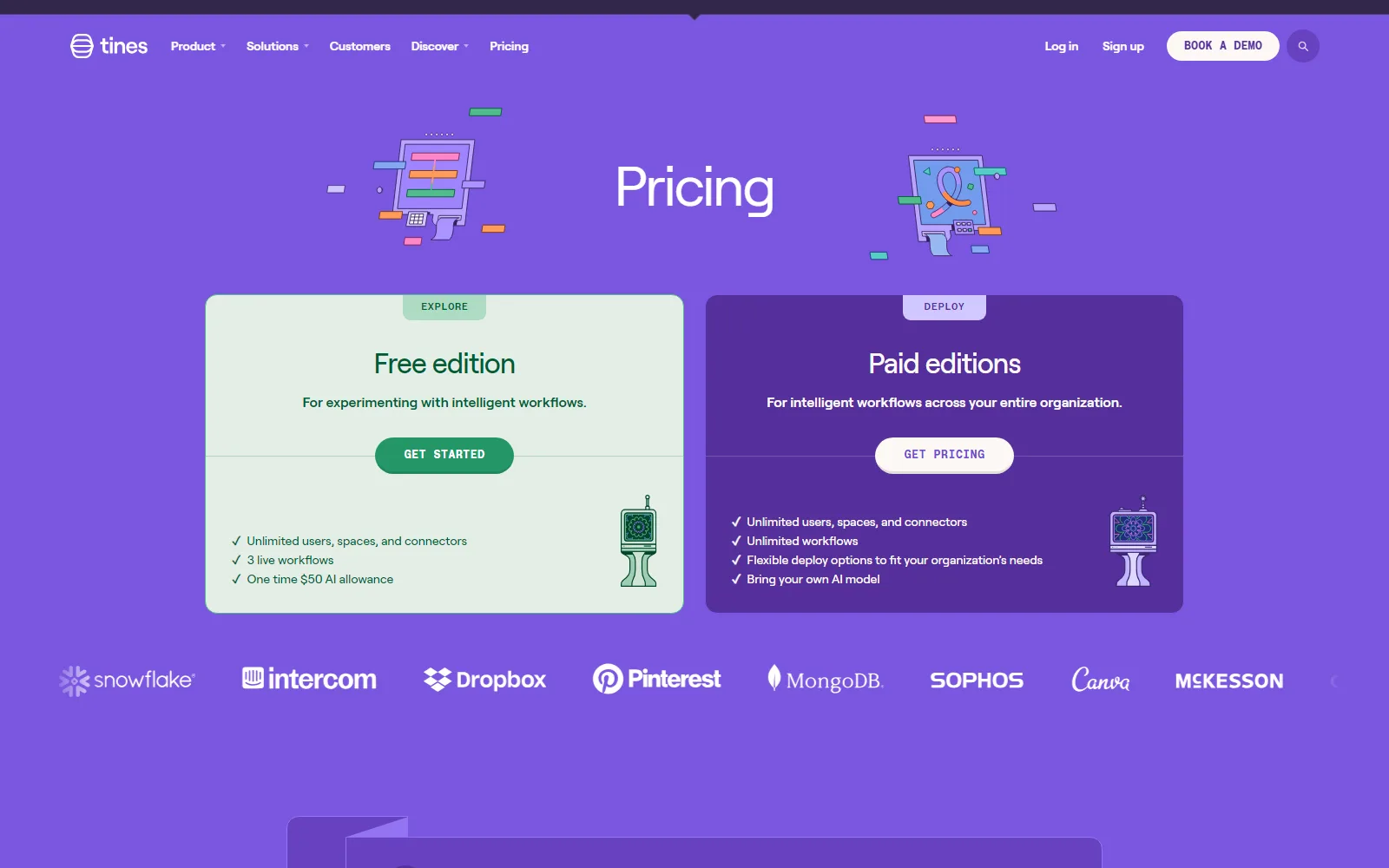
Tines is a workflow and AI-agent platform sold on one idea: any team can build automations, while IT and security keep visibility and control. It began in security operations and now covers IT, finance, people and operations teams. There are two editions: a free one with 3 live workflows and a one-time $50 AI allowance, and paid editions with no listed price.
We read Tines's pricing page, homepage, Terms, Privacy notice and About page on 13 October 2026. Our read: the free edition is generous on people and connectors (both unlimited) and tight on the one thing that matters, live workflows, where the cap is 3. The paid side is a sales conversation, and the Terms add that fees are non-refundable and non-cancelable. The Terms and the Privacy notice also leave one question open: neither page says whether customer content can be used to train AI models.
Tines at a glance
| Question | Short answer |
|---|---|
| Editions | Free; paid editions (price on request) |
| Free limits | 3 live workflows, one-time $50 AI allowance |
| Paid | Unlimited workflows, flexible deployment, bring your own AI model |
| Refunds | Fees non-refundable and non-cancelable, except where law requires |
| Read | tines.com, 13 October 2026 |
What is Tines used for?
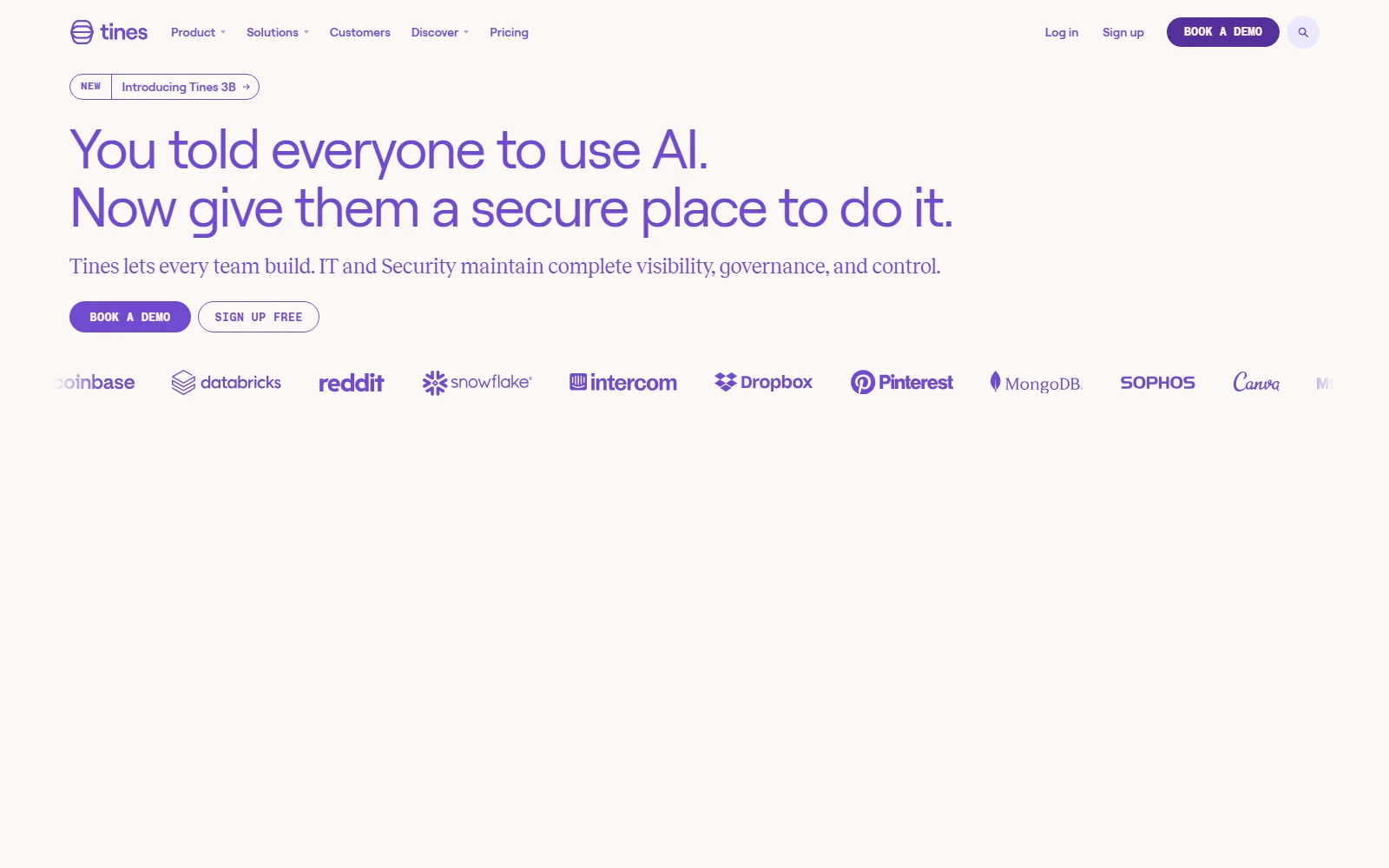
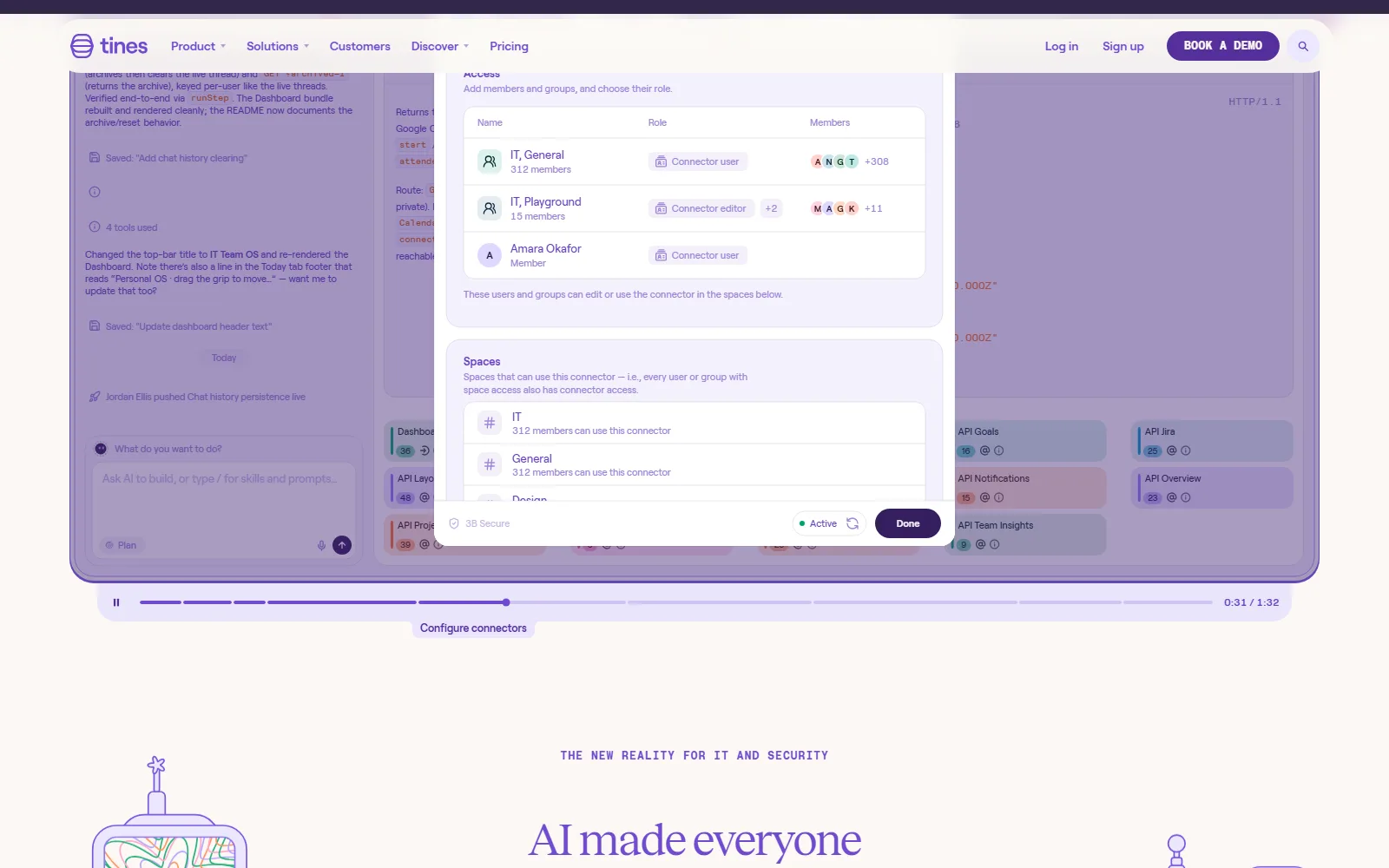
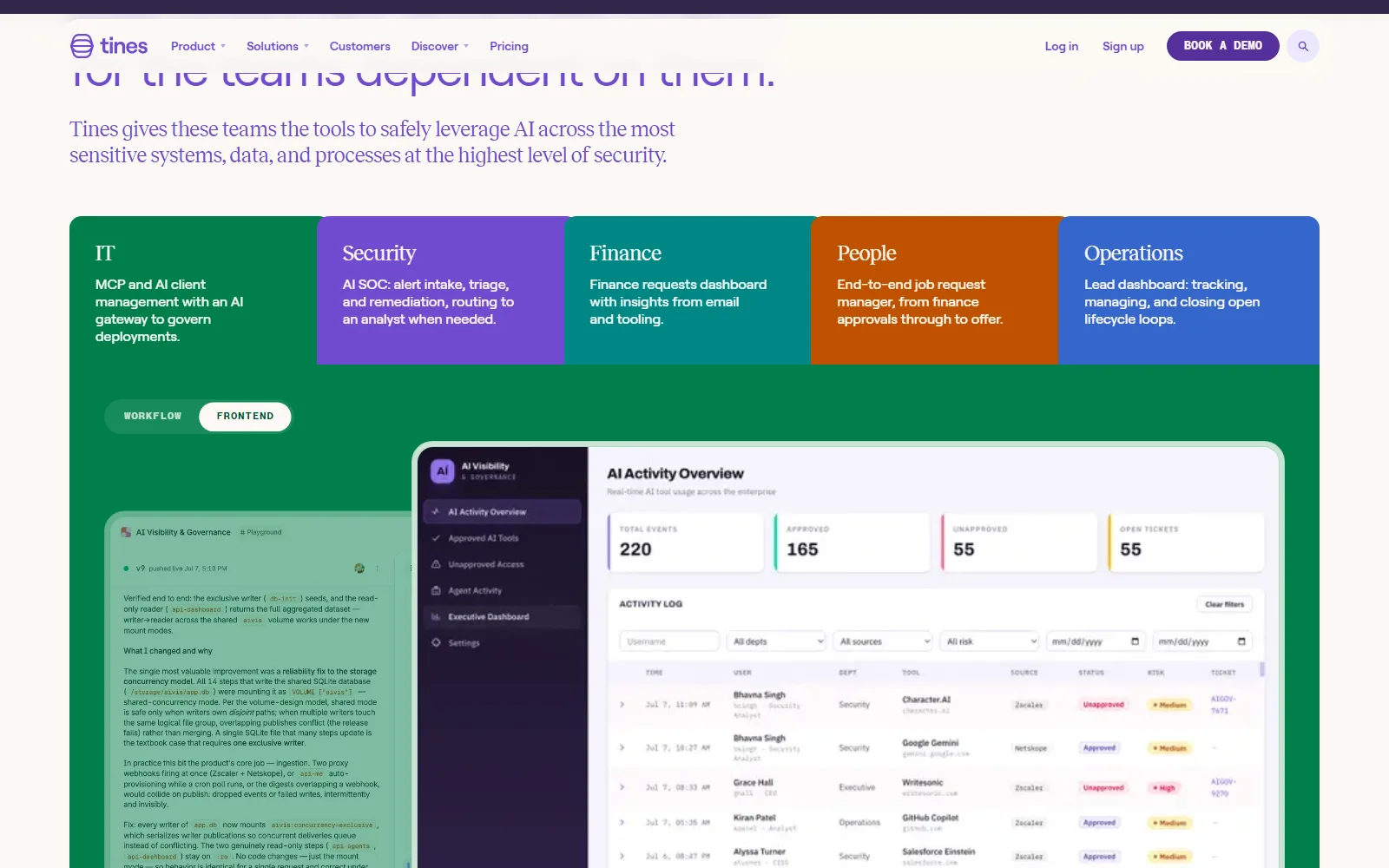
For automating multi-step work across the tools a company already runs, with a governance layer on top. The homepage headline calls it "the secure environment for AI agents, apps and automation" and names workflows, agents, cases, MCP and AI client management, an AI gateway and frontends (dashboards and request forms) as its building blocks.
Security operations
The homepage lists an AI SOC use: alert intake, triage and remediation, with routing to an analyst when a person is needed. The company describes itself as "born in security, built for the enterprise", and the About page says its founders, Eoin Hinchy and Thomas Kinsella, were senior security operators for over a decade before starting it in 2018.
IT governance of AI
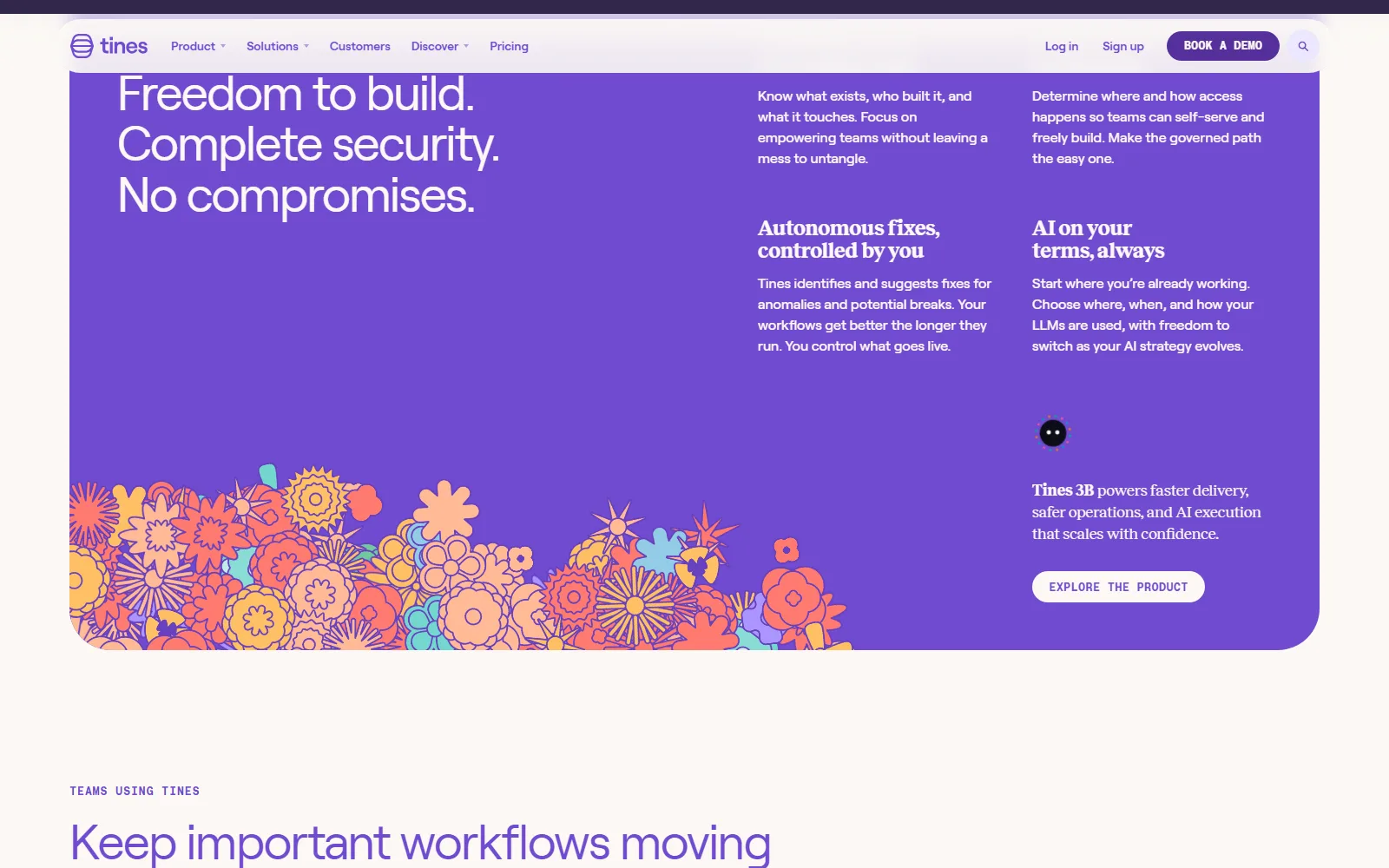
Tines lists MCP and AI client management with an AI gateway to govern deployments. It also promises visibility across AI-created work: what exists, who built it and what it touches. The control pitch is that the governed path is the easy one, and that it flags anomalies and suggests fixes while "you control what goes live".
Business teams
Finance gets a requests dashboard fed from email and tooling, people teams get an end-to-end job request manager from approval to offer, and operations gets a lead dashboard for closing open loops. None of this is described in detail on the homepage, so ask for a demo of the one you care about.
What the homepage claims, and what it leaves out
The homepage leans on adjectives more than numbers. Its one figure is the line that AI made security and IT "100× harder", which it answers with "our 100× solution" and no measured result behind it. It also says Tines lets you choose where, when and how language models are used and switch providers as strategy changes, which matches the bring-your-own-model line on the paid edition. The homepage names no integrations and gives no certification list, and sends you to its Trust Center, docs and pricing page for those. That is normal for an enterprise vendor, but it means a buyer has to do the checking through the docs or a sales call, since this review can only report what the pages state.
Who Tines is for, and who should skip it
It suits security, IT and operations teams in larger organisations that want many people building automations without losing an audit trail. Customer logos on the homepage include Coinbase, Databricks, Reddit, Snowflake and Dropbox.
- Skip it if you want a self-serve paid plan. The pricing page has no paid price, only a link to book a demo.
- Skip it if you need more than 3 live workflows to try it properly. The free edition stops there.
- Skip it if you need refunds. The Terms call fees non-refundable and non-cancelable.
- Skip it if you need to see integrations before a call. The homepage names none, and points to its docs.
How much does Tines cost?
Tines publishes two editions on its pricing page, read 13 October 2026.
USD, read 13 October 2026, from Tines pricing (tines.com/pricing)
| Edition | Price | What is listed |
|---|---|---|
| Free | $0, self-serve sign-up | Unlimited users, spaces and connectors; 3 live workflows; one-time $50 AI allowance |
| Paid | Not published; "Get pricing" opens a demo booking page | Unlimited users, spaces and connectors; unlimited workflows; flexible deploy options; bring your own AI model |
A Startup Program is mentioned: a "heavily-discounted, fully-featured Tines Stories tenant" for small, growing teams, excluding services companies such as managed service providers and consultancies. The discount amount is not stated and the page links to a blog post for it.
The Terms add the billing rules. Paid plans are billed in advance, monthly or annually. Features such as AI Credits may bring usage-based charges, including charges above plan limits after notice. Pricing changes apply to later subscription periods or upgrades. Fees are non-refundable and non-cancelable, including for partially used periods, unused capacity and unused credits.
Is Tines free?
Yes, with limits. The free edition is described as "for experimenting with intelligent workflows". Users, spaces and connectors are unlimited, but only 3 workflows can be live at once and the AI allowance is $50 one time, not monthly. Once that is used, the pricing page gives no free AI usage, so expect the next step to be a sales call or bringing your own model on a paid edition.
How Tines handles your data
- Ownership. The Terms say you retain all rights in customer data, processed under a Data Processing Addendum and the Privacy notice.
- AI training. The Privacy notice (published 14 July 2026) says Tines does not use your personal data to train, fine-tune or improve public or third-party foundational AI models. It does not address customer content or AI inputs beyond that. The Terms incorporate AI Terms and an AI Acceptable Use Policy by reference, which we did not read.
- Usage data. Tines may use operational, configuration and diagnostic data to run and improve the product.
- Subprocessors. The privacy page names none; it says third-party providers are contractually bound.
- Deletion. You can ask for deletion unless Tines must keep data for legal reasons, by writing to legal@tines.io. After access ends you may export customer data for a limited period described in the docs.
Where Tines's own pages disagree
- The Terms say the contracting entity is Tines Technology, Inc. for North America or Tines Limited elsewhere, yet the governing-law section names Tines Automation, Inc. (Delaware law) and Tines Security Services Limited (Irish law). Ask which entity you would sign with.
- The Privacy notice promises not to train foundation models on personal data, while the Terms say nothing about customer content. Treat the question as open until you read the AI Terms.
- The homepage describes deployment only as running "within your infrastructure", while the pricing page lists "flexible deploy options" for paid editions only.
How Tines compares with other tools reviewed here
n8n is the closest neighbour: workflow automation for technical people. Our n8n review lists a free self-hosted Community Edition and a Cloud free trial of 14 days at $0, capped at 1,000 executions. The choice is about control: n8n offers a free version you run yourself, while Tines gives you a free hosted edition but caps it at 3 live workflows and puts its paid price behind a demo. Tines pitches governance and audit for security teams; n8n pitches visual building.
For voice, see Vapi, which is a different job (phone agents) but also publishes enterprise controls such as SSO and role-based access.
Sources
- Tines pricing, tines.com/pricing, read 13 October 2026
- Tines homepage, tines.com, read 13 October 2026
- Tines Terms, tines.com/terms, read 13 October 2026
- Tines Privacy notice, tines.com/privacy, read 13 October 2026
- Tines About page, tines.com/about, read 13 October 2026