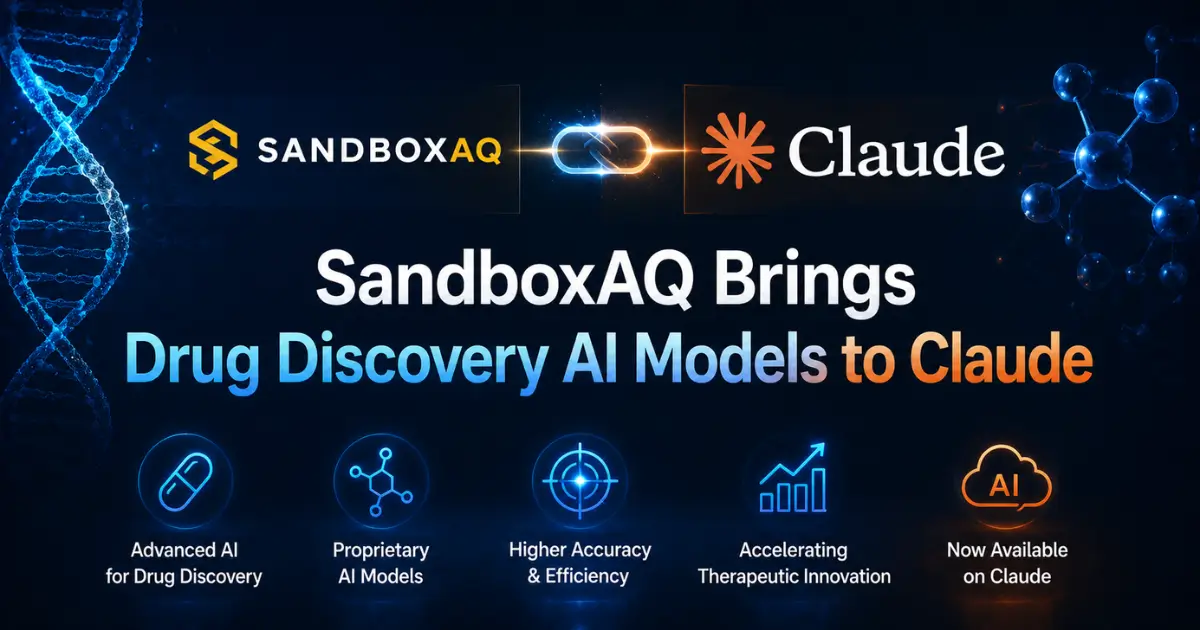
Eric Schmidt-backed SandboxAQ has integrated its drug discovery and materials science AI models directly into Anthropic's Claude. The partnership puts powerful quantum chemistry simulations behind a conversational interface. Researchers can now run molecular dynamics calculations, simulate chemical reactions, and evaluate drug candidates by typing natural language prompts — no specialized computing infrastructure or PhD in computational science required.
What SandboxAQ Built
SandboxAQ produces large quantitative models — AI systems trained on real-world lab data and scientific equations rather than internet text. These models can run quantum chemistry calculations, simulate molecular dynamics, and study how chemical reactions unfold at the molecular level. That capability tells researchers how candidate drug molecules are likely to behave before anyone steps into a laboratory.
Previously, using these models required researchers to set up their own digital infrastructure — servers, specialized software, and the computational expertise to operate them. The Claude integration eliminates that barrier. Scientists can describe what they want to analyze in plain language. Claude processes the request through SandboxAQ's models and returns results.
Nadia Harhen, SandboxAQ's general manager of AI simulation, described it as a first. A frontier quantitative model on a frontier language model that someone can access in natural language. The combination makes tools that were previously available only to computational specialists accessible to experimental scientists and research teams without coding expertise.
Why Access Matters More Than Models
The drug discovery AI market is crowded with companies building better models. Chai Discovery signed a deal with Eli Lilly. Isomorphic Labs — Alphabet's AI drug discovery platform — raised $600 million. Both are focused on improving the science of molecular prediction.
SandboxAQ is making a different bet. The company believes access is the bigger obstacle. The models are already capable. The problem is that most scientists cannot use them without specialized infrastructure and computing expertise. By putting those models inside Claude, SandboxAQ makes them available to anyone who can type a sentence.
The bet connects to what 10x Science is pursuing from a different angle. That Stanford-born startup raised $4.8 million to automate molecular analysis using AI agents trained on spectrometry data. Both companies have identified the same bottleneck: the gap between what AI models can do and what scientists can actually access.
The $50 Trillion Opportunity
SandboxAQ frames the opportunity in enormous terms. Its models target what it calls the quantitative economy — a $50 trillion sector spanning biopharma, financial services, energy, and advanced materials. These industries depend on physics, chemistry, and mathematics rather than text and language. The tools they need are fundamentally different from chatbots and coding assistants.
The company has raised over $950 million from investors. Eric Schmidt, Google's former CEO, serves as chairman. The Claude integration is part of a broader strategy to bring quantitative AI to industries that language models alone cannot serve.
For Anthropic, the partnership extends Claude's reach into scientific research — a vertical where the company has been less active than in legal, small business, and enterprise coding. If SandboxAQ's models prove valuable through Claude, it creates a template for integrating other specialized scientific tools into the platform.
The Bigger Picture
The SandboxAQ-Claude integration represents a broader pattern in the AI industry. The most impactful AI applications may not be chatbots or image generators. They may be interfaces that connect non-technical users to powerful specialized tools they could never access before.
A chemist who can run quantum simulations by asking Claude a question. A materials scientist who can evaluate new compounds in natural language. A pharmaceutical researcher who can test drug candidates without building computing infrastructure. These are the use cases where AI moves from convenience to transformation.
Drug discovery remains one of the most expensive and failure-prone processes in modern industry. Finding a single viable molecule can take a decade and cost billions. If AI can compress that timeline — by making powerful simulation tools accessible to every scientist, not just computational specialists — the downstream impact on healthcare and human wellbeing could be enormous.
SandboxAQ is betting that the bottleneck was never the models. It was always the interface. Claude just became the interface.